Search
Explore digital transformation resources.
Uncover insights, best practises and case studies.

Search
Explore digital transformation resources.
Uncover insights, best practises and case studies.

For faster, safer policy delivery
Digital public infrastructure (DPI) is the backbone of modern society, enabling interoperability, secure data exchange and digital identity at scale. But technology alone does not build trust. Success depends on governance, regulation and design choices that respect sovereignty and strengthen resilience. In the age of AI, transparency and accountability must be embedded into DPI to ensure that intelligent digital systems operate in ways society can understand and verify.
Nortal brings decades of experience designing and implementing DPI for digital nations across Europe, the Gulf and North America. Our solutions power some of the world's most advanced digital economies, from policy and regulation to full-scale implementation.






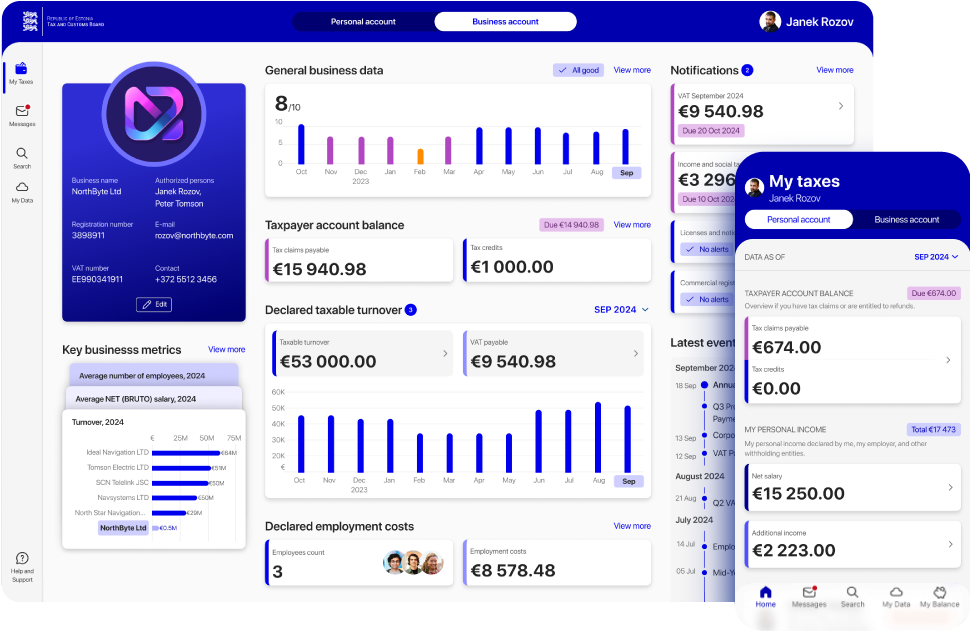
For over 15 years, Nortal has supported the Estonian Tax and Customs Board in its transition from legacy-heavy systems to a continuously modernized, digital-first tax administration. The Board has improved operational efficiency, strengthened digital sovereignty and developed one of the most effective tax administration systems globally. The IT landscape remains in continuous evolution, with individual components modernized incrementally while maintaining uninterrupted service for taxpayers and government.

ISBJ is Berlin’s central digital platform for determining eligibility, calculating parental contributions and financing childcare and after-school services. We designed and implemented the platform and continue to evolve its architecture into a secure, service-oriented ecosystem integrated with core state systems and operated within the ITDZ Berlin environment. Supporting the administration and billing of more than 220,000 childcare placements annually, the system enables automated calculations, transparent decision-making and cross-agency data exchange. Continuous modernization and structured governance ensure the platform remains resilient, compliant and scalable as policy requirements evolve.
Nortal is partnering with Accela in modernizing its core platform by transitioning from VM-based hosting to a cloud-native architecture on Azure Kubernetes Service. The program includes containerization of mission-critical workloads, implementation of automated DevSecOps practices aligned with GovRAMP standards, and modular refactoring supported by CI/CD and GitOps. This reduces technical debt, improves system resilience and enables more efficient delivery across citizen- and agency-facing services.
The Nordic and Baltic regions set the global standard for secure digital identity and electronic signatures. In Estonia, a trusted ecosystem built on two-factor authentication and digital signing has become a model for governments worldwide. For more than two decades, we have helped design and expand this ecosystem, from chip-based ID cards and Mobile-ID to the Smart-ID application. Our experience covers the full lifecycle of digital identity, from infrastructure and trust services to authentication and policy development.
.png?width=108&height=80&name=eID%20Logo%20(1).png)

Nortal supported a Finnish healthcare organization in transitioning critical health information systems to a secure cloud-based architecture, ensuring compliance with national regulations and data protection requirements. Legacy infrastructure was modernized and integrations redesigned to support a scalable cloud environment, improving system resilience and enabling secure data exchange across care providers. The result is a stable digital foundation supporting continuous service development, analytics and uninterrupted patient care.