Search
Explore digital transformation resources.
Uncover insights, best practises and case studies.
Search
Explore digital transformation resources.
Uncover insights, best practises and case studies.

AI-driven legacy modernization
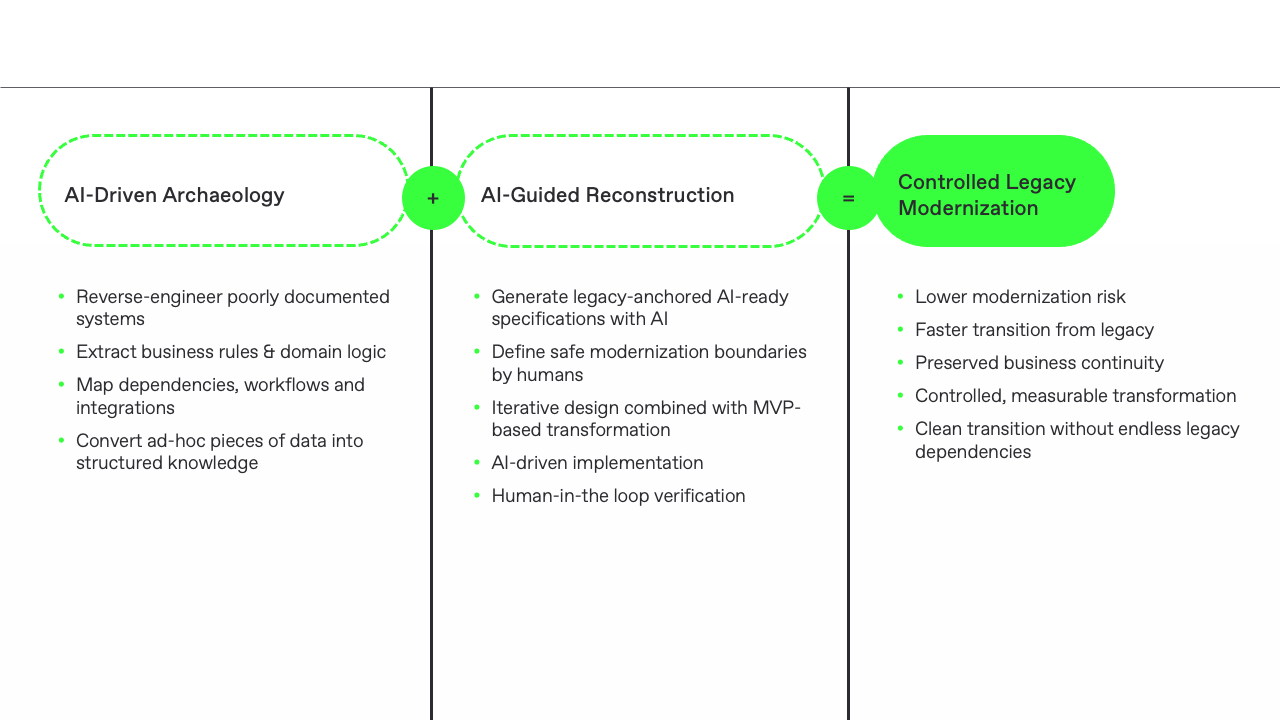
Gain a clear, system‑derived understanding of your legacy landscape and modernize with confidence. AI Legacy Archaeology reveals what is inside your systems, while AI‑driven implementation transforms those insights into a clear, accelerated path to delivery.
Legacy systems hold years of business rules, workflows, and decision logic. Manual analysis can take months and still miss important details.
AI Legacy Archaeology analyzes millions of lines of code, databases, and documents in a fraction of the time. It produces structured, factual documentation of what the system actually does and often uncovers end‑to‑end business flows that even longtime system owners no longer fully see.
This gives you a clear, reliable view of your system landscape and a confident starting point for modernization.
AI-First approaches don’t just accelerate development, they reshape it. By embedding coordinated AI agents throughout the lifecycle, organizations achieve:
Faster delivery cycles through automated analysis, coordination, and execution
Higher quality outcomes with AI-driven testing, consistency checks, and guardrails
Predictable delivery through deterministic workflows and continuous optimization
Lower total cost of delivery with automation removing friction, waste, and rework
AI‑assisted development has evolved from individual assistants to coordinated multi‑agent workflows operating across large, complex codebases. This shift makes large‑scale legacy modernization practical – not just a single developer prompting an AI, but an orchestrated delivery pipeline where agents analyze, specify, implement, and test under human oversight.

10
days from legacy codebase to a running proof‑of‑concept that supports real decision‑making.
4,8B
data points processed in a fully working analytics application delivered in weeks on the customer’s environment.
50%+
estimated reduction in delivery effort using AI‑first methods - less manual work, more verifiable progress.
AI supports analysis, testing, and implementation, while humans define boundaries, validate outputs, and maintain accountability. This collaboration enables modernization to advance more quickly without compromising quality.
Humans establish architectural, security, and compliance boundaries to ensure modernization aligns with enterprise needs.
AI agents perform large‑scale analysis and generate implementation‑ready outputs, which specialists review before moving forward.
Human validation remains central, ensuring responsibility stays where it belongs and enabling faster cycles.
Coordinated team workflows replace isolated experiments, making modernization more scalable.
A six‑week AI‑first project turned modernization uncertainty into concrete proof by delivering a fully functional time‑series analytics application on the customer’s own big‑data stack. It removed key risks, validated performance and integration, and demonstrated over 50% delivery efficiency gains.
A focused AI‑first project turned a decade‑old, hard‑to‑understand WebForms application into a clear modernization blueprint in just weeks. It delivered a runnable .NET and Angular prototype, clarified hidden functional complexity, and gave the customer a reliable view of the actual modernization effort.
Complex does not have to mean complicated. For decades, we have supported public institutions and global enterprises, helping them understand and evolve the large, business‑critical systems their operations rely on.
Every modernization initiative is grounded in clarity and designed for long‑term durability. That is why clients trust us with the systems that matter today – and those they need to evolve for the future.
Meet with our experts to discover how AI Legacy Archaeology and modern delivery practices can provide a clearer system landscape and a well‑managed path to modernization.