Search
Explore digital transformation resources.
Uncover insights, best practises and case studies.

Search
Explore digital transformation resources.
Uncover insights, best practises and case studies.
A practical guide for employees looking to hire developers in Poland, from IT salaries and hiring costs to regulatory considerations and market trends.
Service
Poland boasts one of the strongest internal IT markets in the region, several academic hubs, and a large pool of tech talent available for IT nearshoring.
Poland has the largest IT market in Central and Eastern Europe and continues to grow despite slower global hiring conditions. The country combines a large engineering talent pool with strong technical education, good English proficiency, and a business environment aligned with EU regulations.
The ICT sector contributes significantly to the economy. Sales of ICT services reached approximately €60 billion in 2023, highlighting its role as one of the fastest-growing high-value sectors in the country. Employment in the sector increases, with the percentage of the population employed in ICT growing year by year.
International companies, including Google, Dell, and many global enterprise brands, have established engineering hubs and delivery centers across Poland. For many businesses, the appeal is no longer just cost savings, but the access to experienced engineers who can build and scale complex products inside the EU.
• Over 50,000 IT companies and about 850,000 IT professionals
• Poland’s ICT market is projected to grow steadily at a 10.2% CAGR
• Polish ICT sector generates €10+ billion annually, making it one of the largest tech ecosystems in CEE.
• Poland operates under harmonized EU regulations, including GDPR and unified corporate and labour law frameworks, creating a predictable environment for international companies.
• Companies can benefit from strong R&D tax relief and the 5% IP Box tax rate for qualified intellectual property income.
• Strong international integration – ICT services are a major export sector, accounting for roughly 14% of Poland’s total service exports.
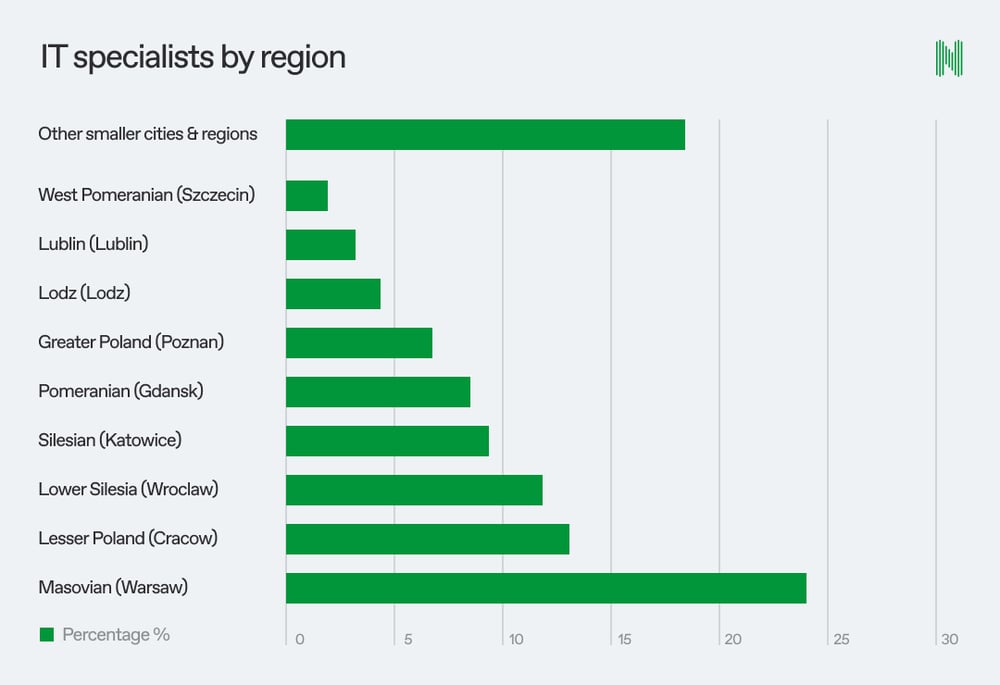
Around 85% of Poland’s IT workforce is concentrated in a handful of major tech and academic hubs, giving companies access to deep and diverse talent pools. The key hiring centers are:
• Warsaw
• Kraków
• Wrocław
• Katowice
• Tricity (Gdańsk–Gdynia–Sopot)
• Over 400 universities across the country
• More than 15,000 IT graduates per year
• 15th globally on the English Proficiency Index
• Polish programmers are recognized internationally, ranking 2nd in total medals in the International Olympiad in Informatics and 3rd globally by Hacker Rank
• Strong presence in AI, cloud, and cybersecurity
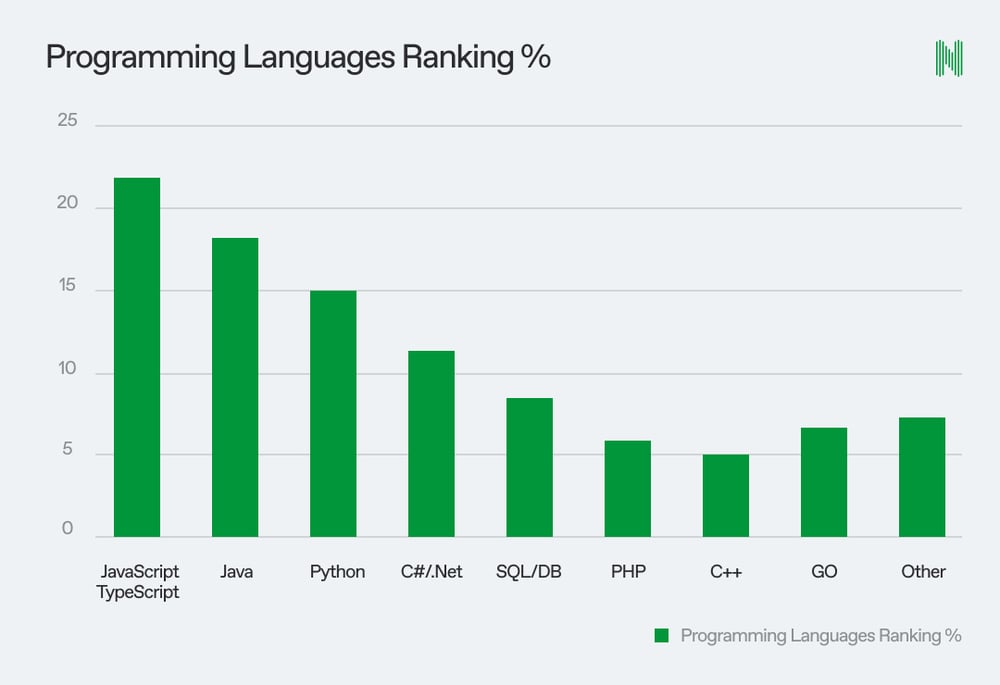
Polish developers are especially active in Java, .NET, Python, and modern cloud/backend ecosystems used by global product and enterprise companies.
• Warsaw – The country's dominant tech hub and main corporate center, home to major banks, global HQ offices, and enterprise engineering teams focused on fintech, cloud, and platform development.
• Krakow – The biggest delivery hub for global IT services and product engineering, especially strong in Java, .NET, DevOps, and shared service center (SSC/GBS) operations.
• Wrocław – A fast-growing engineering hub with a strong presence in R&D, embedded systems, and product development teams, especially for automotive, cloud, and software platforms.
• Tricity (Gdańsk–Gdynia–Sopot) – a Coastal tech cluster focused on software development, cybersecurity, and international product teams, with a strong presence of global IT and telecom companies.
• Poznań – Known for enterprise IT, SAP ecosystems, and automotive/software engineering, with a strong mix of shared services and product-focused tech teams.
Probably the single biggest employer of tech talent in Poland. International companies use cities like Kraków, Warsaw, and Wrocław as global capability centers and delivery hubs for engineering, cloud, cybersecurity, support, and enterprise systems.
Typical roles: Java/.NET developers, DevOps engineers, cloud engineers, cybersecurity analysts, SAP consultants, IT support, data engineers.
Major employers: IBM, Accenture, Capgemini, Infosys, EPAM Systems, Cisco
Poland’s financial sector hires massive numbers of engineers to supply large in-house tech teams. Warsaw, especially, is a fintech and enterprise software hub.
Typical roles: backend developers, data scientists, ML engineers, fraud analysts, cloud architects, mobile developers.
Major employers: ING Bank Śląski, mBank, PKO Bank Polski, UBS, JPMorganChase, PayU, BLIK
Poland has long been a strong location for IT outsourcing, but more recently, the country has become a serious pick for on-site product and engineering operations. Teams here often own full products, infrastructure, or AI/platform services.
Typical roles: software engineers, SREs, platform engineers, AI/ML specialists, frontend engineers, product managers.
Major employers: Google, Microsoft, Amazon Web Services, Intel, Samsung Electronics, Nokia
Poland’s e-commerce sector exploded over the last decade, and companies now employ huge in-house tech organizations. A lot of hiring here focuses on scalable backend systems, mobile apps, payments, logistics, and recommendation engines.
Typical roles: full-stack developers, mobile engineers, data analysts, recommendation/AI engineers, platform reliability engineers.
Major employers: Allegro, InPost, Booksy, Docplanner, OLX Group
Poland has one of Europe’s strongest gaming industries, and it attracts a mix of hardcore engine programmers and creative tech talent. The sector is smaller than banking or outsourcing, but very visible internationally.
Typical roles: gameplay programmers, graphics engineers, Unreal/Unity developers, QA automation experts.
Major employers: CD PROJEKT RED, Techland, 11 bit studios, People Can Fly, Bloober Team
This sector is especially strong around Poznań, Wrocław, and Katowice. Tech jobs in this sector involve building software for vehicles, factory automation, IoT devices, and autonomous systems.
Typical roles: embedded C/C++ engineers, automotive software developers, FPGA engineers, robotics engineers, test automation specialists.
Major employers: Aptiv, Continental, Volvo Group, Stellantis, Volkswagen Poznań
Telecom companies remain major tech employers due to ongoing investment in large-scale infrastructure, cloud transformation, 5G networks, and enterprise digital platforms.
Typical roles: network engineers, cloud/network automation engineers, cybersecurity specialists, backend developers.
Major employers: Orange Poland, T-Mobile Poland, Play, Plus
There are two costs to consider when hiring developers in Poland: the developer’s salary expectations and the company’s total hiring cost.
Beyond salary, employers also need to account for social contributions, benefits, recruitment, onboarding, and retention costs.
When working with Nortal, these operational costs are already included in the partnership model. The employer costs listed below reflect the total delivery cost, not just base salary and statutory contributions.
|
Role |
Net salary |
Total employer’s cost (based on our 2025 market analysis)* |
| Junior Software Engineer | € 1,400 – € 2,800 | € 2,500 – € 3,700 |
| Middle Software Engineer | € 2,800 – € 4,200 | € 3,700 – € 5,800 |
| Senior Software Engineer | € 4,200 – € 5,300 | € 5,800 – € 7,500 |
| Expert Software Engineer | – | € 7,500 – € 8,600 |
*Inclusive of social contributions, benefits, recruitment, onboarding, training, and retention costs.
DevOps and Cloud Engineers – typical total employer cost ranges:
• Junior DevOps/Cloud Engineer: € 3,700 – € 4,600
• Medium DevOps/Cloud Engineer: € 4,600 – € 6,300
• Senior DevOps/Cloud Engineer: € 6,300 – € 8,000
• Expert DevOps/Cloud Engineer: € 8,000 – € 8,900
ML/AI Engineers – typical total employer cost ranges:
• Junior ML/AI Engineer: € 2,500 – € 4,000
• Medium ML/AI Engineer: € 4,000 – € 6,300
• Senior ML/AI Engineer: € 6,600 – € 8,000
• Expert ML/AI Engineer: € 8,000 – € 9,500
|
CEE IT Salaries Guide 2026 For a full salary breakdown of the most common tech roles and a comparison with other key CEE markets, see our detailed market guide. |
Hiring software engineers in Poland follows a structured cost model. On employment contracts (UoP), employers should expect total employer-side contributions of around 20% on top of gross salary, covering pension, disability, accident insurance, and labour fund payments.
On the employee side, deductions include about 13% social security (ZUS), 9% health insurance, and income tax of 12% up to PLN 120,000 annually (rising to 32% above that threshold). In practice, this means employees typically take home around 65–70% of gross salary, depending on income level and tax reliefs.
Many tech companies also use B2B contracts, where engineers invoice directly and handle their own taxes. In this setup, taxation models include: 12/32% progressive, 19% linear, or 12% lump-sum (IT ryczałt), plus ZUS contributions. B2B often results in higher net earnings compared to UoP, but shifts taxation responsibility to the contractor while reducing employer-side overhead.
In Poland, IT specialists can be employed through various forms. Each model has a different range of mandatory benefits and taxation.
• The most common employment form is the Employment Contract (UoP), preferred by around 40–50% of professionals, especially juniors and mid-level specialists. It’s the most stable model with full social benefits like ZUS, PPK pensions, and paid leave.
• The B2B contract (self-employment) is the preferred form for around 50–60% of senior specialists in Poland. It offers higher net pay and greater flexibility, but requires handling taxes independently and does not include paid leave, making it a popular choice in a competitive, talent-scarce market.
• The Civil Contract (Umowa Zlecenie, UZ) is used by 5–10% of juniors and freelancers. It’s flexible and includes basic ZUS contributions but limited benefits and stability, suitable for short-term projects.
• Contract for Specific Work (Umowa o Dzieło, UoD), accounts for ~2–5% of cases, mostly one-off projects like freelance web development, with minimal tax burdens but no social benefits.
At Nortal, we don’t hire on a civil contract or contract for specific work since they are limited in terms of employee stability and social benefits.
In the most popular employment form, UoP, employees are entitled to:
Benefits such as private healthcare, sports cards, home office allowances, and performance bonuses are now standard across most tech employers in Poland. Since the market is increasingly competitive, companies that fall below market expectations on benefits often struggle to attract and retain talent.
Other commonly offered perks include language classes, mental health support, shopping vouchers, office meals, wellness and relaxation spaces, team events, and professional growth opportunities like conferences.
Notice periods in Poland depend mainly on the length of employment with a given employer. In most tech roles on standard employment contracts (UoP), the notice period is 2 weeks, 1 month, or 3 months.
• 2 weeks – employment shorter than 6 months
• 1 month – employment between 6 months and 3 years
• 3 months – employment longer than 3 years
In practice, many software engineers at mid and senior level fall into the 1–3 month notice period range, which is standard for planning hiring timelines in the Polish IT market.
The probationary contract can be concluded for a maximum of 3 months. It may be terminated, and the period of notice is three working days if the probationary period does not exceed 2 weeks, one week if the probationary period is longer than 2 weeks, and two weeks if the probationary period is 3 months.
• LinkedIn sourcing is one of the most effective and popular channels.
• Local job boards like justjoin.it or nofluffjobs.com are also widely used and provide strong access to candidates across all seniority levels.
• Internal and external referrals are useful in a highly competitive environment, where they tip the scales when deciding between two similarly skilled candidates.
• Developer communities and events (e.g., Devoxx, DevConf, and ecosystem-specific events like App.js Conf or .NET Developer Days) help companies build long-term visibility and relationships that can lead to future hires.
• Recruitment agencies can speed up hiring for hard-to-fill, niche roles, but most of them specialize in one-off projects, not long-term collaboration.
First contact
The initial outreach should remain professional and is typically made via LinkedIn or email.
Phone calls are generally not preferred as the first point of contact. Reaching out through personal social media platforms like Facebook or Instagram is considered inappropriate.
Next steps
Once the initial interest is confirmed, the next step is usually a recruiter conversation to discuss the role and key details.
These conversations are most commonly held via phone or video platforms such as Microsoft Teams.
After the interview
Communication usually becomes more informal once both sides have spoken directly.
During the interview process, candidates and recruiters typically agree on preferred communication channels, such as email, phone, text, or LinkedIn.
Though the size and maturity of the IT talent pool in Poland are its advantages, they lead to several challenges in hiring:
• Strong competition for talent
• Longer recruitment processes
• Occasional fake profiles and inflated resumes (rare but noticeable due to talent pool size)
These factors can significantly impact time-to-hire, particularly for niche or business-critical positions, increasing the risk of delivery delays.
In a competitive talent market like Poland, traditional tech recruitment and simple outreach often are not enough.
Instead of focusing on single project delivery and role filling, Nortal operates as a long-term talent and delivery partner to cover everything from sourcing and hiring support to setting up embedded tech teams. Using our established talent networks and long-standing candidate relationships, we help you fill niche positions to support your execution and meet the roadmap.
Typical hiring process structure
Our hiring processes in Poland follow a 3–4 stage model:
1. Recruiter screen – 30-45 minutes
2. Technical interview – 1-1,5 hour, depending on the interviewer and requirements
3. Customer interview/pairing session – 0,5-1 hour; varies from client to client
4. Optional second client interview or test task if required
|
Worth knowing • Interview processes longer than 4 stages are considered overly complex and can discourage candidates from applying. • Take-home assignments are generally unpopular in the Polish IT market, with many candidates, particularly senior engineers, refusing to complete them. • Live technical interviews remain the most common and widely accepted method of evaluating technical skills. |
When building augmented, nearshore tech teams, cultural considerations are just as important as skills and experience. Here’s what you can expect when hiring and working with IT professionals from Poland:
Strong work ethic and delivery focus, with a strong emphasis on punctuality, ownership, and meeting deadlines. Polish engineers are generally very reliable in execution and accountable for outcomes.
Yes. Poland remains one of the strongest markets in Europe for building software engineering teams. The country combines a large, experienced, and English-proficient IT talent pool with a strong technical background and a mature business environment aligned with EU regulations, located conveniently at the heart of the continent.
Due to all those advantages, companies no longer hire in Poland for cost efficiency alone. While rates remain competitive, today, Poland is one of the most reliable destinations for businesses looking to scale engineering capacity.
From connecting you with senior engineers to handling recruitment, onboarding, and operational support, we help businesses build high-performing teams faster and focus on long-term growth. All to put your next project on the fast track to delivery without hiring stopblocks.
We work with UK companies from candidate sourcing through onboarding and ongoing management to build dedicated tech teams that slot into your workflows, ramp up without friction, and start shipping within weeks.
Start with the data: download our 2026 CEE Tech Salary Guide for country-by-country breakdowns of pay ranges, role availability, and regulatory considerations.
Total employer costs usually range from:
The final cost depends on seniority, technology stack, hiring model, and benefits.
Polish developers are especially strong in Java, .NET, Python, TypeScript, cloud, and DevOps technologies. Demand for AI, cybersecurity, and platform engineering skills continues to grow.
Most technical hiring processes take between 3 and 6 weeks, depending on the role and interview structure. Senior and niche roles may take longer due to competition for experienced talent.
The two most common models are employment contracts (UoP) and B2B contracts for self-employed specialists. B2B contracts are especially popular among senior developers because they offer higher net earnings and more flexibility.
Companies choose Poland because it combines a large engineering talent pool, strong technical education, EU regulatory alignment, good timezone overlap with Europe, and lower operating costs than Western Europe. Poland is a common location for nearshore development, dedicated IT teams, and Global Capability Centers (GCCs).
The main challenges include strong competition for senior engineers, longer hiring cycles for niche specialists, and increasing salary expectations in highly competitive sectors. The market is moving fast, and partner-based hiring or IT outsourcing offers a way to stay ahead and smooth out the recruitment and onboarding process.