Search
Explore digital transformation resources.
Uncover insights, best practises and case studies.

Search
Explore digital transformation resources.
Uncover insights, best practises and case studies.
Built on first-party salary data from teams responsible for hiring, placing, and retaining engineers in production environments.
Fill out the form to get your copy.
Service:
Covers Poland, Ukraine, and Bulgaria.
Total employer costs in EUR, GBP, USD.
Our guide is built on first-party salary data from teams responsible for placing and retaining engineers in active delivery environments across Poland, Ukraine, and Bulgaria. It reflects what companies actually pay today.
Inside, you’ll find role-by-role salary ranges by seniority for core technology roles, including:
All figures are shown as total monthly employer cost (salary plus taxes, social contributions, bonuses, and mandatory benefits), presented in EUR, GBP, and USD. Each role is paired with a short commentary explaining how pay has shifted year on year and where demand has tightened or softened.
Use this data to compare CEE markets, sanity-check compensation assumptions, and understand how different roles and seniority mixes affect the cost and sustainability of extended or distributed teams.
For convenience, the full salary data is also available in editable spreadsheets (Excel and Google Sheets), making it easy to model costs and compare scenarios.
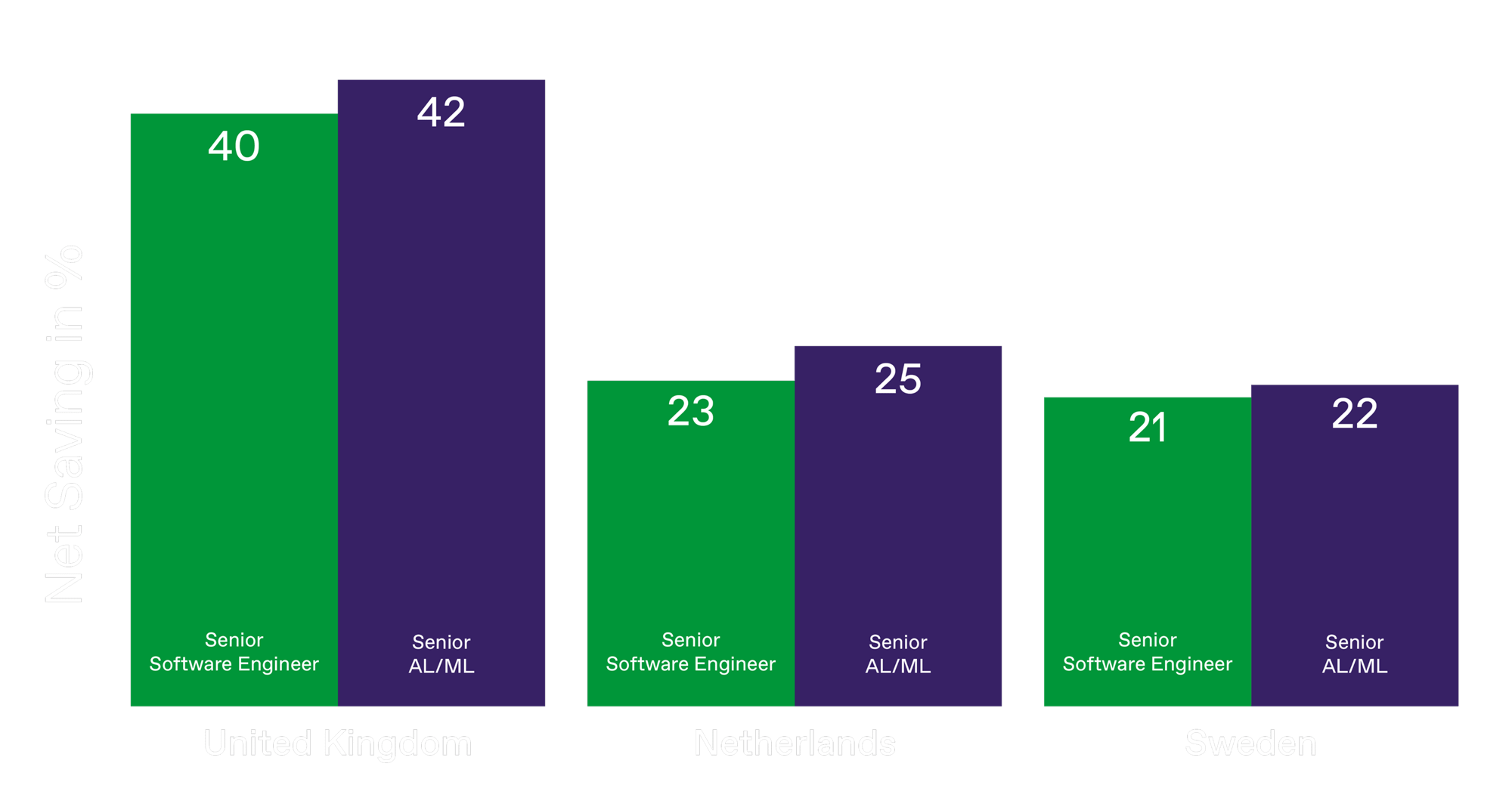
Relative cost difference for senior roles (CEE vs Western Europe), based on total monthly employer cost
Across AI, data, and advanced cybersecurity roles, demand remains high, and salaries continue to move, but more selectively. In our data, year-on-year increases for specialized roles range from 4–12%, while generalist roles across much of CEE show flatter or marginal growth. Compensation now tracks more closely to seniority and delivery experience than to volume alone.
At the same time, CEE continues to offer a meaningful cost advantage. The chart alongside shows the relative difference in total employer cost for senior software and ML/AI engineers compared with Western European markets. Below, we're sharing a few role-level snapshots that illustrate how these shifts play out in practice.

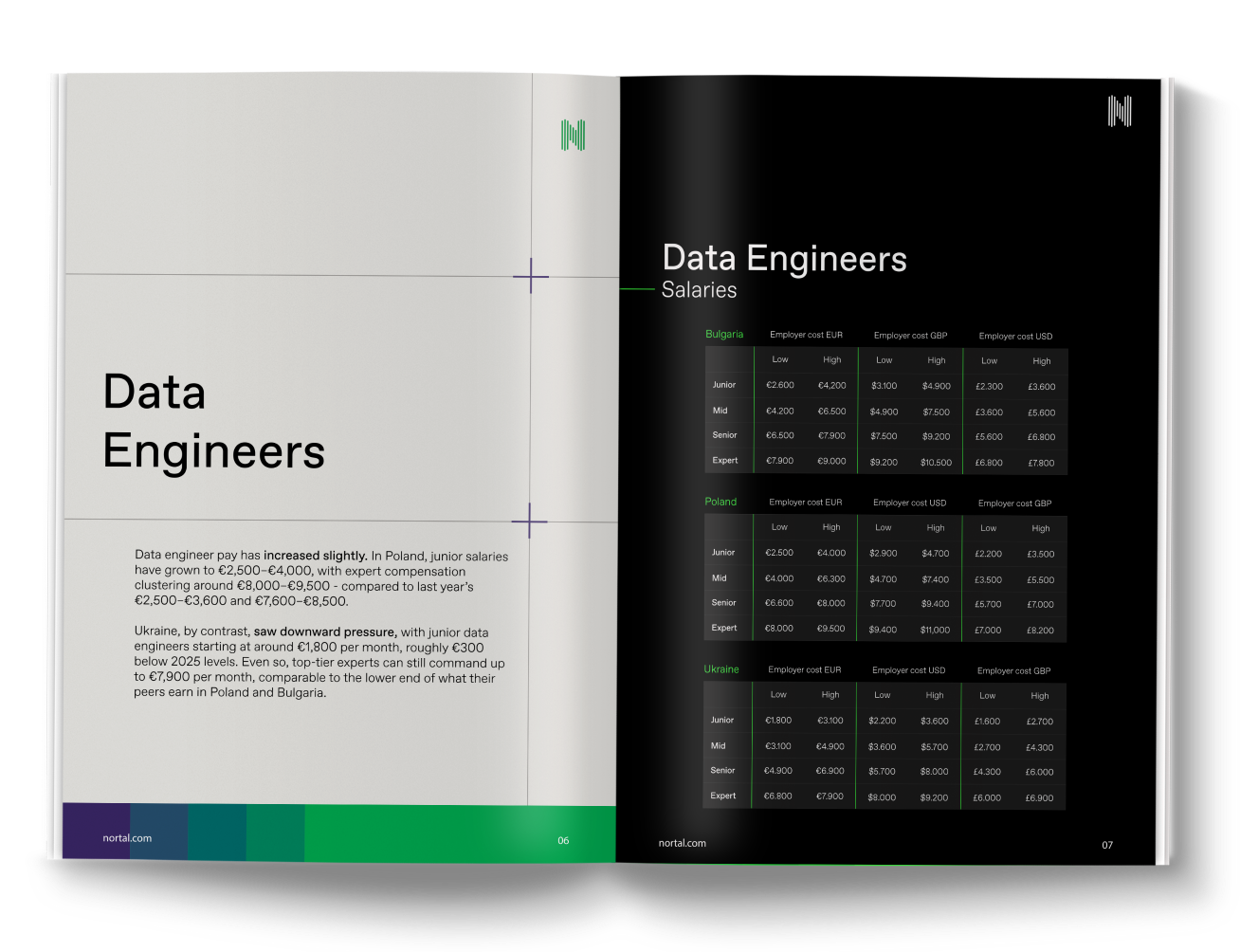
Data engineer pay has increased slightly. In Poland, junior salaries have grown to €2,500–€4,000, with expert compensation clustering around €8,000–€9,500. Ukraine, by contrast, saw downward pressure, with junior data engineers starting at around €1,800 per month, roughly €300 below 2025 levels.
Even so, top-tier experts can still command up to €7,900 per month, comparable to the lower end of what their peers earn in Poland and Bulgaria.
Widespread adoption has made ML/AI talent essential for companies. As AI projects move from pilots to production, demand and salaries reflect that shift.
Bulgaria and Poland show comparable ranges, with juniors earning €2,600–€4,200 and experts clustering around €8,000–€9,500 per month. Ukraine remains the most cost-efficient option, with mid-and senior-level roles typically priced between €3,000 and €7,900.
Cybersecurity pay across CEE has remained largely flat, with junior and mid-level roles slightly down in Ukraine and Bulgaria. This may seem counterintuitive when 63% of organizations report cybersecurity staffing gaps. For employers, this creates a real window of opportunity.
In Poland, Ukraine, and Bulgaria, junior cybersecurity specialists typically cost between €2,300 and €4,300 per month, while top-tier experts command up to €6,900–€8,900.
Data in this guide is maintained by talent teams who work with CEE markets daily. They match engineers to long-term delivery teams and keep them there.
96%
of our engineers pass the trial period
95.7%
95%
Salary ranges for 10+ core technology roles, split by seniority
Coverage across Poland, Ukraine, and Bulgaria
Figures shown as total monthly employer cost
Data presented in EUR, GBP, and USD
Full access to editable Excel and Google Sheets, alongside the PDF
This guide is intended for engineering leaders and decision-makers responsible for planning and resourcing technology teams – including CTOs, Heads of Engineering, and senior delivery or product leaders. It’s most useful if you’re comparing markets, reviewing compensation assumptions, or planning how to extend or structure teams across Central and Eastern Europe.
Unlike survey-based reports or advertised salary ranges, this guide is built on first-party compensation data from teams actively placing and retaining engineers in production environments. The numbers reflect real employer costs, updated to current market conditions, rather than self-reported expectations or historic averages.
The guide covers IT salary ranges across Poland, Ukraine, and Bulgaria.
It includes core technology roles such as software engineers, data and ML/AI specialists, DevOps and cloud engineers, cybersecurity, QA, UX/UI, product owners, support roles, and IT architects.
All figures are shown as total monthly employer cost and presented in EUR, GBP, and USD.
Yes. By showing total employer costs by role, seniority, and country, the guide can be used to pressure-test compensation assumptions, compare markets, and understand how role mix and seniority levels affect overall team costs — particularly for extended or distributed teams.
Yes. Many readers use the guide to sense-check existing setups, understand how market conditions have shifted year on year, and identify where assumptions about cost or availability may no longer hold, especially for senior or highly specialised roles.
Fill out the form and access our salary dataset.