Search
Explore digital transformation resources.
Uncover insights, best practises and case studies.

Search
Explore digital transformation resources.
Uncover insights, best practises and case studies.
Explore developer salaries, hiring costs, outsourcing models, and IT market trends in Ukraine. Practical guide for companies building engineering teams in Ukraine.

Service
A mature IT outsourcing market, Ukraine offers deep technical talent, a favorable tax regime, and costs 50–70% below Western benchmarks.
The short answer is that companies continue to hire developers in Ukraine for four structural reasons:
- substantial cost savings
- favorable tax and employment structure
- strong technical depth
- resilient, high-commitment workforce
Despite wartime disruption, Ukrainians continued to deliver production code from bomb shelters and push commits by generator light. Instead of shrinking, the IT workforce grew 11% year-on-year from 2022 to 2025, signaling continuity rather than contraction.
The war accelerated specialization. Defense tech now dominates, powered by engineers building cyber threat protection, battlefield AI, and IoT systems hardened against real adversaries, stress-tested in the real world.
The result is a convergence of three forces: cost efficiency, technical depth, and operational resilience.
Ukraine’s IT sector operates as a large-scale, export-oriented engineering workforce integrated into global product delivery chains. It includes approximately 290,000+ IT professionals, with some estimates reaching 360,000, depending on classification.
The market structure is supported by:
- around 2,200 active IT companies (according to a study by the Ukrainian Ministry of Digital Transformation)
- up to 5,000 broader tech-related organizations
- 902 new IT companies registered in Q1 2026 alone, as reported by Dev.ua
This growth trajectory is closely tied to the Diia.City framework, which formalized legal and tax conditions for tech companies and reduced friction for international hiring.
At the same time, Ukraine is deeply embedded in global delivery networks. Engineering and R&D operations from companies such as Google, Oracle, Samsung, Nvidia, Cisco, and Rakuten are active in the country, reinforcing a hybrid model in which local teams operate within global product ecosystems rather than outside them.
One of the defining features of the Ukrainian IT market is its hybrid employment structure. Most developers operate through contractor-based models, supported by Diia.City or sole proprietorship (FOP) frameworks.
This creates a predictable cost structure with relatively low friction for international employers:
- Diia.City personal income tax: 5%
- Military levy: 5% (or 1%)
- Social security contribution: ~22% of the minimum wage
- Corporate tax options: 9% exit capital model or 18% corporate income tax
- Standard VAT: 20%
This framework allows companies to structure engagements flexibly while maintaining legal clarity, particularly in cross-border setups.
Ukraine’s IT sector is fundamentally export-driven, with most revenue coming from international clients.
Key indicators include:
- IT exports hit approximately $8.2 billion in 2025
- 9.3% year-on-year growth
- Total sector turnover running at $7.5–7.8 billion
- Ranked 30th globally in the E-Government Development Index (published by the United Nations), with a score nudging 0.88
This export orientation reinforces Ukraine’s position as a delivery-focused engineering market integrated into global supply chains.
The talent pipeline remains one of Ukraine’s most structurally important advantages. Each year:
- ~25,000–30,000 ICT graduates enter the market; one of the biggest outputs in Central and Eastern Europe
- Around 80–85% of the active workforce operates at an intermediate level or above
- Ukrainian teams have earned 107 medals at the International Olympiad in Informatics
- Consistent top-shelf performance in European programming competitions and global algorithmic benchmarks
In recent years, workforce composition has also shifted. Wartime labor dynamics have increased female participation in the tech sector, while demand for AI, cybersecurity, and defense-related engineering has accelerated skills development in those areas.
|
What is Diia.City? |
What is FOP in Ukraine? |
|
Diia.City is Ukraine’s legal and tax framework for IT companies. It provides simplified taxation, contractor flexibility, and structured employment conditions designed to support international tech companies operating in Ukraine. Key features:
|
FOP (Sole Proprietor) is a simplified contractor-based employment model widely used in Ukraine’s IT sector. Developers operate as independent contractors rather than employees. Key features:
|
Ukraine’s tech talent is concentrated in a handful of strong regional hubs, each with a slightly different specialization. While Kyiv and Lviv dominate in scale, other cities add depth in defense, industrial tech, and product engineering.
Ukraine also ranks 42nd in the Global Startup Ecosystem Report, with a steady push to position itself as Europe's leading technology hub, especially in defense, agriculture, government, and AI.
Key tech hubs in Ukraine and what they’re known for:
|
City |
Strength |
Technology focus |
Companies |
| Kyiv | The largest and most diverse hub and home to 42%-48% of the national tech workforce | Fintech, healthcare, AI and machine learning, product development, cybersecurity, and enterprise software | Global: Microsoft, Samsung (R&D), Google (R&D), Oracle, Deloitte, Ubisoft, Siemens, Visa, Mastercard, Palantir, Philips Healthcare, GE Healthcare, IBM Watson, Medtronic, Nvidia Local: Grammarly (major R&D), Monobank (fintech), Reface (AI), Ajax Systems, MacPaw |
| Lviv | Second-largest IT hub with a strong outsourcing and senior talent base; the Lviv IT Cluster pulls together firms, local government, and universities | Cybersecurity, AI and machine learning, custom development, DevOps | Global: IBM, GlobalLogic, Siklu, Gameloft Local: Lohika, Spendbase, BetterMe, UnderDefense |
| Kharkiv | Deep academic roots and a heavy tilt toward telecom and hard tech, with its own IT cluster | Complex, math-heavy software engineering, defense tech, cybersecurity, game development | Global: Grid Dynamics, Gameloft, Cisco Local: Argus, Finsoft, INSART |
| Dnipro | A strengthening specialist pool with a strong industrial and logistics background | DevOps, enterprise apps, industrial tech and IoT, logistics, outsourcing | Global: Zazmic Local: Perfsys, Yalantis |
| Odesa | A broadening startup and product scene, with Odesa IT Family actively promoting regional IT growth | AI services, greentech, maritime tech, SaaS, cybersecurity, mobile and web development | Global: Oracle, Snapchat, Rakuten Local: Readdle, KeepSolid, Augmented Pixels (R&D), adtelligent |
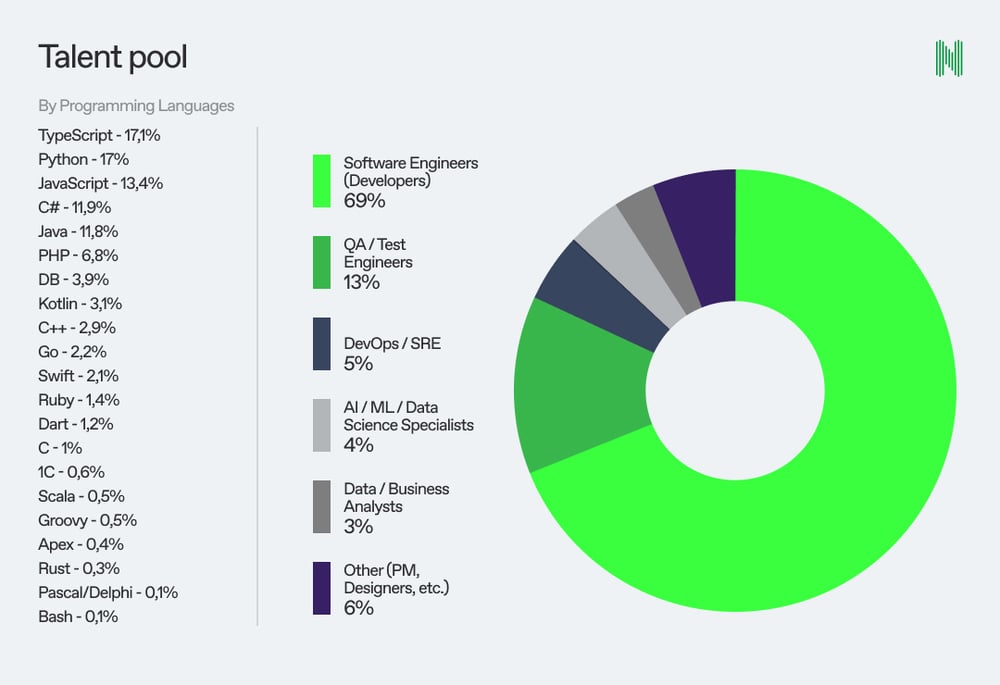
TypeScript, Python, and JavaScript dominate, confirmed by the 2026 dou.ua rankings and our own research (DOU is the go-to hub for Ukraine's IT community).
TypeScript comes out on top at nearly 21% and is trending upward, with broad use across software engineering, full-stack, and QA, especially for complex multi-page applications.
Python follows close behind as the language of choice for AI work, holding strong in DevOps and data analytics. JavaScript hangs in there for web and frontend, though TypeScript is steadily crowding it out.
Mobile technologies, Kotlin, Go, Swift, Dart, occupy a smaller slice, which is telling.
Ukrainian engineering talent is concentrated around desktop, full-stack, and distributed systems, the more architecturally demanding end of the stack. AI, machine learning, and data science are on a sharp upward trajectory, with defense tech and computer vision driving much of that growth.
Ukrainian developers are tackling complex, high-stakes projects rather than routine tasks. With a strong, modern tech stack built for scale, particularly TypeScript, Python, JavaScript, AI/ML, cloud, and cybersecurity, Ukrainian teams consistently deliver architecturally demanding solutions, working on advanced challenges in AI, deep tech, miltech, and other sophisticated domains. Far from being “cheap extra hands,” they bring proven capability in high-complexity environments, operating as a cross-sector production layer embedded in global digital infrastructure.
Typical work: large-scale enterprise platforms (ERP/CRM/internal systems), SaaS product engineering, workflow automation systems, cloud migration and modernization, data infrastructure and engineering platforms, API ecosystems, enterprise integrations, and long-term platform maintenance for global clients.
Typical work: payment systems, digital banking platforms, core banking infrastructure, fraud detection systems, trading and risk platforms, and regulatory compliance systems.
Typical work: cybersecurity platforms, DevSecOps pipelines, secure communications systems, endpoint protection tools, cloud security architectures, threat detection systems, defense-tech software, drone software systems, encrypted communications, and dual-use industrial engineering platforms.
For a deeper look at real-world implementations and security delivery patterns in this space, see our selected enterprise cybersecurity case studies.
Typical work: large-scale e-commerce platforms, marketplace infrastructure, retail data systems, recommendation engines, search and discovery systems, inventory and logistics platforms, customer experience systems, and high-traffic transaction platforms.
Typical work: healthcare data platforms, patient management systems, medical imaging software, AI-assisted diagnostics tools, clinical data infrastructure, telemedicine platforms, wearable/IoT healthcare integrations, and regulatory-compliant healthcare software systems.
Typical work: learning management systems (LMS), online education platforms, video-based learning infrastructure, content delivery systems, assessment engines, AI-based personalization for learning, and scalable multi-tenant education platforms.
Typical work: customer data platforms (CDPs), marketing automation systems, ad-tech infrastructure, analytics pipelines, personalization engines, attribution systems, CRM integrations, campaign management platforms, and high-volume data processing systems for marketing ecosystems.
Hiring developers in Ukraine typically costs 50–70% less than equivalent roles in Western Europe or the US, while maintaining comparable senior-level engineering output.
Senior engineers generally fall into the following total employer cost range:
|
Role |
Seniority |
Total employer’s cost (based on our 2026 market analysis)* |
| Software Engineer | Junior | € 1,500 - € 2,300 |
| Middle | € 2,300 - € 4,300 | |
| Senior | € 4,300 - € 5,800 | |
| Expert | € 5,800 - € 7,100 | |
| Cybersecurity Engineer |
Junior | € 2,300 - € 3,100 |
| Middle | € 3,100 - € 4,900 | |
| Senior | € 4,900 - € 6,900 | |
| Expert |
€ 6,900 - € 7,900 |
|
| Machine Learning/AI Engineer |
Junior | € 1,800 - € 3,100 |
| Middle | € 3,100 - € 4,900 | |
| Senior | € 4,900 - € 6,900 | |
| Expert | € 6,900 - € 7,900 |
*Inclusive of social contributions, benefits, recruitment, onboarding, training, and retention costs.
Remuneration across Ukrainian IT has shifted around over the last few years, but the cost advantage has held firm. Ukrainian specialists tend to earn about half what their Western counterparts earn across comparable tech roles, with no corresponding dip in quality or output. That said, salary figures alone don't tell the full story.
Recruitment, onboarding, fringe benefits, taxes, and the ongoing HR overhead all stack up, and when you factor them in, the gap can widen further in your favor. At Nortal, we fold all of it in, so what lands on your desk is a clean monthly figure with no surprises tucked underneath.
For a full breakdown across the most common tech roles and a comparison with other key CEE markets, see our detailed market guide.
Cost is a powerful pull factor, but it doesn't work in isolation. Any company recruiting tech talent in Ukraine needs to walk in with eyes open, particularly if going it alone without local market knowledge.
A few recurring headaches worth flagging:
Geopolitical chaos, AI disruption, and tech layoffs arriving in droves have made for an unsettled operating environment. Companies aren't necessarily bleeding revenue, but they're bracing for what might come, trimming costs and tightening up their workforce strategies.
With over 73,000 tech jobs cut globally in early 2026 amid ongoing cost-control measures and AI-driven restructuring, many companies are actively seeking more affordable, high-quality talent pools. That instinct toward optimization is precisely what makes markets like Ukraine worth a serious look.
The conflict has a real and ongoing impact on business, candidates, and the recruitment process. In the immediate aftermath of the Kyiv invasion, demand took a knock as companies held their breath and mobilization swept up large numbers of men. Some businesses pulled back, spooked about the durability of their Ukrainian operations. Yet what followed was more nuanced than the early panic suggested.
The war has hit the Russian market far harder, with as many as 1,500 global brands curtailing operations there, according to the Yale School of Management. Ukrainian demand has largely bounced back.
The conflict has also thrown up some unexpected byproducts: tech companies pivoting from vendors to critical infrastructure providers, consumer software and devices finding military applications, and a massive acceleration in real-world deployments of AI, machine learning, and data analytics. The net effect has been a sharpening of domestic tech capability, making Ukrainian talent more competitive, not less.
The global habit of over-specifying roles has turned hiring into a scavenger hunt for a purple squirrel (Harvard Business Review defines it best). When the requirements list runs long enough to describe a candidate who almost certainly doesn't exist, recruiters suffer, and timelines blow out.
This is a global trend rather than a Ukrainian peculiarity, but it's showing up here too, and it requires skillful navigation.
Companies have raised the bar on what they expect from candidates, and it's no longer purely about technical seniority. A senior AI engineer with years of fintech experience might get passed over because the product is in healthcare.
Industry familiarity now carries serious weight alongside hard skills, pushing more companies to cast wider nets beyond their home markets.
Ukraine’s broad cross-sector experience spanning medtech, fintech, cybersecurity, defense tech, agritech, and enterprise platforms positions it exceptionally well, as the IT Ukraine Association’s broad study confirms.
Finding, vetting, and successfully onboarding engineers in an unfamiliar market is a slog at the best of times. Having a player who knows the legal, economic, HR, and political terrain at their fingertips can spare you a lot of expensive trial and error.
Our team has deep on-the-ground expertise and can give you a realistic assessment tailored to your needs.
Ukraine's employment and tax setup for the IT workforce is primarily structured around three engagement models:
The most important distinction in Ukraine is not salary level, but employment structure.
Under standard employment, companies bear higher social contributions and tax obligations. Under contractor-based arrangements, taxation is simplified and shifted to flat-rate systems, significantly reducing total employer cost. Because of that, most developers work as contractors rather than employees.
Diia.City sits between these two models, offering a regulated structure with lower taxes and clearer legal frameworks for international companies.
Out of the last two, the contractor route, which is far more common in tech, splits into two variants depending on registration type:
The difference between the two contractor models is relatively narrow in cost terms. The Diia.City paths carry more legal structure and are generally the cleaner option for international companies that need audit trails and clarity on compliance.
Employment benefits are regulated under the Labor Code of Ukraine, and most of them apply to employment contracts rather than contractor arrangements:
Ukraine moves faster than most on the notice period, with just 14 calendar days’ notice on the employee’s side. This is short for European standards (usually a minimum of a month) and meaningfully compresses hiring timelines when backfilling roles. The flip side is that if the employer initiates termination for restructuring or redundancy, a minimum of two months' written notice is required. The war adds its own impact: under martial law, standard employment rules can be modified, and contracts may be suspended.
Business travel has historically ranked as a major pull factor for Ukrainian tech candidates. However, again, under the war realities, most men of conscription age aren’t allowed to leave the country, which makes that benefit apply selectively.
Among other meaningful ways to compensate for employees’ time and efforts are training and education budgets, wellness support, learning platforms, performance bonuses, and extra vacation allowance.
Through the same channels that work everywhere else, LinkedIn, referrals, community platforms, job boards, and dedicated people solution partners, with a few Ukraine-specific nuances worth knowing.
Built on 25 years of experience, Nortal has developed a hiring approach that respects how Ukrainian professionals prefer to be approached, which turns out to matter quite a lot.
The process itself runs through four stages:
Some companies tack on a second client interview or a test task. Our considered view is to keep the process to four stages or fewer.
Longer pipelines bleed candidates, particularly strong ones who are fielding multiple offers. Test tasks are a particular friction point with Ukrainian professionals, especially at the senior level, where they tend to read as a signal of distrust rather than due diligence. Technical interviews carry far more weight and are the expected format.
If you're considering building a team in Ukraine, Nortal can help you structure a process that aligns with how local engineers engage, while keeping hiring efficient and predictable on the client side.
Діло майстра боїться. Work fears the master.
That old saying still maps surprisingly well to Ukrainian tech culture. Work is taken seriously, competence is respected, and outcomes matter more than visibility. This is not a “perform in meetings” culture. It’s a “ship and deliver” culture.
Ukrainian developers tend to be pragmatic, disciplined, and quietly high-performing. They won’t over-index on self-promotion, but they will consistently push work forward with a strong bias toward completion and responsibility.
Ukrainian work culture skews more conservative, collective, and hierarchical than its Western and Northern European counterparts, though younger generations are nudging that needle steadily toward more autonomy and flatter collaboration.
Authority is generally respected, ambiguity is uncomfortable, and vague direction tends to be pushed back. This can feel direct from the outside, but it tends to produce cleaner execution: fewer assumptions, fewer performative layers, more straightforward accountability.
There is also a strong collective orientation. Family ties, group cohesion, and long-term stability matter, and this has been reinforced by wartime realities. The result is a workforce that values reliability, consistency, and trust within teams.
From a cultural value perspective (e.g., the Shalom Schwartz framework), Ukraine sits closer to higher embeddedness (the overlap of collectivism and respect for authority) and a hierarchy-oriented orientation than many Western European markets, which translates into structured teamwork, respect for leadership, and strong execution discipline.
In practical terms, that translates to:
These cultural patterns directly shape what Ukrainian developers look for in an employer.
Severance pay typically covers one month's salary, occasionally two.
|
One line you should never cross Ukraine and Russia are at war. Over 1,500 global brands have curtailed or wound down their Russian operations since the 2022 invasion, and the conflict has reshaped professional allegiances in ways that run deep and aren't going away. Pitching Ukrainian candidates on Russia-based or Russia-funded roles is a non-starter, and mixing Ukrainian and Russian professionals in the same team is a serious misstep that will cost you trust, candidates, and credibility in the market. |
Yes. The market has remained structurally viable despite prolonged external pressure, supported by the depth of talent, cost efficiency, and continued global integration.
Ukraine offers a combination that is still rare in one location:
The sector is export-oriented by design, globally integrated through delivery partnerships, and increasingly specialized in high-stakes domains like AI, cybersecurity, defense tech, and fintech.
At the same time, the risks are real and worth taking seriously: martial law, mobilization constraints, and an operating environment that demands flexibility and local know-how. But companies that have stayed the course – and many have – consistently report high engagement, low voluntary attrition, and a strong focus on execution, particularly on complex or high-responsibility work.
If you are evaluating Ukraine as a hiring market, it is less a speculative option and more a strategic one that depends on risk tolerance and delivery design.
We’ve been operating in this market for years and can give you a straight read on what’s realistic for your specific situation.
We work with UK companies from candidate sourcing through onboarding and ongoing management to build dedicated tech teams that slot into your workflows, ramp up without friction, and start shipping within weeks.
Start with the data: download our 2026 CEE Tech Salary Guide for country-by-country breakdowns of pay ranges, role availability, and regulatory considerations.
Ukraine has approximately 290,000–360,000 IT professionals. The market is senior-heavy, export-oriented, and strongly specialized in TypeScript, Python, AI, and cybersecurity. Despite wartime conditions, the sector has continued to grow and remains deeply integrated into global tech delivery.
Ukraine combines lower hiring costs (50–70% below Western Europe) with a large pool of highly experienced engineers. Strong performance in international programming competitions, a mature outsourcing ecosystem, and growing specialization in AI and defense tech further strengthen its position.
Three dominant models are used:
Dedicated teams are the most widely used model for sustained engineering output.
Direct hiring reduces long-term costs but requires handling the legal, tax, and compliance complexities locally. Partner-based hiring (EOR or outsourcing provider) speeds up onboarding and reduces operational risk, especially for companies new to the market.