Search
Explore digital transformation resources.
Uncover insights, best practises and case studies.

Search
Explore digital transformation resources.
Uncover insights, best practises and case studies.
Poland remains the largest of the three markets in this overview and, on paper, the broadest as well. It is the largest IT market in Central and Eastern Europe and one of the most mature ecosystems in the EU. After the global tech slowdown, the market has stabilised and returned to moderate growth in 2025–2026.
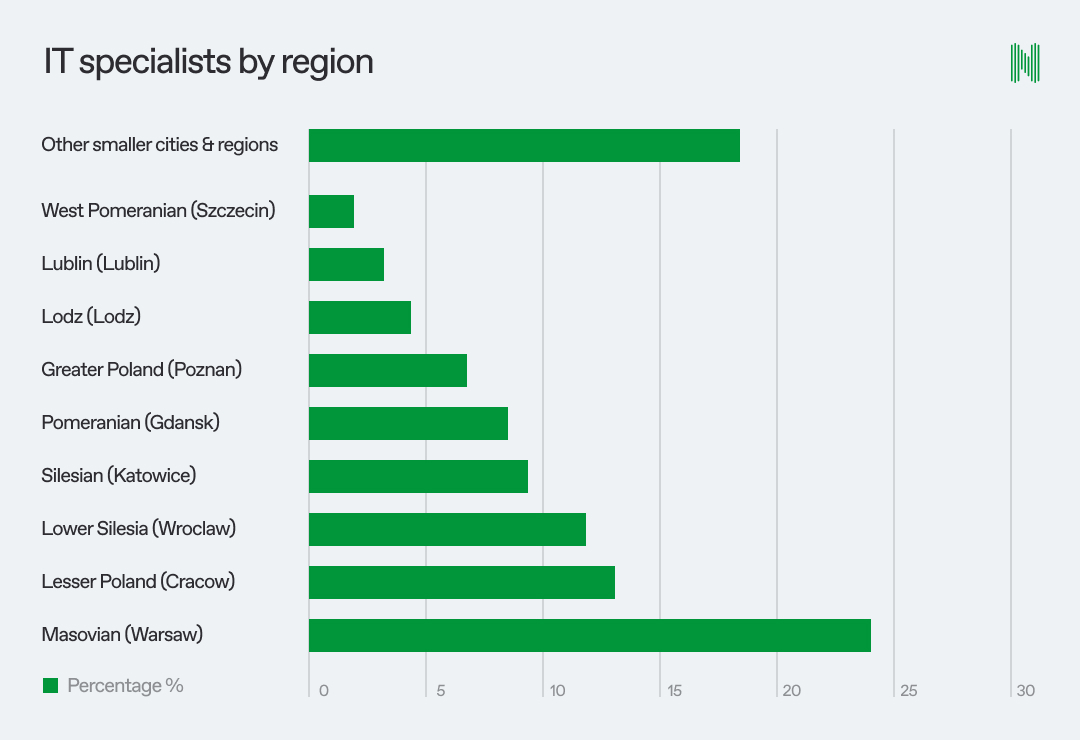
With around 850,000 IT professionals and more than 15,000 annual graduates, Poland gives teams both scale and range. The main talent hubs are Warsaw, Cracow, Wroclaw, Katowice, Gdansk and Poznan.
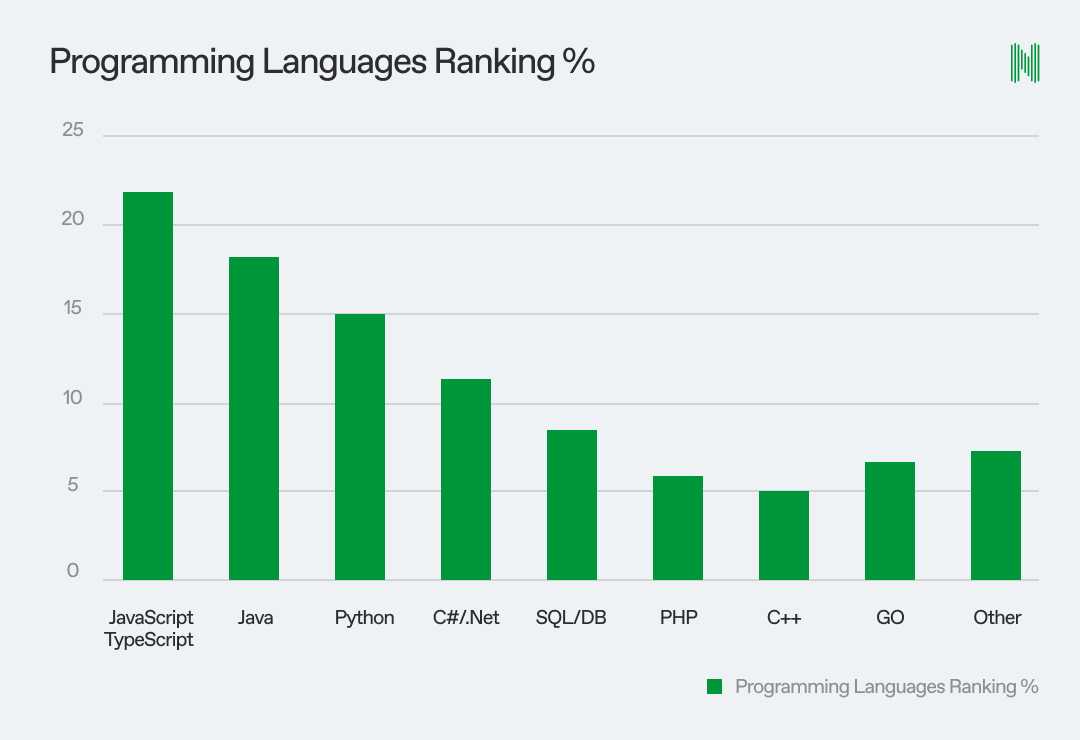
Poland’s tech talent pool is highly skilled and diverse, with many developers working across multiple modern languages. TypeScript is growing faster than plain JavaScript, while Python remains strong not just in AI, but also in automation, backend, and data-related work.
The main market trends point to strong demand in AI and machine learning, data science, big data and analytics, alongside increased investment in automation, cybersecurity and cloud migration. The market is also more selective than during the hyper-growth years, with hybrid work now the dominant model.
That makes Poland the broadest option here for teams that need a large, mature market, especially when the goal is to build across several technical areas rather than solve a single narrow gap.
The market is facing high competition for talent, a severe shortage of specialised profiles, longer, more rigorous processes, and even fake profiles or inflated skills.
That combination matters. A large market does not automatically mean an easy one. Poland offers depth, but strong specialists still have options, and sloppy process design can slow things down fast.
A typical recruitment process is fairly standard: recruiter screen, technical interview, and customer interview, with the option of one extra step if needed. But there is also a clear warning: more than four stages is seen as too long, and test tasks do not work well in the Polish market, especially for senior specialists. Technical interviews are the most common way to assess technical ability.
Notice periods depend on the person’s length of service. They are typically two weeks for employees with less than six months at a company, one month after six months, and three months after three years.
Poland has a mixed employment landscape. The most common forms are employment contracts and B2B contracts. Employment contracts are more common among junior and mid-level specialists, while many senior specialists favour B2B because it offers higher net earnings and more flexibility.
For a full-time employee, the income tax shown here is 12% for income not exceeding PLN 120,000, and 32% for the surplus above PLN 120,000.
For contractors, the picture is more mixed. The options shown here are a 19% flat tax, progressive tax at 12% and 32%, or lump-sum tax on revenue at 12%. There are also mandatory social and health insurance, as well as VAT.
In Poland, the same headline compensation can land differently depending on whether someone works as an employee or as a contractor, so it helps to look at the structure, not just the number itself.
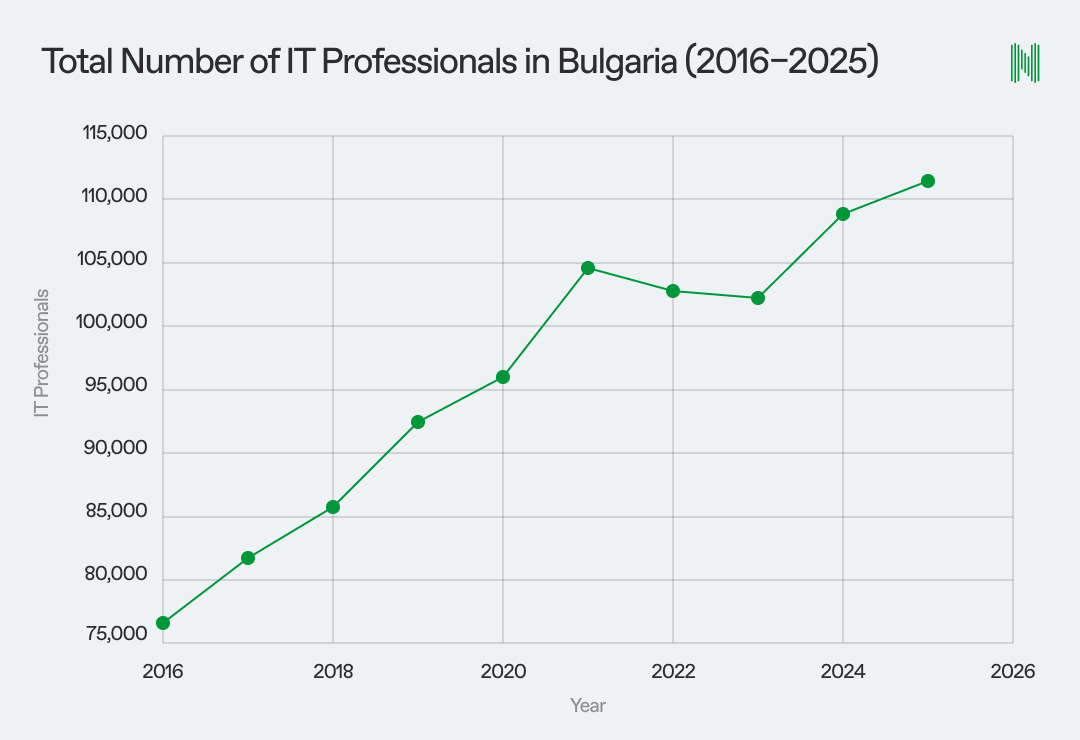
Bulgaria is smaller than Poland, but it is a steadily growing ICT services market covering BPO, ITO and R&D. In 2025, it lists 111,500 IT professionals.
It is also a much more concentrated market. Sofia is the largest IT hub, home to nearly 80% of the country's IT companies and the majority of developers. Plovdiv, Varna and Burgas are the main secondary centres.
That concentration can make the market easier to read. Instead of a long list of major hubs, there is typically one dominant centre with a smaller supporting group behind it.
Bulgaria stands out for clear communication, a collaborative working style, and strong language capability. English is the primary working language for 71% of Bulgarian tech experts, and other languages are visible too, with 16% speaking German and 10% speaking French.
From a technical point of view, Bulgaria shows strong concentrations in Java, JavaScript, .NET/C#, and Python, with additional strength in C++, DevOps, and cloud-related expertise across AWS, Azure, and GCP. Current demand is especially visible in cloud computing, machine learning, artificial intelligence, cybersecurity, data analytics, and Salesforce.
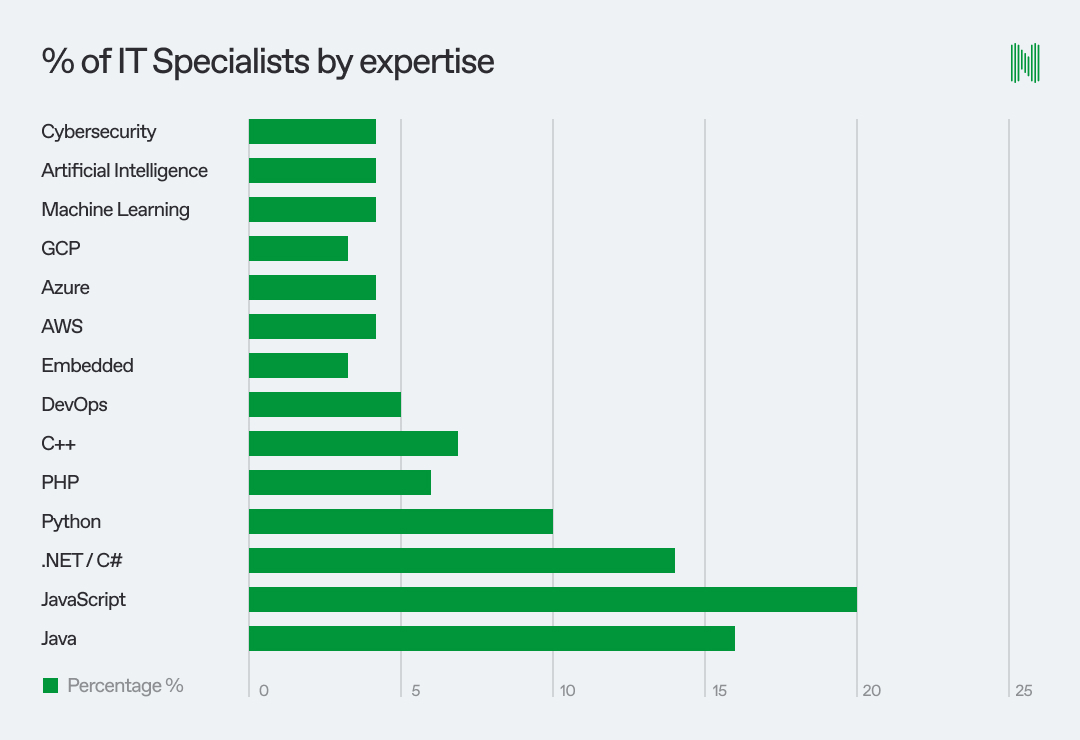
Bulgaria also has one of the highest shares of female ICT specialists in the EU, at 27%.
The main motivation drivers are technically challenging work, work-life balance, competitive pay, and job security.
This makes Bulgaria look like a market where the basics matter a lot: strong projects, decent flexibility, clear communication, and enough stability for people to feel good about the move.
The challenges are familiar, but they still shape how teams scale. Competition for skilled professionals remains high, especially in emerging areas such as AI, machine learning, mobile development, and AR/VR. Economic uncertainty continues to affect the market, while remote work increases global competition by widening the pool of companies hiring from the same talent base.
Process design matters too. Lengthy interview processes and shifting requirements can still lead to candidate drop-off.
So while the market is growing, it is not a free-for-all. Good specialists are still being pulled in different directions, and delays in hiring can be costly.
A typical hiring process in Bulgaria consists of a recruiter screen, an initial chemistry call with the client, and then a technical interview or pairing session, with an extra step only if needed. More than four stages is considered too long. Take-home tasks are generally not viewed as good practice and are not desired by many engineers, while live practical work during the technical interview is presented as the better option.
Notice periods are usually between one and three months, with one month being the most common. Some notice periods can be negotiated down to 2 or 3 weeks, and people in Bulgaria are ready to move quickly, so delays pose a real risk of losing them.
In Bulgaria, the standard setup is still full-time employment, and that is the option most people tend to prefer because it offers more security and stability. B2B exists too, but it is less typical and usually comes up in more specific cases rather than as the default.
The practical difference shows up clearly in how costs are structured. In a full-time employment setup, the employee pays 13.78% in social security plus 10% income tax, while the employer pays 18.92% in social security. Using the example shown here, a €2,000 net salary translates into a total company cost of €2,912.74.
In a B2B setup, 20% VAT may apply. The example shown here uses a total invoice cost of €2,400, with VAT reimbursed to the company by the state.
That matters less as a legal detail and more as a planning point. Even when two offers look similar on the surface, the cost structure and the way compensation is framed can differ quite a bit depending on the setup.
Ukraine is the market most shaped by external conditions. Despite the war, the tech industry has remained resilient, continues to supply talent globally, and remains one of the leading sectors of the domestic economy. In 2025, it lists 289,044 IT private entrepreneurs. In practice, that means a large share of specialists work as registered private entrepreneurs and provide services to companies under service agreements rather than through a standard full-time employment model.
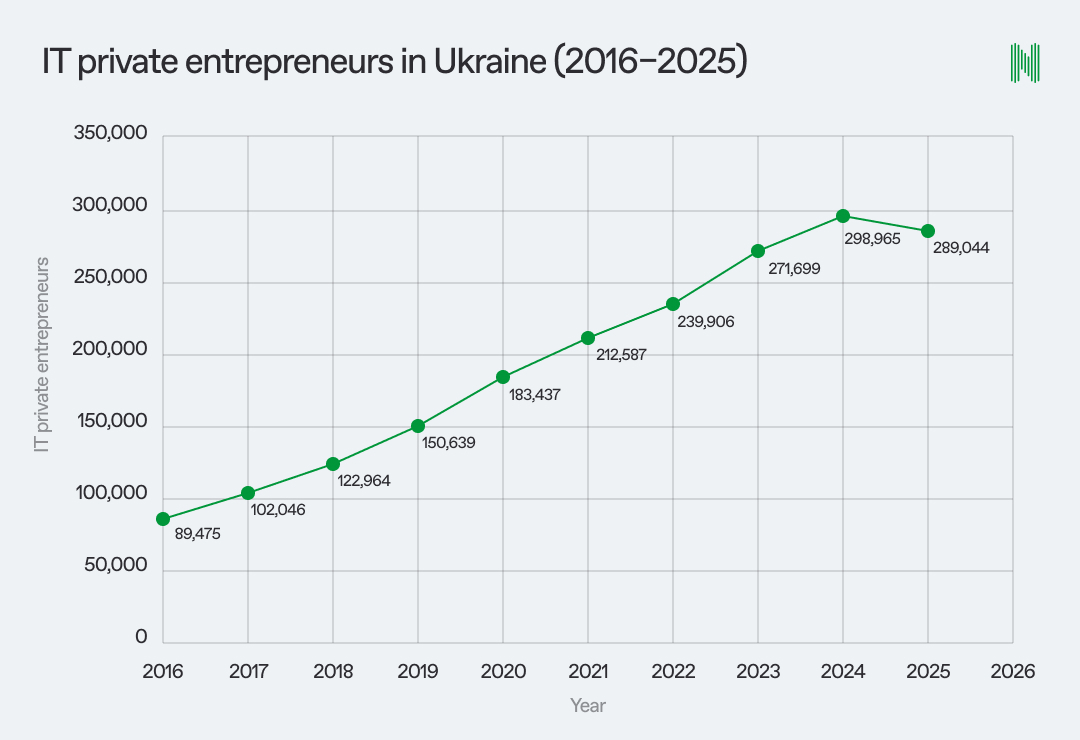
The specialist base is spread across several regions, with Lviv, Kyiv city, Kharkiv, and Dnipro among the main hubs.
Ukraine remains a large and relevant engineering market, but one that needs to be understood on its own terms.
Ukraine has a developer-heavy talent mix. Developers make up 69% of the IT talent pool, followed by QA/Test engineers at 13%, DevOps/SRE at 5%, AI/ML/Data Science at 4%, and Data/Business Analysts at 3%. The most visible languages include TypeScript, Python, JavaScript, C#, Java and PHP.
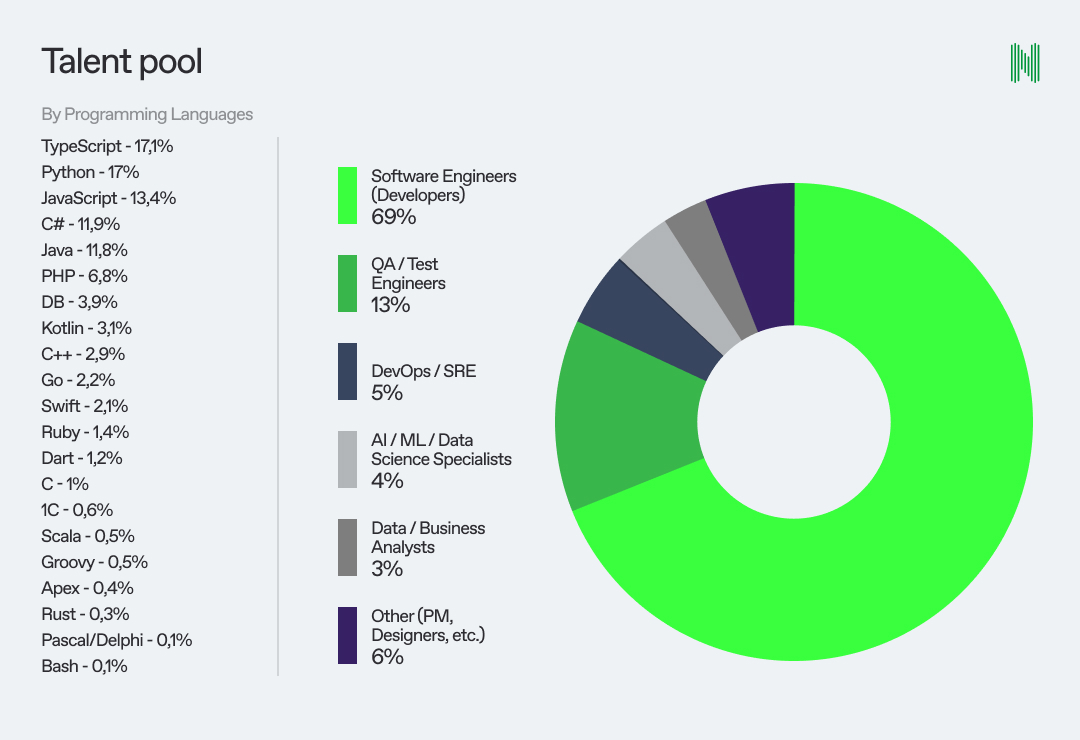
Most technical specialists have at least intermediate English proficiency, which supports work in international teams. The share of women in IT has also been rising steadily and now stands at around 25–30% across specialisations. At the same time, miltech roles and offers linked to reservation benefits are becoming more visible, and many candidates now tend to prioritise those opportunities first.
The market is also supported by a steady education pipeline, with around 16,000 technical bachelors and 8,000 masters graduating each year, alongside roughly 25,000 junior professionals coming through non-formal education.
The main challenges are clear. The war still affects business conditions, candidate availability, and recruitment more broadly. Requirements are often too narrowly defined, and expectations around technical level have risen, especially where senior or full-stack profiles are preferred.
English is not a broad market problem, but it can still create friction in selected specialisations. Most technical talent has at least intermediate English, yet roles such as system administrators and LDBA may still show weaker proficiency.
Long interview cycles and shifting requirements can also lead to candidate drop-off.
A typical hiring process is a recruiter screen, a technical interview, and a customer interview, with an additional step only if needed. As in the other markets, more than four stages is considered too long. Test tasks do not work well, especially for senior specialists, and technical interviews are the default way of evaluating capability.
Notice periods are usually around one month, but can sometimes be negotiated down to two or three weeks. Speed is also a key factor: candidates in Ukraine are often ready to move quickly, sometimes starting the first interview within a day or two. As a result, delays in the process create a real risk of losing them.
Most IT professionals in Ukraine are engaged through private entrepreneur arrangements, which remain the standard model in the market. Gig contracts have also become more common in recent years. This setup shapes how the market operates, including how compensation is typically discussed, with salary expectations usually framed in gross terms.
The cost structure looks quite different depending on the model. In a full-time employment setup, the employee pays 23% income tax and the employer pays 22% in social security. As a simple example, a $2,000 net salary translates into a total company cost of $2,900.
For a contractor working as a private entrepreneur, the tax burden is lighter. A typical example would include tax of up to 5% of revenue, pension tax of 1902.34 UAH, and 1% military tax. On that basis, a $2,000 net salary would be expensed at $2,164 to the company.
For a gig contractor, a comparable example would include 5% personal income tax, pension tax of 1902.34 UAH, and 5% military tax. In that case, a $2,000 net salary would be expensed at $2,244 to the company.
The practical point is that employment structure in Ukraine can affect cost quite significantly, so it is worth looking at the setup as closely as the headline salary.