Search
Explore digital transformation resources.
Uncover insights, best practises and case studies.

Search
Explore digital transformation resources.
Uncover insights, best practises and case studies.
Developer salaries, hiring costs, taxes, and IT market insights in Bulgaria. Nearshore engineering guide for companies building engineering teams in Bulgaria.
Service
Bulgaria is a mid-cost EU nearshoring hub with a mature software engineering market and a strong outsourcing ecosystem.
→ IT workforce: ~110,000+ professionals
→ Senior developer employer’s total cost: €5,900–€7,300/month
→ Corporate tax: 10% flat rate
→ Main hub: Sofia (~80% of IT companies)
→ Hiring time: 3–6 weeks
→ Notice period: 1–3 months
Best for: EU-based engineering teams, long-term delivery, cost-efficient scaling
Yes. It offers EU legal alignment, strong engineering talent, and 40–60% lower cost than Western Europe.
Key reasons:
• EU legal framework
• Lower hiring costs
• Strong outsourcing ecosystem
• Reliable engineering talent pool
The IT industry is structurally distinct from the domestic economy. It is export-driven, shaped by stable foreign demand, EU legal alignment, a flat 10% corporate tax, and a commercial court system that handles business disputes with relative efficiency.
That combination has created a delivery environment more predictable than the country's macro profile would suggest.
The scale reflects it.
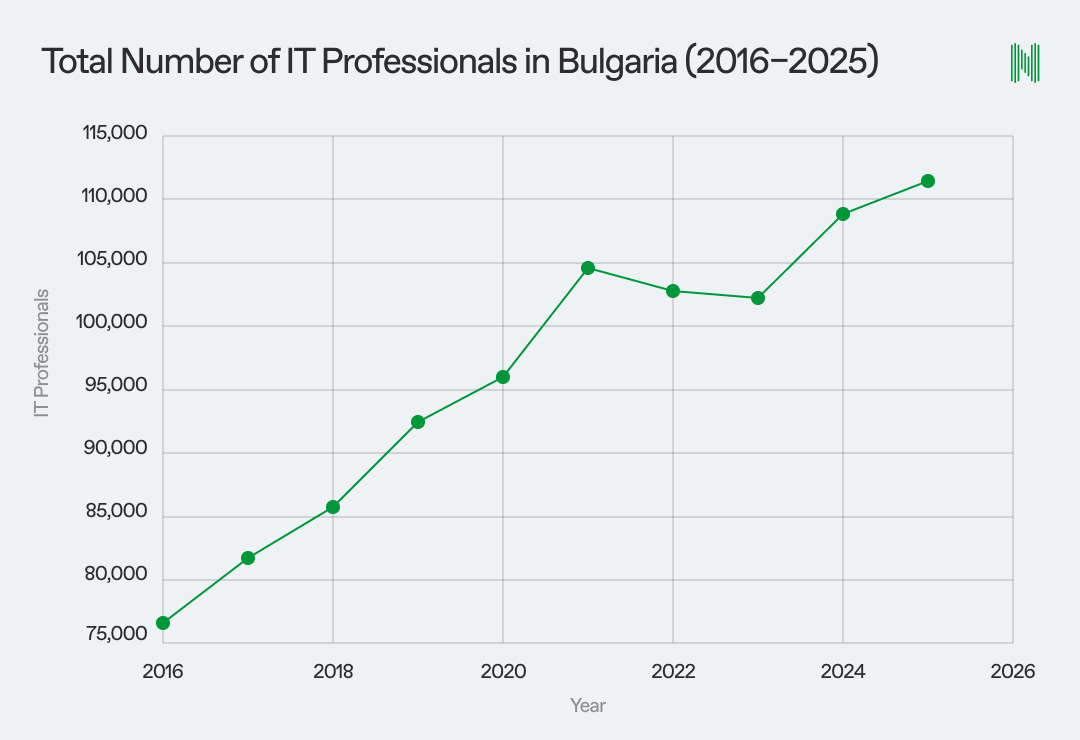
The Bulgarian IT workforce has grown by nearly 50% over the past decade, reaching more than 111,000 professionals. The market is projected to reach $8.77 billion in 2026, with cybersecurity and cloud-related roles expanding at a faster pace than the broader industry average.
Public initiatives such as the nationwide 5G rollout and the Digital Bulgaria 2025 program have supported this growth by expanding the talent pipeline and accelerating digital adoption, even if they have not been the primary drivers.
For companies prioritizing predictable EU-based engineering capacity at lower total cost, Bulgaria consistently performs above what its macro profile would imply.
Compact but concentrated IT ecosystem
Bulgaria covers roughly half the area of the UK, yet it has a dense and mature IT outsourcing landscape:
A genuinely competitive business environment
Nearshore without the nearshore caveats
Digital and workforce infrastructure
The talent profile
According to our own research, Bulgaria's IT sector employed more than 111,500 professionals in 2025, up roughly 3% year-on-year, and nearly 50% more than a decade ago.
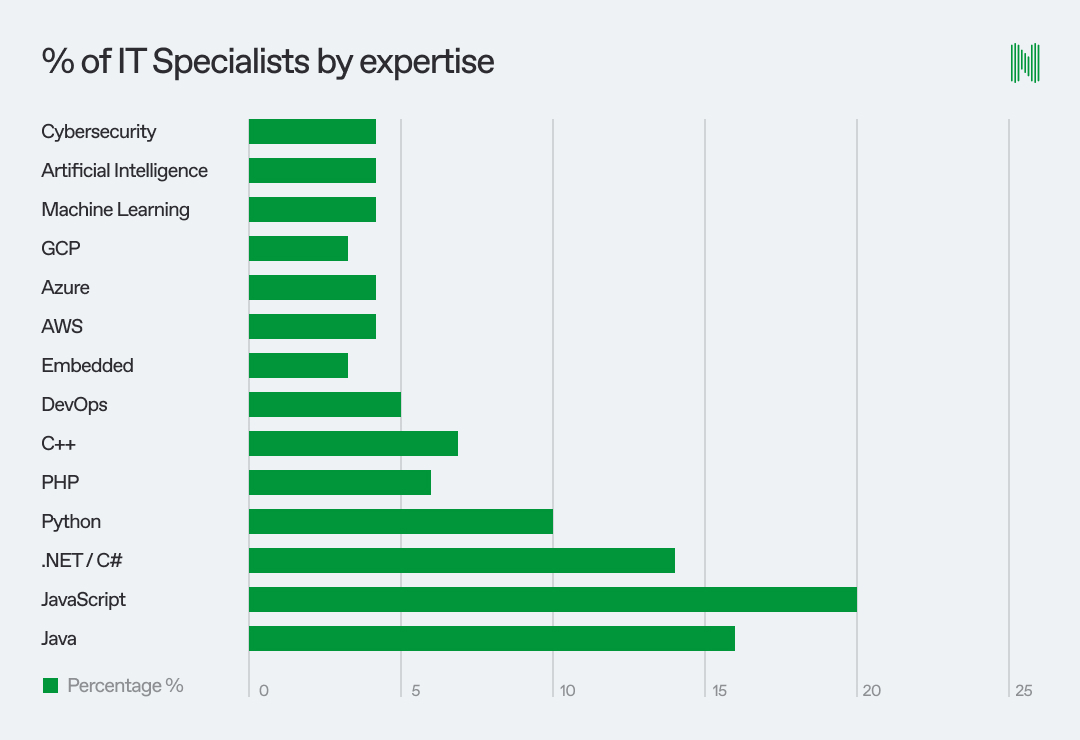
Software engineers form the largest segment, estimated at 45–55% of the total IT workforce, consistent with European market averages. QA, DevOps, cybersecurity, and ML/AI specialists make up most of the remainder.
In terms of demand, the most sought-after profiles in 2025 were cloud computing, machine learning, AI, cybersecurity, data analytics, and Salesforce engineers – a lineup that reflects Bulgaria's shift from cost-efficient generalist outsourcing toward higher-complexity, specialized delivery.
Bulgaria's IT industry is geographically concentrated, which simplifies hiring but intensifies competition for senior talent in the major cities.
|
City |
Strength |
Talent density |
Cost pressure |
| Sofia | Main hub, internationals | Very high | Higher |
| Plovdiv | Growing tech base | Medium | Medium |
| Varna | Emerging hub | Medium-low | Low |
| Burgas | Small but growing | Low | Low |
Sofia
The country's dominant tech hub, home to roughly 80% of IT companies and the majority of senior engineering talent. Multinationals, product companies, and outsourcing firms all compete here for the same candidate pool. This concentration has also helped position the city as an emerging innovation center, with international firms actively investing in its ecosystem (as illustrated in this case study of an international firm building engineering capacity in Sofia).
Plovdiv
The second city, which has a growing IT community supported by improving infrastructure and strong university output. It attracts companies looking to build teams outside Sofia's salary pressure.
Varna and Burgas
Both on the Black Sea coast, have smaller but developing tech sectors. Local universities feed a steady pipeline, and both cities are drawing increasing investment from companies seeking talent outside the main hubs.
Companies here handle everything from full product development and system integration to long-term team augmentation for European and North American clients. The outsourcing model is well-established and mature.
Local players: ScaleFocus, Dreamix, Accedia, Musala Soft, Sirma Group, BGO Software, Uran Company, ITGix.
Global operators: DXC Technology, SAP Labs Bulgaria, HPE, VMware (Broadcom), Accenture, PwC Digital Consulting.
It is a fast-growing vertical covering payment infrastructure, digital banking platforms, credit scoring engines, fraud detection systems, digital identity and e-signature solutions, and crypto/blockchain applications.
Regulatory alignment with EU financial law makes Bulgarian teams attractive for compliance-heavy builds, particularly in AI-driven fintech, where data governance, explainability, and regulatory oversight are core to delivery (check out this breakdown of AI implementation challenges in fintech).
Local: tbi bank, Capital.com, Paynetics, Evrotrust.
Global: Sutherland Global Services (fintech BPO), and outsourcing partnerships with major European banks and insurers.
Operators maintain substantial in-house engineering teams that handle network infrastructure, OSS/BSS systems, customer-facing digital products, and, increasingly, 5G service-layer development.
These organizations are not just infrastructure providers but full-scale digital product companies, continuously modernizing customer experience platforms and backend systems to stay competitive (as illustrated in this example of large-scale telecom e-commerce transformation).
Key operators: A1 Bulgaria, Yettel Bulgaria, and Vivacom (United Group), three dominant players competing across mobile, broadband, and digital services in a tightly contested market.
This segment covers software for clinical workflow management, electronic health records, medical device integration, patient-facing digital health platforms, and pharma regulatory compliance tools.
The sector is driven by increasing demand for integrated, data-driven healthcare systems that improve efficiency, patient outcomes, and regulatory compliance, areas where digital platforms and analytics play a central role.
Local: BGO Software (specialized in digital health).
Global partnerships: Companies like Dreamix and Accedia support international MedTech and pharma clients with custom platforms, AI integration, and data-driven systems, reflecting the broader shift toward digitalization across the healthcare and pharmaceutical sectors. Clients include major pharma players such as Zentiva.
Bulgaria has developed a significant iGaming engineering cluster, encompassing RNG platform development, live-dealer systems, sports betting engines, player management systems, and compliance tooling for regulated markets.
Local: Smaller game studios and iGaming platform developers.
Global: DraftKings (major R&D center), Evolution, Playtech, Amusnet.
Engineering teams here work across ERP systems, e-commerce platform development, supply chain and logistics software, and personalization engines. The sector blends enterprise-scale infrastructure work with consumer-facing product development.
Local: Retail-tech specialists serving international retail clients.
Global: Kaufland Bulgaria, Lidl Bulgaria (via Schwarz Digits), eMag.
There are two distinct numbers worth tracking: what a developer expects to earn, and what that hire truly costs the company once employer contributions, mandatory benefits, recruitment, onboarding, and retention are factored in.
For companies working with Nortal, recruitment infrastructure, employer-of-record obligations, onboarding, and ongoing HR overhead are absorbed into the partnership. The total employer cost figures above reflect the all-in delivery cost, not just salary plus statutory contributions.
|
Role |
Net salary |
Total employer’s cost (based on our 2025 market analysis)* |
| Junior Software Engineer | € 1,500 - € 2,300 | € 2,300 - € 3,600 |
| Middle Software Engineer | € 2,300 - € 4,100 | € 3,600 - € 5,900 |
| Senior Software Engineer | € 4,100 - € 5,150 | € 5,900 - € 7,300 |
| Expert Software Engineer | -- | € 7,300 - € 8,200 |
*Inclusive of social contributions, benefits, recruitment, onboarding, training, and retention costs.
Junior Cybersecurity Engineer: € 2,300 - € 3,600
Junior ML/AI Engineer: € 2,600 - € 4,200
• Medium ML/AI Engineer: € 4,200 - € 6,500
• Senior ML/AI Engineer: € 6,500 - € 7,900
• Expert ML/AI Engineer: € 7,900 - € 9,000
|
CEE IT Salaries Guide 2026 For adjacent roles such as UX Designers, IT Architects, and Product Owners, compensation levels typically follow similar CEE benchmarks but vary by specialization, product maturity, and enterprise vs. startup environment. For a full breakdown of all roles across the CEE, refer to our detailed market guide. |
Bulgaria has a relatively simple tax and employment cost structure by EU standards.
Employers pay approximately 18.92%–19.62% in social security contributions on top of gross salary, depending on occupational risk category and specific insurance settings. These rates are defined under Bulgaria’s social insurance framework and are confirmed in the official remuneration and insurance system published by the Ministry of Economy and Industry.
These contributions typically cover pensions (11–12%), health insurance (4.8%), unemployment insurance (0.6%), and occupational risk coverage, with exact percentages varying slightly by sector (0.4–1.1%).
Employees contribute an additional 13.78% in mandatory social security payments, in addition to a flat 10% personal income tax. The income tax rate is set out in Bulgaria’s national tax legislation.
In practice, a developer earning around €2,000 net per month typically costs an employer roughly €2,900–€3,000 in total monthly employment cost. For B2B contractors, a 20% VAT applies, although it is generally reclaimable under standard business conditions.
Compared to Western Europe, employer costs are significantly lower. In France, contributions often exceed 40% of gross salary, while Belgium and Italy typically sit around 30%. Bulgaria remains closer to the lower-cost end of the EU structure.
Employers in Bulgaria must, by law, include:
Benefits such as healthcare, vouchers, and bonuses are standard in most competitive employers. Companies unwilling to match the market on perks will find the shortlist shrinking quickly.
Food vouchers and performance bonuses are widely used as standard benefits, partly due to tax advantages. More competitive employers expand benefits into training budgets, wellness support, and learning platforms to improve retention.
Notice periods typically start at 30 days and can extend up to three months for senior or specialist roles. In practice, shorter notice periods are common in in-demand segments, especially when both the employer and the employee agree to faster transitions.
Severance pay typically covers one month's salary, occasionally two.
|
A word of warning A candidate who can exit their current role in two weeks will expect your process to move at a comparable pace. |
On paper, hiring in Bulgaria follows familiar Western European patterns: LinkedIn sourcing, job boards, referrals, agencies, and community engagement. In practice, the execution demands more precision than most companies expect.
This is also where structure matters. Teams with a clear hiring framework tend to keep decisions moving and reduce drop-off between stages. Without it, even strong candidates often end up accepting another offer while still in the process.
One firm rule across all these channels: if a candidate has applied or been contacted via professional channels, phone and email are appropriate. Personal social profiles on Facebook, Instagram, and the like are not. This boundary is taken seriously in the Bulgarian market.
Managing hiring across Bulgaria requires coordinating multiple channels, navigating a largely passive senior talent pool, and maintaining speed in a competitive market where strong candidates often receive multiple offers in a short timeframe.
This is also where different operating models in the market emerge. Some companies function as long-term talent and delivery partners rather than traditional recruitment agencies. These models typically combine talent sourcing, hiring support, and embedded team setup, allowing engineering teams to be integrated directly into client organizations.
The distinction matters because it changes execution. In a passive talent market, access to pre-built candidate networks and ongoing relationships can significantly reduce time-to-hire, especially for senior or niche roles where cold outreach alone is rarely sufficient.
Typical hiring process structure
Our hiring processes in Bulgaria follow a 3–4 stage model:
1. Recruiter screen – 30-45 minutes
2. Client chemistry call – 30 minutes, to establish fit and position the role effectively
3. Technical interview/pairing session with the client's engineers – 90-120 minutes
4. Optional second client interview for senior or complex roles
Processes with more than four stages tend to increase candidate drop-off, especially in high-demand segments.
Practical considerations
- Speed is a critical factor in candidate conversion, particularly for senior engineers.
- Overly complex or slow hiring processes can result in losing candidates mid-cycle.
- Live technical evaluation is generally preferred over take-home assignments, which are often poorly received in this market.
Searches that drag past four interview stages, or that go quiet between rounds, regularly lose strong candidates to competitors who simply moved faster.
Yes – with the clarity that comes from understanding exactly what you're getting.
Bulgaria offers a combination that is genuinely rare in European hiring: EU legal framework, CET time-zone alignment with Western Europe, a mature engineering talent base, multilingual fluency, and total employer costs well below Western European equivalents for comparable seniority.
The sector has been tested at scale by global companies across fintech, enterprise software, cybersecurity, iGaming, and MedTech. The results are consistent, but hiring well requires market knowledge, active candidate relationships, and a process that signals competence and speed. Cultural integration takes deliberate effort, particularly for teams accustomed to flat, spontaneous engineering cultures.
Companies that approach Bulgaria with realistic expectations, structured processes, and a long-term view of team-building consistently get what they came for: capable, reliable engineers, operating within a predictable legal environment, at a cost that makes sustained investment viable.
For those who'd rather not build the local infrastructure to deliver that outcome themselves, the value of a partner with genuine market presence is straightforward. The talent is there. The question is how efficiently you can reach it.
We work with UK companies from candidate sourcing through onboarding and ongoing management to build dedicated tech teams that slot into your workflows, ramp up without friction, and start shipping within weeks.
Start with the data: download our 2026 CEE Tech Salary Guide for country-by-country breakdowns of pay ranges, role availability, and regulatory considerations.
The total employer cost for a senior software engineer in Bulgaria is typically €5,900–€7,300/month (based on 2026 data). This figure includes social contributions (~19% on top of gross), recruitment, onboarding, and retention costs. Net salary for a senior engineer runs €4,100–€5,150/month. For senior-level ML/AI specialists, total employer cost rises to €6,500–€7,900/month.
Yes. Bulgaria is an EU member state, which means contracts, IP ownership, GDPR compliance, and data protection all operate under EU legal frameworks. This makes it straightforward for European and North American companies to structure employment relationships, protect intellectual property, and remain audit-ready without adapting to non-EU legal systems.
Typical time-to-hire for a software engineer in Bulgaria is 3–6 weeks from kick-off to accepted offer. A well-structured hiring process runs 3–4 stages: recruiter screen, client call, technical interview, and an optional second round for senior roles. Processes with more than four stages consistently lose candidates to faster-moving competitors in this market.
The most in-demand and widely available specializations in Bulgaria include cloud computing, machine learning and AI, cybersecurity, data analytics, and full-stack software engineering. QA, DevOps, and Salesforce engineers also form a significant part of the talent pool. The market has shifted over the past decade from generalist outsourcing toward higher-complexity, specialized delivery.
Standard notice periods in Bulgaria start at 30 days and can extend to three months for senior or specialist roles. In competitive segments, shorter exits are common when both parties agree. Severance typically covers one month's salary, occasionally two. Factoring in notice periods is important when planning start dates for new hires.