Search
Explore digital transformation resources.
Uncover insights, best practises and case studies.

Search
Explore digital transformation resources.
Uncover insights, best practises and case studies.
Downloading an mHealth app (a mobile application delivering health services, improving health outcomes, or enabling health research) feels effortless and takes just minutes. And then, with one tap, you can check your heart rate, access nutrition tips, or book a doctor’s appointment. But behind this ease lies an elaborate mix of technologies, protocols, programming languages, and frameworks tied to strict medical accuracy and compliance.
Expertly merging all these elements matters in mHealth like nowhere else because mobile health apps can tip the scale between life and death. They can even provide critical forensic evidence in criminal cases! And while they might look light, the weight of the data they carry is substantial.
For this reason, when building mobile health apps, it’s critical to use a skilled team familiar with healthcare regulations, security protocols, and privacy protection measures. Any omission from inadequate skills or lack of due care may lead to the app market failure and substantial fines.
To avoid that, it’s important to understand the risks of developing or expanding your healthcare mobile app. Join me as I discuss various mHealth apps and their challenges, provide an overview of skills and roles you need to fill to build them and explain the value of dedicated teams like the ones Nortal helps deliver in creating effective, user-friendly, and secure mHealth solutions that keep users engaged.
Data from the Google and Apple app stores reveal 36,000 Android-based healthcare apps available for download in Q1 of 2024 and 35,000 iOS apps in Q2. Interestingly, these numbers fluctuate significantly quarter by quarter. The demand for mHealth apps – and their production – soared at the pandemic's peak. But now, we experience a downward trend in their releases.
This is not to say we've abandoned mHealth apps. Quite the opposite. Some people cannot imagine life anymore without the convenience of managing their doctor’s appointments on their smartphones. And for many others, step counting or sleep tracking has become an integral part of their wellness routine. As I am writing this, new health and disease management app ideas emerge, bringing solutions no one could imagine a year ago.
The shifting numbers in healthcare-related mobile apps highlight the intense competition in this market. While thousands of apps are launched yearly, most have a short lifespan.
That’s because several vital factors must align in a successful mobile health app that storms the market and stays relevant for years. Besides delivering its core feature, such an app must ensure strong data security and comply with various regulations. It should also work well with other apps and devices and have a simple and engaging user interface. Today, successful apps often incorporate AI and machine learning features, such as image recognition, speech-to-text, image enhancement, and generative AI. Finally, a successful mHealth app must ensure great performance and readiness to scale up quickly as needed.
An effective mHealth app must unequivocally deliver on its promises, providing essential functionalities like medication management and health tracking without fail.
Since mHealth apps manage highly sensitive data, they must strictly adhere to legal data protection regulations. It is imperative that these apps implement robust security measures, including encryption and multi-factor authentication, to safeguard user information.
An mHealth app's success hinges on its ability to seamlessly integrate with other healthcare apps, platforms, medical databases, and IoT devices. Without it, its functionality is severely compromised.
To achieve high user engagement and retention, a medical mobile app must offer a straightforward and rewarding experience. It is crucial to address health management challenges, ensuring that users feel comfortable and supported throughout their journey.
Flaws in app performance can lead to user frustration and attrition, directly affecting individuals' health and well-being. A successful mHealth app must operate smoothly at all times and exhibit the ability to scale effectively, accommodating a growing user base and usage peaks without disruptions.
mHealth apps help users manage their health and wellness. They integrate technology with medical data and functional design to deliver personalized and convenient health solutions on any mobile device.
It's a common misconception that they only benefit patients and commercial users. Depending on the app type, mHealth apps also target doctors, nurses, therapists, caregivers, medical researchers, pharmacists, technicians, insurers, and other roles involved in providing healthcare and wellness products and services. I’ve selected some examples to illustrate that.
Wellness and fitness mobile apps aim at improving physical and mental well-being. Leading apps like Calm, Strava, MyFitnessPal, and Nike Training Club effectively track activities, sleep, and body vitals, providing personalized, guided advice on exercise, rest, meditation, and nutrition.
From a technical standpoint, creating them involves operating on vast amounts of historical and real-time data and ensuring smooth, secure integrations with wearables, maps, and payment systems. Many also use powerful AI-based features for tailored meal and workout recommendations.
Ensuring efficient scaling to accommodate the growing user base is another key consideration, highlighted by Les Mills fitness program’s explosive 300% user increase during the pandemic. Without elastic cloud computing services and robust auto-scaling capabilities, the mobile app would have inevitably crashed when faced with sudden spikes in demand. Skilful design made it resilient to this surge.
Mobile apps for managing chronic diseases have a tremendous potential to revolutionize healthcare and tap into a giant market. In Europe, one in three people reports having a long-term health problem. In the USA, the ratio is similar, with an estimated 129 million Americans facing at least one chronic disease.
Chronic disease monitoring apps like MySugr, Propeller Health or Bowelle empower millions of users to manage their health, monitor symptoms and adhere to treatment and medication plans. They also facilitate communication with healthcare providers, saving thousands of hours on facility visits.
However, to achieve these outcomes, mHealth apps must overcome several technical challenges, such as seamless data integration across multiple systems and devices, as well as the meticulous handling of highly sensitive and legally protected information.
Additionally, creating an engaging and intuitive interface is crucial, especially for users who may not be tech-savvy or who face accessibility issues due to their conditions. Combining appealing features with a user-friendly design is essential for widespread adoption.
Who hasn’t googled their symptoms at least once, raise a hand! While health professionals frown upon them, symptom checker apps remain popular. They can be an effective triage tool, helping reduce unnecessary doctor visits while encouraging individuals to seek medical advice when symptoms are confirmed.
Applications like WebMD Symptom Checker or Symptomate connect and analyse extensive data collections to cross-reference user-reported symptoms, delivering a list of potential causes. Applying advanced AI models, they interpret user inputs using natural language processing, navigate expansive medical knowledge databases, and map the reported symptoms against collected data to generate the most accurate diagnoses.
However, two major concerns are related to the mass use of symptom checker apps. First, their accuracy is low, ranging from 19-38%. Secondly, there are critical issues surrounding data security and protection. Vital data security and protection issues in mHealth apps can be mitigated by a cross-functional team with expertise in software development, data science, analytics, and AI technologies.
Skipping medication is a significant issue that consistently needs to be addressed. While some people intentionally avoid taking the prescribed drugs – particularly in the USA – many simply forget to do it amidst their busy schedules.
Mobile reminders and medication adherence apps like the Medisafe app aim to help by notifying users when it’s time to take their medications. But they usually provide more than just reminders, featuring more advanced functionalities that use sophisticated tech. For instance, some medication adherence apps allow users to scan drug labels to create comprehensive medication lists, track prescriptions, and even automatically order refills.
To deliver even the basic functions, these mHealth apps must provide secure data encryption, storage and transfer. They must also comply with regulations such as HIPAA in the United States or GDPR in the EU. Depending on their features, they may need to integrate with wearables, pharmacy databases, medical records, and e-commerce platforms, including an image recognition system for scanning and reading medication labels.
Moving from patient-facing to provider-facing mHealth apps, I cannot overlook surgical planning and simulation tools. These highly technologically advanced, feature-rich mobile applications use complex data science, 3D modelling, AR & VR, and advanced AI models to create lifelike simulations and presurgical plans. Using them enables surgeons to rehearse the upcoming procedure in an ultra-realistic setting to ensure better performance.
A well-known example of such a tool is Touch Surgery. It is a simulation platform, also available on mobile, where surgeons can go step by step through hundreds of medical procedures. It features state-of-the-art, detailed 3D graphics of anatomical structures for an immersive experience replicating real-life cases.
Nurses also have their mHealth apps designed to tackle critical challenges in healthcare amidst the alarming nursing shortages (experienced by 15 out of 27 EU countries currently). A key solution is patient wandering and monitoring apps, which empower overworked nurses to manage unruly patients by integrating wearable devices, GPS/location tracking, and mobile applications.
Our Nortal experts have played a pivotal role in developing an app tailored for one of our long-standing clients, a Belgian health tech provider, Televic. As integral members of the client’s R&D team, they have contributed to innovative core solutions that relieve the burden on nurses, including a comprehensive wandering prevention and detection system linked directly to the nurses’ mobile devices.
The solution equips patients with a trackable IoT wristband that connects to a server via Wi-Fi, Bluetooth, or cellular networks. If a patient exits a designated safety zone or remains inactive for a set time, the nurse’ receives an alert with the patient’s exact location. The app integrates smoothly into other tools to enhance communication between patients and nurses and improve care efficiency.
mHealth apps also include solutions that support administrative tasks in healthcare. One example is shift scheduling and workflow management applications. ShiftMed, NurseGrid, and similar solutions have become centralized hubs for the workforce and shift management.
The biggest challenge in delivering these mobile applications is the real-time synchronization and data exchange between various systems and devices. More advanced versions of these solutions also offer proactive shift and resource management, helping hospitals, clinics, and other medical facilities optimize their employees’ schedules to prevent under- or overstaffing and rota conflicts. Doing that requires implementing machine-learning predictive algorithms and ensuring frictionless, real-time data flow.
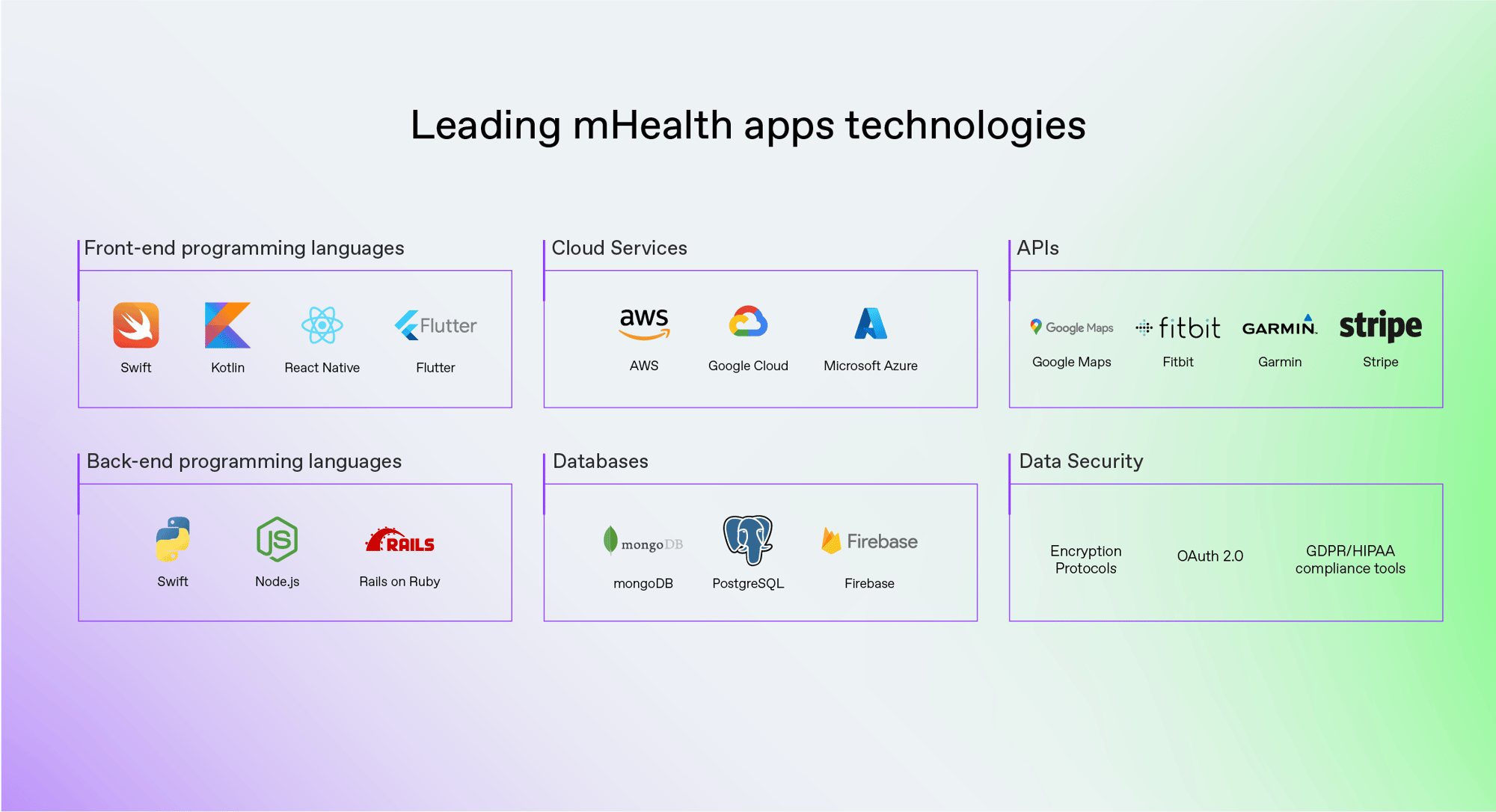
In addition to the mHealth app types mentioned earlier, several others effectively promote health and wellness. These include:
While the technical and business challenges of developing these apps differ slightly, common hurdles often arise. Understanding them is crucial if you plan to create your own mHealth application.
They define app goals, features, and roadmaps and check progress alignment with the assumed deadlines, budgets and milestones.
Responsible for the mHealth app infrastructure, they establish CI/CD pipelines for seamless code integration, automated testing, and deployment, ensuring app scalability and continued operation.
They integrate advanced algorithms and machine learning models to provide functions like image processing, predictive analytics, health behaviour insights, and other features for personalised, immersive, and safe experiences.
Security Engineers implement tools and policies to safeguard access to mHealth applications and their data, ensuring secure information exchange, minimising data collection and processing to only what is essential, and instilling effective incident response measures.
They build the app interface and server-side systems (responsible for data storage and management, authentication and authorisation, API communication, etc.).
Designers create intuitive and appealing interfaces to make your mHealth app easy and pleasant to use.
These specialists are responsible for data collection, processing and analytics, helping you build a stable, performant, and personalised app.
Essential in health-related products, they ensure adherence to health data regulations.
QA specialists test the app for bugs and usability issues before launching it.
I’ve already hinted at some challenges in developing mHealth apps. Here’s the full picture.
The impact of UX on app longevity and popularity is uncontested. In the crowded world of mobile apps, a staggering 20-25% are ditched after just one use. It's a clear indication of a deeper issue – poor user experience. In a study of over 5 million mobile health app reviews, researchers found that nearly 56% of users who had uninstallation issues and 52% who faced login problems (both UX-related) rated the app one star.
People download apps excitedly, lured by glowing reviews and recommendations, only to experience frustration upon opening them. A clunky design, confusing navigation, and a lack of guidance can instantly turn enthusiasm into disappointment. Often, they leave because they don't even know where to start. The onboarding is missing, and the layout is confusing. And it's not like there's no alternative in the marketplace.
Insufficient testing and inadequate post-launch support can significantly damage the adoption and retention of mHealth apps by undermining user confidence. Occasionally, this may result in spectacular yet harmless failures, such as the 2024 crash of a fitness, nutrition, and mental health app. It’s possible that no amount of stress testing could have foreseen the inflow of users when fans of Ronaldo flooded the mobile app stores.
However, in most cases, comprehensive testing and continuous maintenance can resolve major functionality, performance, and security problems before and after the release, ensuring reliable and smooth app performance and enhancing longevity.
In 2025, our lives revolve around mobile apps. From family chats through banking to managing our health, a small, smart device holds our whole story and all data securely locked. Or so we hope, as the likelihood of specialized cyberattacks has soared from 17% to 29% for iOS devices and more than doubled for Android phones.
For the 13th consecutive year (!), the healthcare sector has ranked as the industry with the highest costs associated with data breaches. The potential for attacks is virtually limitless, especially since these apps rely on multiple API integrations with other systems to deliver value, which broadens their attack surface. Furthermore, inadequate development and maintenance, and reliance on insecure networks, can create gaps in encryption and authentication, heightening the risk of cyberattacks.
The fallout could be severe if your app fails to uphold the security and privacy standards it is legally obligated to meet. In a study cited by the Wall Street Journal, 78% of mHealth app providers that experienced a data breach incurred reputational damage, and 75% reported that patient goodwill was affected.
The issue of security is related to navigating stringent healthcare regulations. In general, mHealth apps must adhere to strict data encryption, multi-factor authentication, and secure data transfer and disposal requirements. Access to data must be role-based, and logs of all operations must be kept.
The list of requirements is already extensive, and country-specific requirements complicate matters further. For instance, when launching mobile health or fitness apps in EMEA and North America, compliance with GDPR and HIPAA is essential. However, these two laws often impose different obligations. Let’s take the breach notification period; while EU regulations mandate notifying users of a data breach within 72 hours, US lenient laws allow up to 60 days. Hence, stricter standards should always prevail.
Additionally, states or countries may introduce own regulations. Germany has the Federal Data Protection Act, the Netherlands adds regional provisions to GDPR, and Finland may require further approvals from their Valvira licencing authority for digital health apps. It is crucial to assemble a knowledgeable cross-functional team to navigate these complexities and avoid potential multi-million dollar fines and loss of trust.
Building an intuitive, secure, and effective mHealth app is undeniably challenging, but a strong, capable team can overcome these obstacles. Assembling it is crucial but usually requires support to navigate its complexities. Why? The answer lies in data.
The latest healthcare report from The European Institute of Innovation and Technology, co-founded by the European Union, clearly highlights significant skills gaps that inhibit the growth of health organizations. There is an acute shortage of data analytics, software development, and artificial intelligence capabilities across Europe, creating a substantial barrier to healthcare advancement. This situation is equally alarming in other regions. In the USA, AON predicts a 10 million digital healthcare worker shortage in the next 5 years. Additionally, a starling 43% of Asian healthcare organizations surveyed by Global Data report a lack of digital skills among their professionals.
Dedicated, expert team augmentation effectively addresses those global hiring issues. Specifically, in the context of creating mHealth apps, partnering with an organization like ours offers the following advantages:
Launching a basic mHealth app can take several months, while compliance-heavy solutions require significantly more time. Dedicated teams streamline recruitment with an established framework, reducing your involvement and expediting project kickoff to start working sooner without upfront fees.
The term “dedicated” applies here to two things. First, our teams are fully dedicated to you, integrated into your business, and working with your employees. Second, they’re composed of specialists with healthcare and compliance experience who understand the industry’s unique challenges and user needs.
Dedicated teams, unlike freelancers or outsourced staff, foster genuine relationships from the hiring stage onward. Our Client Partners team guides you through, helping you select and seamlessly integrate successful candidates. We offer ongoing support to ensure you and the candidates are satisfied, contributing to our impressive 95,7% retention rate. This allows you to focus on other critical aspects of your mHealth app project.
Partnering with a dedicated team ensures you have access to specialists who understand healthcare regulations, user needs, and technical complexities. Additionally, team augmentation is one of the most time- and cost-effective ways of securing top tech talent in healthcare.
Nortal is a strategic innovation and technology company with an unparalleled track-record of delivering successful transformation projects over 20 years.

.jpg)