Search
Explore digital transformation resources.
Uncover insights, best practises and case studies.

Search
Explore digital transformation resources.
Uncover insights, best practises and case studies.
Stora Enso, a global leader in renewable packaging materials, has set its purpose to “do good for people and the planet.” The company combines expert forest management with innovative bio-based solutions that store carbon and support low-carbon construction. Its products enable circular packaging and advanced biomaterials that help reduce environmental impact. You can find Stora Enso’s materials in everyday life, from building and retail to food packaging and cosmetics.
Service
Industry
Globally, Stora Enso runs multiple highly automated packaging board mills that produce vast amounts of data through sensors and process automation systems. The company aimed to uncover hidden value in this data, boost operational efficiency, and create digital solutions that scale across all sites. Relying on centralized cloud services, however, sometimes led to unnecessary costs, increased latency, and the loss of important business context when harmonizing mill data in a single central cloud environment. To address these challenges, Stora Enso needed to bring insights closer to where the data originates.
A couple of years ago, Stora Enso’s cloud-centric data platform was delivering significant value, enabling robust centralized analytics and scalability. However, the enormous data flow from hundreds of thousands measurement points posed some challenges. High data transfer costs and latency made near-real-time analysis inapplicable in some scenarios. In addition, full reliance on cloud connectivity meant that any disruption could temporarily limit access to critical analytics and automation, including essential operational data. This dependency introduced potential risks to production continuity and safety and reduced optimization flexibility. Depending entirely on the cloud for analytics and decision-making also introduced a single point of failure, increasing operational risk. While the cloud remains a powerful enabler for advanced analytics and decision making, these experiences emphasized the importance of balancing cloud capabilities with resilient, complementary solutions.
As Mikko Leinonen, Stora Enso’s Lead Architect, Data & Analytics, explains, “Production processes are fast, and every second counts. It’s expensive and too slow to extract massive amounts of data to the cloud, especially for near real-time use cases.” For example, when debarking raw wood, near real-time computer vision enables optimizing the process so that no valuable material is wasted by taking too much, while avoiding quality issues by taking just enough. Cloud-based setups, however, often introduce delays that compromise the quality of such closed-loop adjustments.
Mikko Suominen, Stora Enso’s Solution Owner for Operations Digitalization, describes another challenge: “If we have a solution that steers a production process, we cannot rely on the cloud connectivity. It needs to be running even if the internet connection is down.”
To allow experienced engineers at the mills to work as efficiently as possible, it is also essential to adapt new technology to current processes and introduce as little disturbance to everyday work as possible. “Previously, when data was harmonized and integrated centrally in the cloud, end-users at the mills sometimes lost their familiar context to the data. This context is crucial for them to make effective decisions,” Leinonen explains.
On top of the imminent challenges from cloud dependency, scaling the newest technologies, such as AI, across multiple sites was difficult without a standardized approach, and deployment delays limited Stora Enso’s competitiveness. These shortcomings in the previously adopted approach encouraged Stora Enso to rethink its architecture and explore alternatives beyond centralized cloud systems.
To address its data challenges, Stora Enso partnered with Nortal and introduced a standardized edge computing layer in mill environments. What the companies jointly created was, in effect, a distributed mini data platform for mill operations. This approach enables data processing and analytics close to the data source, allowing real-time analytics and automation to run locally and reducing the need to send all data to the cloud.
Leinonen and Suominen describe that Stora Enso’s edge computing initiative is delivering several business benefits. Local filtering and data processing reduce cloud costs and bandwidth requirements. Mills can keep operating and making decisions even if cloud connectivity is interrupted. At the Oulu mill, for example, a visualization solution now shows real-time production KPIs directly on dashboards, helping employees make quicker decisions every day. Similar dashboards can be rolled out to other mills without separate projects, accelerating adoption and reducing project overhead, thanks to the standardized platform, templates, and applications.
“The idea is to bring holistic visibility and management to all our applications that we run across our mills,” explains Mikko Suominen, and continues: “The edge platform also standardizes application deployment, making it easier to roll out containerized solutions across all mills. Core services such as logging, security, and monitoring are built into the edge platform, which strongly supports compliance and risk mitigation across the mills.
Stora Enso can now provide local tools to site subject-matter experts and enable ad hoc dashboards and temporary insights. In the near future, AI-assisted tools enabled by the edge will help Stora Enso’s packaging board mills improve quality control and maintenance while optimizing processes, without delays or dependence on cloud connectivity.
Mikko Suominen emphasizes the importance of building any data platform with a long-term mindset. He also notes that it has been crucial for Stora Enso to adopt modular architecture and to use existing cloud services and open-source components. During all phases of development and deployment, management sponsorship and alignment at every level of the organization have been crucial.
Suominen explains that a key to success has also been that when the platform is scaled to new mills, the main driver is always a new application that delivers measurable business value to the mill. Instead of approaching mills with technology first, the edge platform itself is always just a side product of a business motive. Stora Enso’s edge solution was also designed for scale, meaning that while every mill has its own processes, the edge architecture and design principles work in different environments.
Both Suominen and Leinonen acknowledge that bringing an outside perspective on the project was very important to its success. Mikko Leinonen concludes: “With these kinds of things, it is important to hire a team, not just extra developer hands. Long-term partnership and flexibility have been key when working with Nortal.”
Mikko Leinonen, Stora Enso’s Lead Architect, Data & Analytics
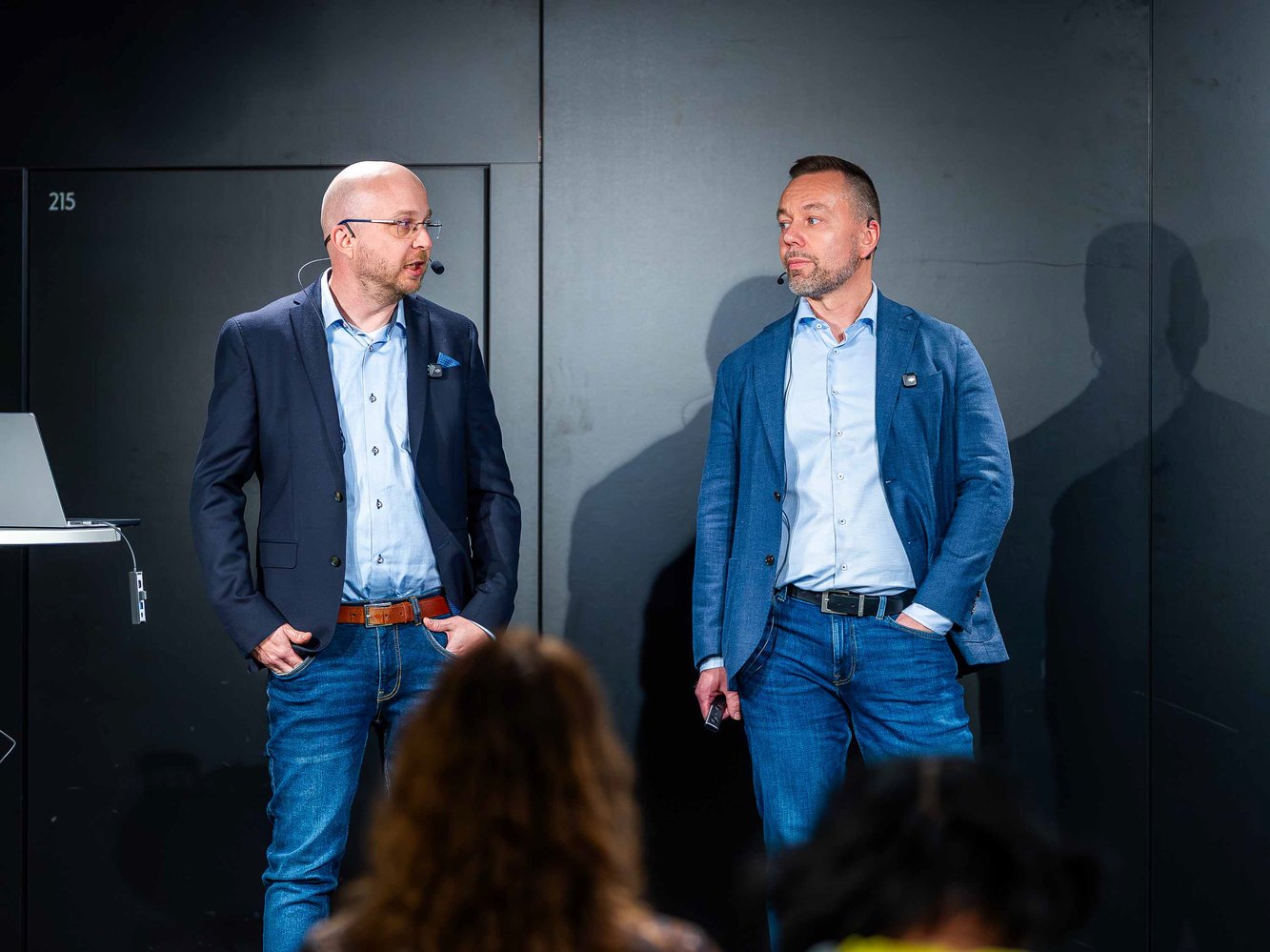
Learn more about this project by watching the keynote by Mikko Leinonen and Mikko Suominen, recorded at Nortal's Partner Event during Helsinki Data Week in November 2025.
Let us offer you a new perspective.