Search
Explore digital transformation resources.
Uncover insights, best practises and case studies.

Search
Explore digital transformation resources.
Uncover insights, best practises and case studies.
Learning used to follow a predictable path: study theory, take a course, get a certificate and then apply what you’ve learned. But in today’s rapidly shifting tech landscape, this model no longer works. The pace of change is so fast that theory often lags practice. By the time something becomes “established knowledge”, the world has already moved on. That’s why learning through experience, not just through academic input, is becoming the dominant trend in career growth.
In this edition of our Career Insights series, Iryna Mandziuk, Team Success Manager at Nortal Ukraine, explores what experiential learning really means, why it matters, and how it can be implemented both by individuals and organizations to stay ahead of the curve.
Traditional learning and certification processes tend to be slow. Courses go through writing, review and publication stages before they become available to learners. In technology, however, innovation unfolds directly in real-world environments, long before it is formalized in textbooks or certification tracks.
This creates a structural gap:
Tools emerge faster than courses can be developed.
New patterns take shape before textbooks can codify them.
Industry shifts occur before certification frameworks can adapt.
By the time a concept is recognized as “official theory”, it is often already widely practiced or evolving further. Relying solely on formal education, therefore, limits a professional’s ability to stay current.
To remain competitive, professionals need more than structured learning pathways. They need hands-on experience - experimenting early, reflecting on outcomes and adapting in real time. In dynamic fields, experience does not replace theory; it frequently precedes it.
Experiential learning means skill-building that happens primarily through:
doing real work tasks, not just completing assignments;
reflecting on outcomes, not just absorbing information;
iteration based on feedback and results, not memorized theory.
It’s not a replacement for formal education; it complements it. But the core shift is clear: action → insight → adaptation, rather than lecture → test → application.
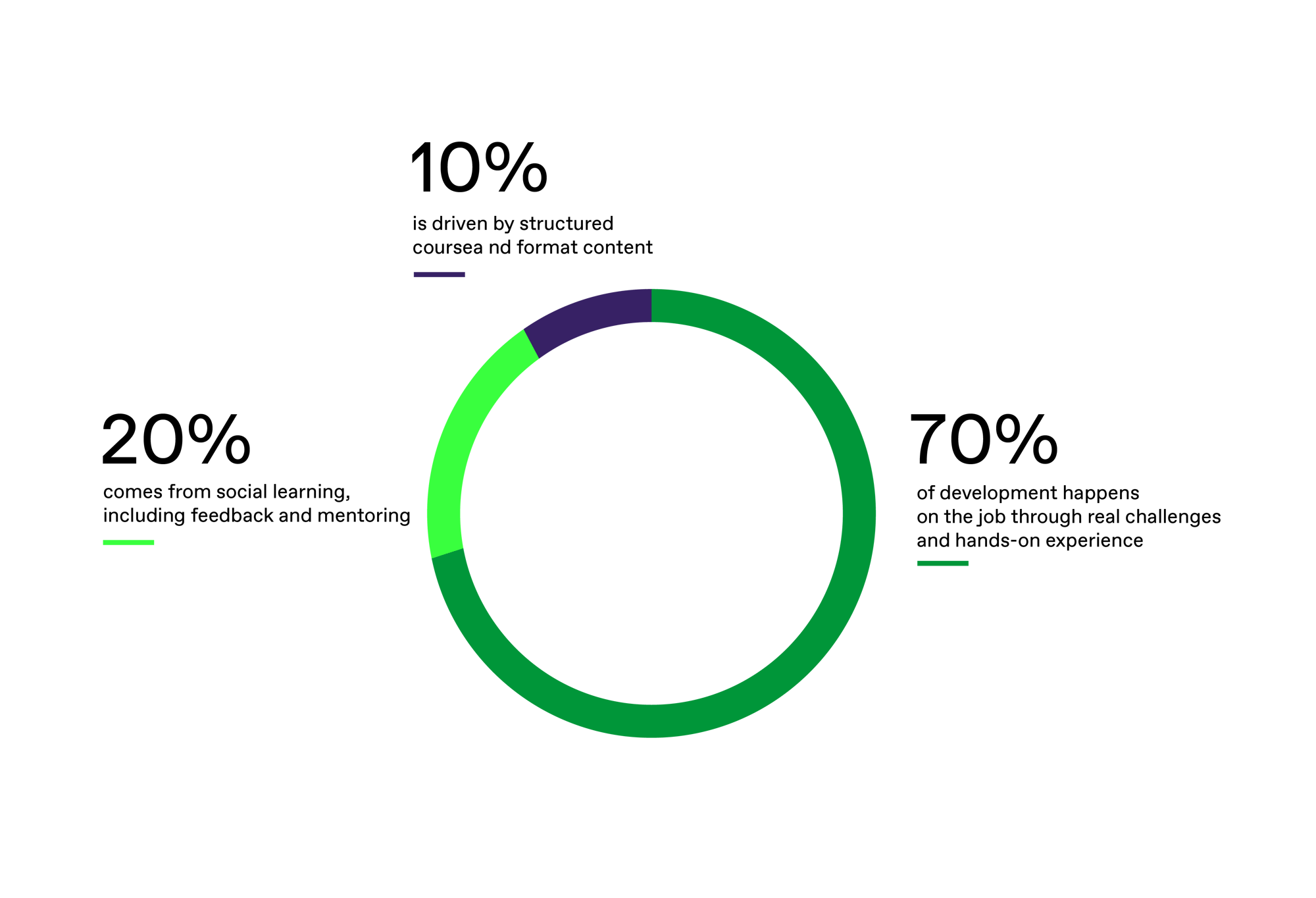
This approach aligns with frameworks like 70/20/10, which suggests:
In dynamic fields like tech, these 70% become the primary engine of growth because real-world problems cannot be fully anticipated by curricula alone.
Some companies claim to value learning, but only the ones that build environments where learning happens through work truly benefit in the long term. These organizations do several things differently:
If you’re aiming for a promotion or looking to develop lasting learning habits, these practical strategies can help you make the most of experiential learning.
Managers who champion experiential learning do more than assign tasks, they:
This shift from directive task management to developmental support transforms teams into learning ecosystems
In the era of rapid technological change, learning through experience is the key differentiator. Theory is important, but by the time it’s fully codified, the world has often already moved forward. The real edge belongs to individuals and organizations who learn while doing, experiment, reflect, and adapt faster than theory can explain.
Because at the end of the day, growth doesn’t come from having more knowledge. It comes from turning experience into wisdom.
Nortal is a strategic innovation and technology company with an unparalleled track-record of delivering successful transformation projects over 20 years.