Search
Explore digital transformation resources.
Uncover insights, best practises and case studies.

Search
Explore digital transformation resources.
Uncover insights, best practises and case studies.
Born from a hackathon challenge, this AI-driven project streamlines disaster relief by connecting real-time needs with the right resources faster and more effectively.
Service
Industry
Artificial intelligence is transforming how we respond to global challenges, and Dreamforce 2025 is the perfect place to witness that in action. Standing out among the many innovative experiences at the event, the Agents for Good Hackathon DF25 combines technology and empathy.
In this blog, we’ll explore the purpose of this hackathon, how we’re participating, and the solution we created to tackle a specific challenge—Global Aidgents, an AI-powered system that uses Salesforce Agentforce to make disaster relief more efficient, transparent, and human-centered.
Agents for Good Hackathon DF25 is an innovation challenge taking place at Dreamforce 2025, where participants build AI-driven solutions to tackle real-world issues around trust, equity, and inclusion. It centers on Salesforce’s Agentforce platform, an AI agentic framework providing the tools, guardrails, and integrations for building autonomous agents across Salesforce Clouds.
In this hackathon, teams use Agentforce to showcase how AI agents can drive positive social impact. Participants from around the world have collaborated virtually for weeks, with DF25 hosting the final presentations and showcase.
Dreamforce is all about learning, networking, and having fun. We’re here to make the most of our participation at the event—rolling up our sleeves and having fun while working on impactful solutions is a true win-win.
We come prepared with deep experience building Agentforce solutions in enterprise settings. In our day-to-day work, we’ve implemented Agentforce agents to automate complex business processes for corporate clients.
But this event is about collaborating and learning from others’ perspectives. We’re bringing open ears and minds to listen to challenges related to accessibility, inclusion, and equity, and to share how technology can make a real difference. The countless extra hours of dedication are worth it when the reward is seeing technology solve human needs.
The problem we chose to tackle is the mitigation of inefficiency in disaster relief donations and resource distribution.
When a natural disaster strikes, people’s generosity is overwhelming; money, goods, and services start pouring in. However, the systems for managing these donations could be fragmented, slow, or inefficient.
Multiple relief organizations and agencies could operate in parallel with little coordination, leading to a disjointed response. Funds and supplies could get spread across various relief organizations without a unified strategy, and critical information not always shared. As a result:
You might have noticed we’re choosing our words carefully to avoid generalizations. That’s because there are many organizations and individuals who make unbelievable efforts and carry out mission-critical tasks that save millions of lives.
We learned that during our research, but we also need to set the stage for brainstorming responsible AI-driven solutions. Let’s imagine a scenario: several NGOs rush to deliver food to one town, inadvertently neglecting a neighboring region in dire need. This lack of coordination means survivors don’t always receive timely aid, despite ample donations. The on-the-ground chaos of an emergency only amplifies these gaps.
From the donor’s perspective, there’s also a transparency problem. People give generously, but then what? Donors often have little visibility into where their money or goods go or what impact they ultimately have. Traditional relief organizations do their best to report back, but the process is opaque and delayed.
A donor might get a generic thank-you email or see a public report weeks later. In the modern era, that’s not enough—donors crave real-time reassurance that their contribution made a difference. They look for relief organizations with proven transparency and measurable results. There are several root causes of this challenge:
Donor drives, relief NGOs, and local authorities each use their own tools to collect and deploy help, and these systems often don’t communicate with one another.
One group might not know what the other is doing in real time. Managing incoming donations (whether money or supplies) and mapping them to evolving needs is still largely manual, relying on phones and spreadsheets that can’t keep up with a fast-moving crisis.
Data about what’s needed where (shelter, water, medical supplies, etc.) might exist in situational reports or government feeds, but it’s not automatically linked to donation pipelines.
In an era of AI and instant communication, some disaster relief efforts could benefit from smarter, more unified approaches.
Our project, Global Aidgents, is an AI-driven agent orchestration system designed to streamline disaster relief donations from start to finish. It acts as a central intelligent coordinator that brings donors, real-time disaster data, and relief organizations onto one platform.
In essence, Global Aidgents works like a smart air traffic controller for disaster aid: it constantly monitors what resources are coming in and where help is needed, suggesting the best direction for relief efforts.
We understand the importance of keeping humans in the loop as the ultimate decision-makers. While generative AI can uncover hidden patterns and process massive amounts of data in seconds, ethical dilemmas require human judgment.
Our goal is to ensure that humans are presented with all the relevant information to make informed and ethical decisions, especially in situations where moral principles may conflict.
As Josh Birk highlighted in his Mile High Dreamin’ keynote, “AI is a prediction calculator, not an ethical or moral one; humans must stay in the loop.” (Watch here)
Another key factor is accessibility and user experience, crucial elements when designing systems that must support such complex, high-stakes scenarios.

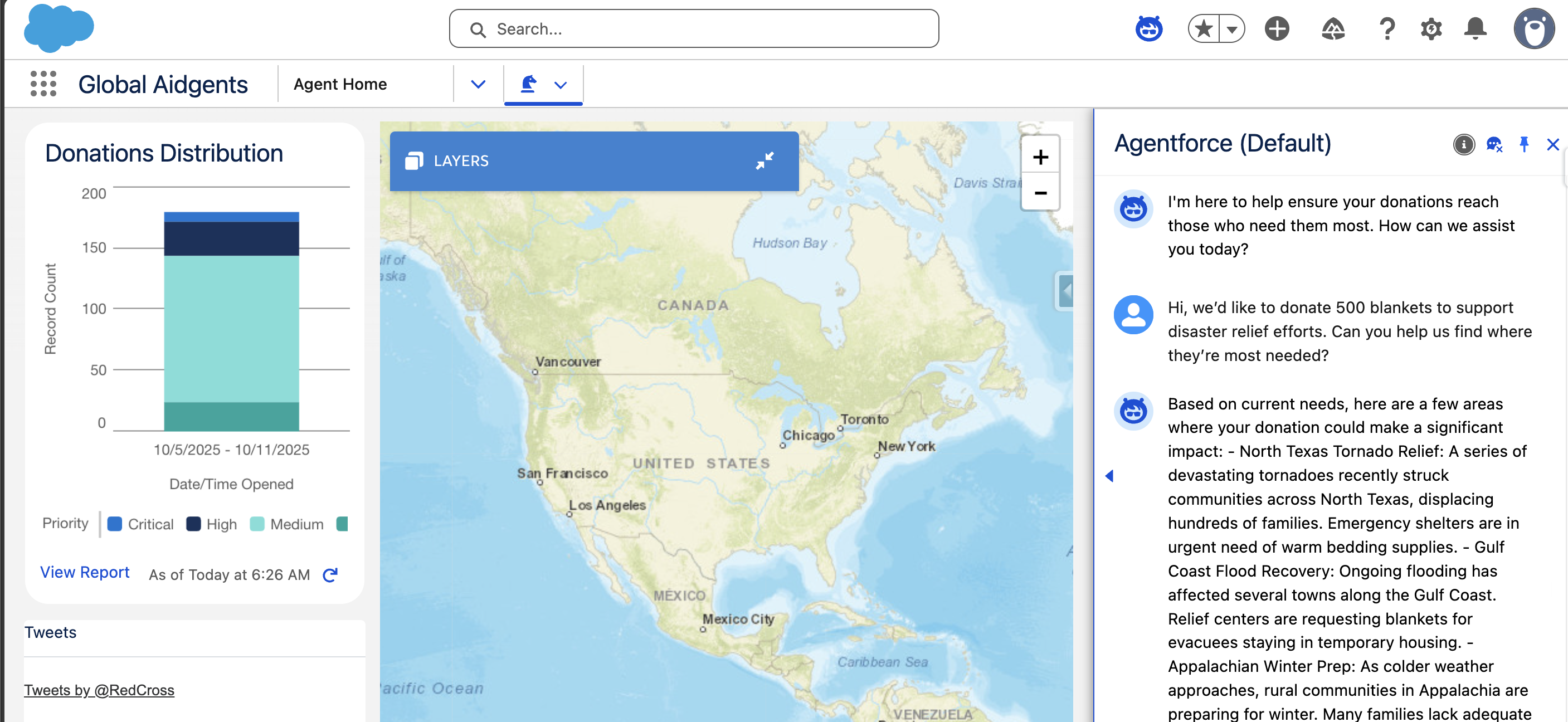
Imagine a hurricane scenario: in the immediate aftermath, people everywhere start donating via different relief organizations’ websites. Normally, these offers flow into separate organizations, often uncoordinated or even idle.
With Global Aidgents, all the pledges
are instantly captured and intelligently routed to where they’re most needed.
At the same time, the system pulls in real-time disaster data, analyzing:
This allows it to identify priorities such as:
So, that $100 from a donor in London? Instantly allocated to buy water filters and fuel for delivery trucks. The 500 blankets donated by a company? Flagged for delivery to shelters in District X once clean water distribution is underway. And a team of volunteer nurses in a nearby state? Automatically matched and routed to Hospital Y to reinforce medical staff.
Leveraging agent-to-agent (A2A) communication, we imagine a network of MCP servers configured to interact and democratize access to information, allowing humans to perform the final step in the allocation process.
Tools like Slack allow coordination between multiple organizations, making human connections possible for better collaboration:
Fun fact:
Thinking about the perfect solution before truly understanding the problem. Sometimes we’re blinded by a powerful solution promising innovation but requiring huge effort.
In our case, we thought sending an audio message to an Agentforce agent would be a differentiator. We explored Vive Coding Text-to-Speech API integrations and native browser capabilities, learning a lot in the process. However, we realized that the cheapest and easiest solution was to leverage the built-in dictation capabilities of computers or phones.
Nortal is a strategic innovation and technology company with an unparalleled track-record of delivering successful transformation projects over 20 years.