Search
Explore digital transformation resources.
Uncover insights, best practises and case studies.

Search
Explore digital transformation resources.
Uncover insights, best practises and case studies.

Authors: Andres Raieste (Senior Vice President – Public Sector (Global) Nortal), Pärt Ojamaa (Consultant - Human-Centric Public Services Nortal), Mihkel Solvak (Associate Professor in Technology Research, General Manager of IT Impact Studies).
The following paper discusses and suggests a vision for providing public services in a post-digital era. In this era, digital transformation and technological progress have lasted for decades, the foundations are mostly solid and time-tested, and society has matured to a level where almost everything is already digital.
It has become evident that the data-based society, the digital infrastructure, and general trust toward digital services and widely available skills are allowing society to rethink how public services (and the mechanisms that provide them) work and what value they create – today’s problems are different than a decade ago, but so is our ability to solve them.
We call this vision personal government for several reasons.
First, one of the most significant problems still to be solved in public administration and service delivery is to provide equitable and high-quality public services sustainably. Traditionally, only another human could render services in a way that felt human. But now, we can surpass human capability to deliver high-quality services while assuring the sustainable renewal of services. We have learned that by simplifying complex processes and the intelligent use of technology, we can increase public approval and efficiency – at the same time.
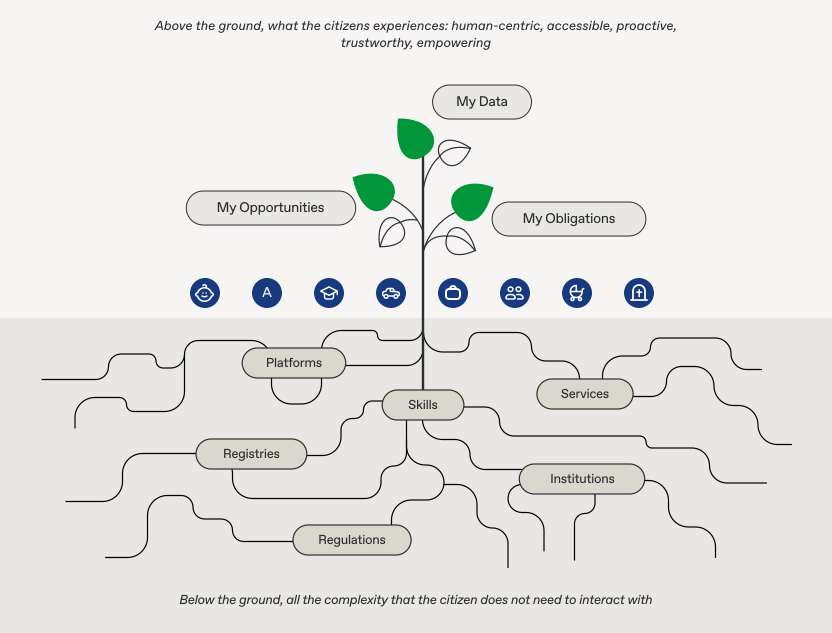
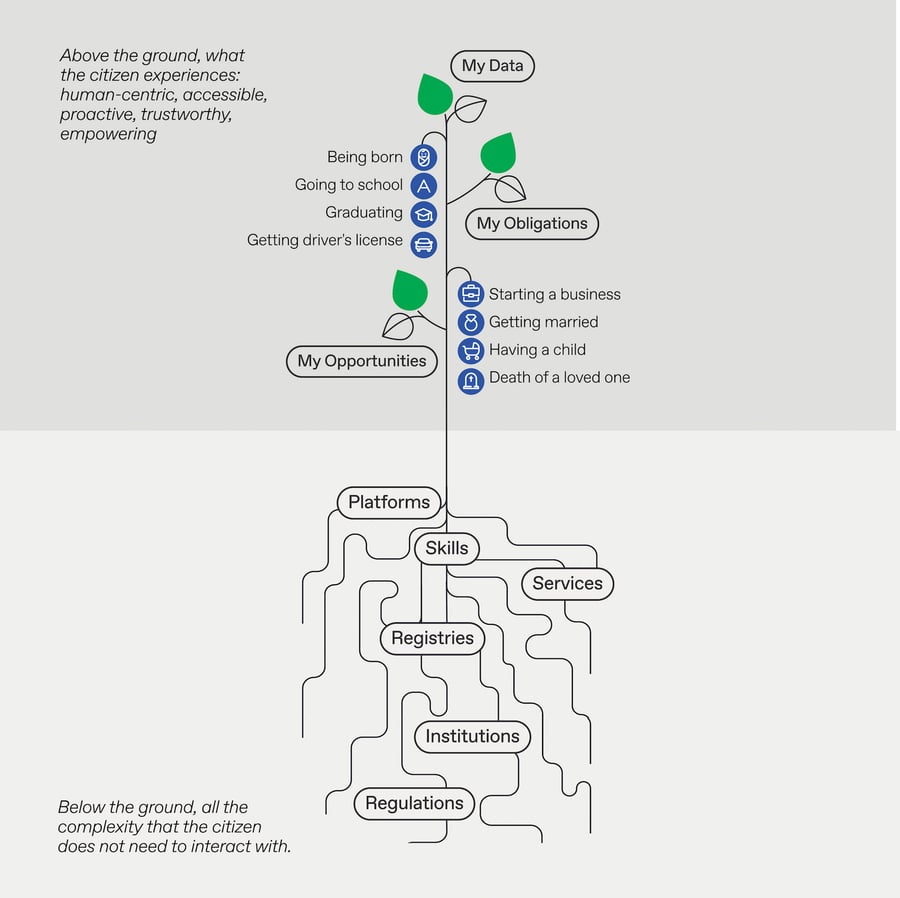
Most of this requires turning the traditional view of government, its plethora of regulations, rules, authorities, and services inside-out to focus on what the citizen should experience – their data, their contextual opportunities, and obligations, and reducing or hiding away everything else. We envision that the services will also be accessible to people who cannot utilize regular digital channels or are not native speakers. We argue that services should be proactive, anticipating the need and, in many cases, render the service invisibly, without the user ever noticing that the service was rendered. Our past experiences creating trust for digital services have taught us that it is possible to develop services that adjust to different individual beliefs and preferences toward data privacy and provide incentives that eventually nudge the citizens toward higher levels of trust. All of this will allow for the re-imagining of public services that will provide additional value, empowering their users with means that traditional services cannot.
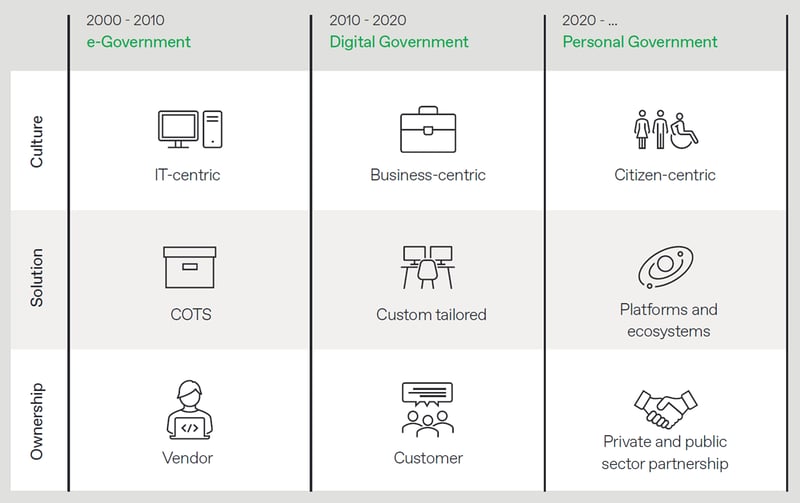
Second, we want to emphasize that during digital transformation, becoming digital was the point of emphasis. Now, while personal government requires and evolves from the strong digital government foundation, the emphasis is on simply providing a better public service experience and efficient public administration. In this, digital is the means to an end, not the point itself. Many organizations (including the World Bank and OECD1)have started to call the equivalent evolutionary step from the digital government era the GovTech era. We see personal government as the description for the outcome and GovTech as the general description of the emerging ecosystem of solutions, services, and approaches to building personal government.
e-Government
Enhanced traditional public services online. More efficient information processing.
Digital Government
End-to-end digital replacement of traditional public services. Whole-of-government approach to service delivery.
Personal Government
Citizen-centric digital-first new type of services and capabilities without traditional analogs. Whole-of-society approach to service delivery.
The journey toward personal government is already on its way in several societies. While this paper discusses mostly the desired outcomes and impact of personal government, it also proposes known and explored key capabilities to create it. We discuss ways to establish services that enable citizens to retain control over their data and its usage to build trust. We discuss means to organize public services from a government-centric view into a citizen-centric one. We point out how modern approaches to platform services can be utilized to provide a seamless experience for citizens to get the most suitable services and create a marketplace for service delivery to drive innovation. We discuss how AI will play an essential part in providing efficiency and quality in service delivery in ways where current approaches struggle. And we discuss that the renewal of services also depends on updating how public services are developed and delivered.
Personal government vision is also relevant to societies that have yet to develop a mature digital government. Setting personal government as a societal goal will allow us to skip some expensive and time-consuming lessons and steps along the way and focus on the original goal – to provide better and more efficient public services for citizens.
For the past several decades, the gradual adoption of new technologies in society and the digitalization of public services has allowed many nations to increase the efficiency and approval of public services. However, the maturity and impact of digitalization vastly differ based on how widely society has adopted new technologies and services into everyday life.
In more advanced digital societies, being digital has become an innate property of public services themselves, setting both expectations and requirements for the government to make life easier and more efficient for its citizens. Young people already expect the state to be an active party that informs its citizens about various opportunities and enables them to manage everything quickly, efficiently, and in a user-friendly way.
But the world has become more complex, and today’s social concerns and global trends force governments to rethink how to offer public services in the future:
Migration, multiculturalism, and an aging society create a new need for social cohesion and bring the sustainability of public sector services into the spotlight. How can the state provide services to all social groups with equally high quality and without discriminating against anyone? Trust in the state and the democratic process is strongly associated with a consistently high quality of public services. The state must be able to provide services of equal quality to people based on their individual beliefs and preferences.
The constant accrual of regulations, services, and processes has made the state difficult to perceive for many. It has also increased social division, reduced efficiency, decreased the quality of services, and slowed innovation. To reduce the complexity and make the government comprehendible for the people, it’s necessary to rethink elements of the government that predate the digital revolution.
Digital society has come of age and enables entirely new service models that often outcompete traditional services. This trend is supported by the overall personalization and provision of platform services that have taken place during the last decade, mostly beginning in the private sector (e.g., the emergence of FinTech, GovTech, sharing platforms, etc.). Public services will benefit from these trends.
The global focus on sustainable development puts an impetus on reducing governments’ ecological footprint while maintaining service levels and quality. An advanced digital state has accrued enough data and data governance processes to aim for unattainable efficiency gains in service delivery. Rather than a blanket one-size-fits-all approach, data-driven personal state promises to offer services efficiently and much more needs-based, thus reducing the overall footprint of public service delivery.
Personal government is a vision that considers the next stage of already developed digital societies to provide more human-centric public services, considering the complexities where traditional digital government approaches do not necessarily provide a straightforward solution.
Personal government is a human-centered government where society is integrated, and services are reliable, function sustainably, and constantly renew to meet society’s changing expectations.
The key goals of the personal government are:
Social cohesion
Demographic changes and diversification bring along the need to provide more human-centered services. If traditional services could only serve the social groups these services were created for, public services through the personal government can involve and address each individual in a way that suits them. That way, personal government increases social trust, equity, and cooperation between different parties, supporting and strengthening democratic processes and social cohesion. Trust is both a means and an end to governing.2,3 High trust makes a service more effective in bringing about the desired service outcome – a citizen needs to be taken care of with their input and voluntary effort. But it will also make society a more effective working unit with less need to regulate and control – a virtuous circle.
Renewal of services
In a rapidly changing and diversified society, personal government creates the prerequisites for the ongoing renewal of services. Personal government reduces the complexity of regulations and institutions, finds the right owners for services, and creates conditions for competition and a marketplace for services to drive efficiency, effectiveness, reliability, and innovation. Personal government as a platform can be considered an ecosystem that automates finding a better service supply and demand fit by allowing services to be constantly tested as perpetual betas, where only versions that optimize the abovementioned criteria come out on top and are taken up by citizens at scale.
Sustainability
Personal government must consider the demographic situation and create the conditions for serving more people with fewer officials. Personal government also helps to achieve green goals, increases the effectiveness of the government, and offers added value to the citizens. The ambition is that personal government achieves further efficiency, growth at least as significant as the first broader wave of digitalization.
These goals will be achieved through rethinking today’s public sector services and the mechanism of the state apparatus that provides them.
The largest differentiator in different maturity levels is how the society has established trust in digital services and high cooperation between authorities and citizens to establish a solid data-based society and governance.
In societies where the fundamentals of digital governance have been resolved to a reasonable extent, new types of services that cross-cut governance domains start to emerge that, as a rule, do not have direct traditional analogs.
To investigate the possibilities of public services in the era of personal government, we suggest 5 key traits that help to characterize the value of public services in that era. These traits have been selected based on analyzing and categorizing examples of innovative and more efficient public services with high public approval.
We envision public sector services to be:
We argue that to prove more personalized and human-centric services, we need to turn the traditional view of government, its plethora of regulations, rules, authorities, and services insideout, to focus on what the citizen should experience – their data, their contextual opportunities, and obligations, and reducing or hiding away everything else.
We envision that the services will also be accessible to people who are not able to utilize regular digital channels or are not native speakers. This will increase equity across all social groups.
We argue that services should be proactive, anticipating the need and in many cases render the service invisibly, sometimes without the user even noticing that service was rendered.
Our past experiences creating trust for digital services have taught us that it is possible to develop services that adjust to different individual beliefs and preferences toward data privacy and provide incentives that eventually nudge citizens toward higher levels of trust.
All of this will allow the re-imagining of public services that will provide additional value, empowering users with means that traditional services typically cannot.
We consider these the key principles based on which to rethink the value of existing public services provided to its users.
The service provides what one expects from it, is simple and transparent, and reduces the communication load from citizen to state and state to citizen. The service does what one assumes the service will do. The service is provided based on the needs one feels due to the events they experience (in life or business), not based on state functions.4 People experience and comprehend the government through the data the government knows about them, their obligations, and their opportunities, not through difficult-tonavigate regulations and a vast plethora of state authorities with a division of responsibilities and corresponding services that might not always relate to each other. A human-centric service is designed to minimize the time spent away from anyone’s core activities, whether work, study, business, or family leisure.
The service is accessible to anyone for whom it is intended and through the most suitable channel for them without losing quality. The state must create the preconditions that enable it to offer the service through different providers and channels according to the consumer’s abilities and preferences.5, 6 The service is designed to maximize the customer experience and outcome exhaustively, meaning any other activities or duties that arise out of that particular service being accessed are also addressed by either providing guidance for the next steps or asking for permission to trigger related services. An accessible service also acts to level the information playing field between citizens so everyone can take advantage of the same opportunities if they wish to do so.
Generally, a user does not have to initiate the communication to consume the service. If a person has expressed their consent, the service is rendered automatically, and communication is initiated by the service when needed.7 Proactive services either eliminate applications and forms or make the processing of them immediately based on a transparent algorithm.8 Proactive services increase user satisfaction and the efficiency of the service (and, more widely, the effectiveness of the underlying policies) for both the government and the citizens.9, 10 As a result, the proactiveness also frees the most precious resource – our time – to engage in activities that bring private or public value and additional economic and social benefits.
Other than reliability and added value to the citizen, trust in public sector services, the state, and society largely depends on transparency11 and whether people’s data is handled ethically.12 Public sector services are transparent and straightforward – this means that the following is simply and comprehensibly explained to everyone: which service they need in any situation, what laws and rules apply in these cases, and what kind of data is used to make decisions. In addition, it is clear how personal data is used to provide a better service (considering an individual’s preferences for transparency and privacy).
In exchange for trust, the service offers added value to the user and guides them to a preferred behavioral pattern, a changed motivation, a negative risk managed, or an offered opportunity taken and realized.13 The more the citizen trusts the service, the more effective it is in bringing about these desired outcomes, as for most services, the citizen is not a mere passive receiver14, 15, but an active creator of the outcome and societal value the service is supposed to bring.
These traits also help plot a course for the renewal of services.
| Public service key characteristics | e-Government | Digital Government | Personal Government |
|---|---|---|---|
|
Human-centricity
|
Public services are state-centric – while information portals exist, citizens need to know where to get what service. |
Almost everything is done via digital means. For most things, citizens do not need to visit a state authority. |
"I do not need to know what state authorities and services exist – everything is organized around me and my life." |
|
Accessibility
|
"While I get information on how the services work, I mostly need to visit a government office to get what I need." |
"I can get all major things done through online channels 24/7." |
"I can get all major things done when I need it through the channel I prefer." |
|
Proactiveness
|
Proactiveness is limited to providing information to the citizen. Some information can be submitted on a form or an application to speed up service delivery. |
Services provide mostly automatic (real-time) outcomes to inquiries and needs. Forms and applications are becoming obsolete. |
Services are initiated automatically when the government knows the citizen is eligible. Some services are predictively rendered or entirely made invisible. |
|
Trustworthiness
|
Trustworthiness is mainly limited to providing information about how data privacy is assured and how the service works. |
The citizen is provided transparency and control over the secondary use of their data. |
Services explain how and what they use data for and what additional benefits can be used if the citizen trusts the service more. |
|
Empowerment
|
The citizen is notified of opportunities available to them, but they need to know where to look. |
The citizen is provided with context-specific opportunities that are relevant for them. |
The citizen understands all their specific value-adding opportunities in a single source of truth. |
The full realization of the goals of personal government requires the adoption of emerging technologies and the reorganization of the government’s working principles in terms of service provision and cooperation between institutions.
The most essential capabilities for realizing the goals of the personal government are the following:
Ability to create trust toward personalized services through providing data ownership, control, and transparency to the citizen.
A person sees their opportunities and obligations, not services and authorities.
Through platform services, the government opens the market for offering value-added public services.
Wide application of AI to provide more human-centered and efficient public services.
Continuous renewal of the services to ensure their efficiency, effectiveness, and public approval.
All these capabilities are either already well within today’s technological development or within reach and can be realized in the foreseeable future.
Ability to create trust in personalized services by giving citizens data ownership, control, and transparency
Trust is defined as a willingness to believe something or someone will act in our best interests without being fully able or wishing to control that this someone or something really does so. In other words, we trust someone or something, such as a service, to deliver what it promises and to perform consistently with high quality. In a personal government, a person has control over and an overview of their data; they can organize and renew their data in one place and, if desired, share their data with third parties. They still need to trust the service to perform to use it, but they should have the means to control this if they wish to.16 This means that trust has a functional role in personal government; it ensures that citizens can easily use services and do not always need to control every aspect of it.17 High-trust societies are more efficient and wealthier due to this.18, 19 But citizens should still have the means of control if they choose not to rely on trust only.
The widely known principle of requesting data only once (the “once-only” principle) requires cross-use of data and that the same data is not asked multiple times if it already exists in another register. This principle has been essential to developing interoperability and modern digital public services that provide a better experience than a traditional counterpart.
However, the “once-only” principle does not guarantee that the data will always be timely and correct. Therefore, in today’s data society, we see that a person should be liable for the correctness of the data that forms the basis for determining their opportunities and obligations. The government, in turn, is responsible for ensuring that a person’s data is used for the intended purpose and according to their personal preferences for what purpose their data can be used. Such a relationship of trust is the first prerequisite for a personal government. This determines the quality and added value of the service that can be provided to a person. For many value-added services, consenting to some specific privacy options is necessary.
People must be fully informed and empowered to change their preferences when making these choices. At the same time, it is also essential that the consent to use the data is not limited to a few individual institutions or specific services but that the use and analysis of data also enable the creation of broader added value in society.
A person sees their opportunities and obligations, not government services and authorities
One of the oldest problems with public service delivery is the complexity for the citizen to comprehend the totality of available services and regulations. Various service catalogs have somewhat lessened the issue but do not solve the root cause – the complexity for individuals to navigate the government to understand and access the services available to them.
Resolving this problem requires turning the government inside out and making the person perceive the government as a single entity, not a group of different authorities that provide services. The person experiences their data, obligations, and opportunities instead of the many public services, authorities, and systems that provide them.
This approach also suggests grouping different public services behind a more citizen-centric and holistic view of events in a person’s life. These life events make the complexity of the government and the multitude of services tangible for a person. This approach flips how the state and citizens interact by taking a client-centric and holistic view, where the life event needs to be covered with a service response endto- end.20
For example, previously, several services related to the birth of a child (birth registration, naming, social benefits, etc.) had to be sought from various state institutions. The event service related to the birth of a child allows one to do everything at once without having to know what services exist and what authorities provide them. This way, the person does not need to comprehend the totality of the government’s complexity and sees the public services more from their point of view.
This approach is complicated by the fact that the way government institutions operate often comes from the pre-digital era.21 A mature digital state allows us to cross institutional and domain boundaries with relative ease as the data, not the client, needs to move between them, so we are no longer restricted by the historical setup of how state agencies operate and divide their responsibilities. Different whole-ofgovernment and interoperability approaches suggest policies and reforms to reduce institutional complexity and align institutions and regulations to match the renewed services better.22
Through platform services, the state opens the market for offering value-added services
User tests and studies have shown that service consumers don’t particularly care whether a service is a state service, a local government service, or offered by a private company – people are primarily interested in the service’s availability, quality, and price for the end user. People are often willing to pay more for a better service with added value.
Therefore, to get a complete service experience, it is reasonable to develop platforms that can integrate different service providers of the same service23 and offer a unified service experience without the need for the user to think about the service provision process.24
For example, suppose there is a service for finding a suitable kindergarten for a child. In that case, a unified platform enables finding a suitable place for childcare both from the local governments and private kindergartens that have joined the service. At the same time, the user is offered a smooth transition between government and private sector services.
The user can focus on the important goal – finding the best kindergarten for their child – and does not have to deal with communicating with different institutions. To provide added value, follow-on services can be offered as well. These allow for a combination of several services – for example, ordering medication for an older adult at home, ordering transport to and from a treatment facility along with booking an appointment, or for a child, in addition to a kindergarten place and transportation there and back.
Platform services also enable the state to purchase fully or partially from the private sector. The government-as-aplatform strategy creates the prerequisites for separating public service from the basic registers and data. The state provides the data and access to market, but the user interface, service design, and delivery come from whoever offers the best value to the customer.
This approach also creates natural competition to offer the best service and creates prerequisites for service innovation. This overall approach leads to the government creating a market for service delivery, which may create entirely new industry verticals and added value to the economy.
Wide application of AI to provide more human-centered and efficient public services
In the long term, AI is important in providing efficient and sustainable human-centered public services. The three main areas of use of AI in the provision of public services are:
Automation of decisions based on large amounts of data. Automating service delivery where data completeness and simple connections enable rule-based decision-making is relatively easy and has been the basis for automation for decades. However, in situations where the amount of data is enormous, but the connections are fuzzy, AI often has the advantage of speeding up the decision-making process or completely taking it over with the human government official moving into a supervisory role, making sure that AI is basing its decisions on correct data and resolves escalations. Implementing AI does come with its risks; therefore, public use of AI can make decisions where, based on the level of risk, AI is allowed to make decisions instead of a human. In risky scenarios, AI mostly remains in the role of decision support (e.g., when making a medical diagnosis) for now until it has become clear that the collective breadth of available information and the ability to make informed, traceable, and ethical decisions, vastly outperforms what any human can do.
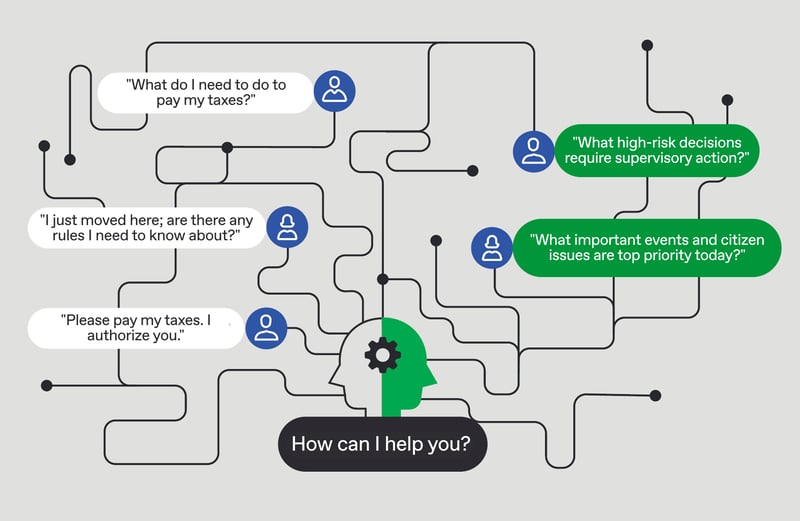
A personal public servant for every citizen. Every person and entrepreneur will have their own virtual public servant, helping them understand a large amount of information simply and efficiently and consume services appropriate for that person. For example, the service can clarify the opportunities and responsibilities of a person (“I have two children; what tax differences and subsidies affect me?”) or help find an appropriate service (“I witnessed a misdemeanor – where do I report this?”) and explain it in such a way as is best for this person (for example, in a foreign language). It is also possible to delegate decisions to the AI and automate services. For example, a person asks AI via an app or a phone call if they have unpaid obligations to the state (e.g., parking fines) and can delegate AI to fulfill such obligations
Virtual assistants for public servants to improve the quality of public administration. The ever-increasing amount of data also requires better services to improve the quality of public administration. Here, too, AI will play a critical role by enabling a faster overview of a large amount of information, better identifying the places that need attention, and assessing how effectively policies and services work. AI will create human-language summaries of important events, problems, and necessary routine decision-making points for officers and state leaders without spending as many hours as are needed today. Thereby, the officer’s work becomes more strategic, directing their focus where AI cannot help.
Continuous renewal of the services to assure their efficiency and public approval
The renewal of services is mainly related to the state’s ability to constantly understand changing user preferences and the state apparatus’s ability to update both services and the state apparatus itself quickly enough.25 The services must continuously change and develop over time as demographic changes, changes in consumption habits, the influx of new trends, and several other aspects influence and design society’s expectations of public services.
Many organizations have reconsidered how to constantly renew their services and, through that, also renew the organization providing the service. In a personal government, the service authority can continually assess the quality and effectiveness of services and feedback, consumer base, and demographics changes, and continuously re-prioritize the organization’s resources and development needs according to the market and users. Personal government itself is agile and can develop services expeditiously. The development of platforms and creating a market for services further drive service innovation and renewal.
This, of course, can be particularly challenging in the public sector, where, traditionally, state apparatuses have been relatively static in structure. Services are often linked to budget structures and a strict framework, which generally does not allow them to react quickly to changes in consumption and the market in terms of changes in the volume and quality of services.
To tackle this difficulty, different mechanisms have been suggested to approach the renewal of services in a digital society. In general, often suggested approaches can be categorized into the following:
Service needs to be developed and operated by the same entity. This ensures an efficient feedback cycle and long-term knowledge that will guarantee continuous growth.
The service delivery organization structure must be fluid, allowing the shift of capacity related to service delivery when needed.
Services are in a perpetual beta format, with inbuilt A/B testing for live services to constantly adjust services for a better supply-demand fit and higher effectiveness in bringing about the desired service outcome.
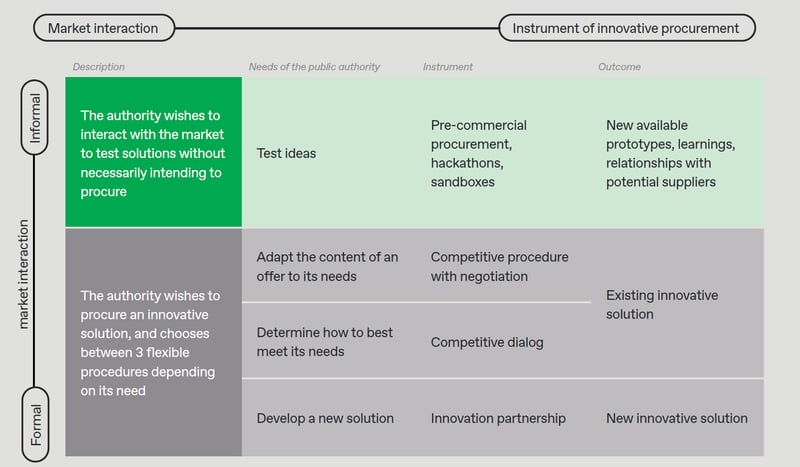
Introduction of innovative procurement mechanisms. Services and solutions relevant in the era of personal government are often building new capabilities and services that do not have earlier counterparts, thus also requiring newer procurement mechanisms.
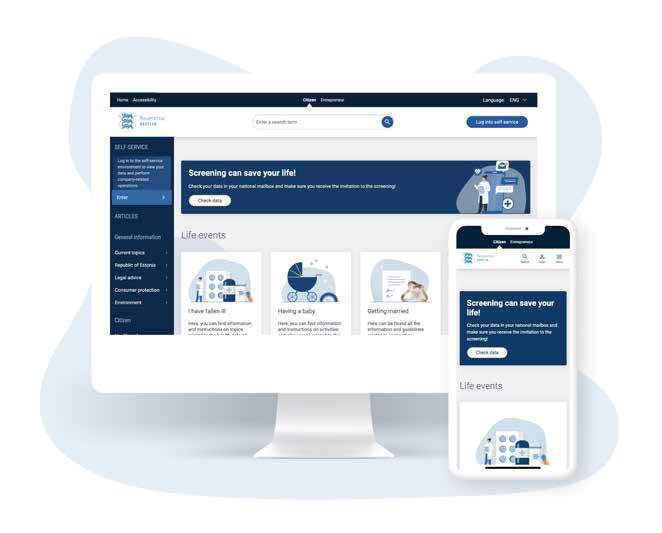
The Estonian state portal eesti.ee is also a good example of the journey toward a more personalized approach to providing citizens with public services.
The state portal serves as a comprehensive resource for both Estonian citizens and residents, providing guidance for various life events and detailing the opportunities accessible to them as individuals. The distinctive and user-friendly aspect of this portal is its life-event-centered approach to service delivery. Citizens don’t need to figure out which government authority provides which service. By concentrating on general subjects like “family” or “business,” the portal presents an array of related services, irrespective of the government authority in charge of those services.
Almost all government services are end-to-end digital in Estonia, from family matters and residential changes to car purchases and pension enrollments. By logging into the portal www.eesti.ee using an ID card, Mobile-ID, or Smart-ID, individuals can view personal information, such as their Population Register data and family doctor details.
This centralized platform offers a variety of state digital services and consolidates information on documents, property, vehicles, and children, ensuring data is current and accurate. It’s particularly user-friendly for those who prefer mobile devices, as it boasts a responsive mobile interface.
Additionally, the portal facilitates direct communication with public authorities. Inquiries made through the portal are either addressed by the user support team or forwarded to the appropriate department, easing the process for users.
Estonia’s approach to data management involves a decentralized, distributed system. The data isn’t stored on the eesti.ee portal but is shared via the “X-road” data exchange and interoperability system (the development of which is funded by several countries and governed by Nordic Institute for Interoperability Solutions inter-governmental strategic governance body). This gives individuals the power to oversee their own data, allowing them to monitor who accesses their information, from which database, and for what purpose.
The first generation was simply an information portal describing how the government works and what authorities exist. The value mainly was to ensure that the person would know where to get service.
The second generation became aware of the user and started to provide more contextual information about what is relevant, as well as the ability to subscribe to different information and refer to already emerging digital services that allow to at least create a transaction online. However, the portal’s value was still mainly to forward the user to the actual authority that provides the service.
The third generation transitioned the service from an information portal to a digital gateway, focused on not explaining how the government works but getting everything completed online without ever or rarely having to visit a government office. A true one-stop shop in the digital government era. But, the service portal was still organized based on government functions, and the complexity of comprehending individual opportunities and obligations still needed to be solved.
The emergence of the fourth generation started with the need to simplify the user experience further. Concepts such as proactive and life event services have allowed further improvement in the ease of use and efficiency of public services. As personal devices have overtaken the preferred channel for service consumption, the service is also becoming channel agnostic, providing the same high-quality experience across different devices. Services are “integrated” through an AI conversational agent layer, Bürokratt, that extracts citizen needs and wishes from voice or text and guides them to services or performs service request-response queries directly.
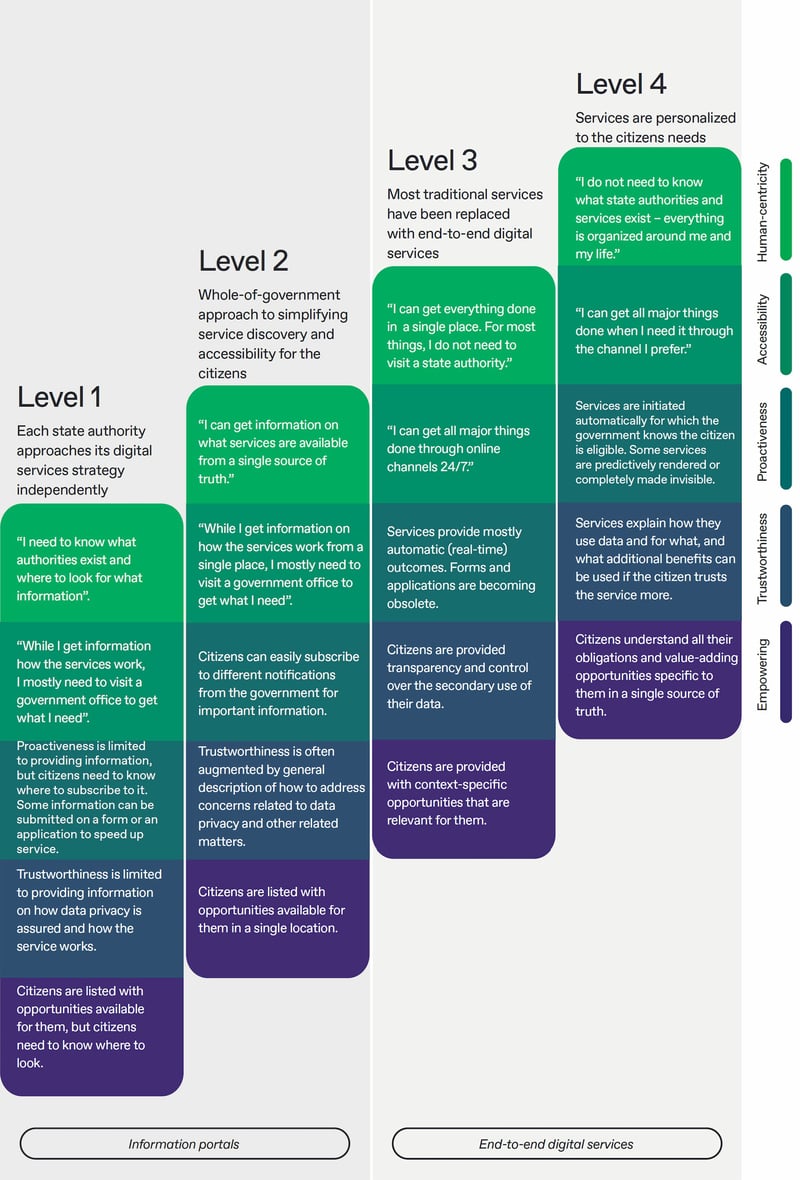
We have plotted a general maturity model of digital public services portals based on the journey of specifically eesti.ee and the overall progression of other digital gateways and state service portals. The model differentiates information and end-to-end service portals and compares the different approaches regarding service value and outcomes for the users.
Imagine one day in the life...

The year is 2030. Mart, a 48-year-old music teacher – and his daily life
The alarm clock rings, and Mart opens his eyes. Beside him is Eeva, next to whom he has woken up for the past 21 years. Since some of their children are already grown up, the pace of Mart’s and Eeva’s weekdays has become slower in recent years, and Mart now has more time for himself in the mornings. He prefers to spend it reading the news and e-mails over coffee and breakfast.
Even though the street Mart lives on will be closed today for road work, there is nothing unusual about this day. Morning rituals are done, and Mart rushes to work. He doesn’t take the bus today but opts for a scooter because of road repairs and traffic jams. The day passes normally, and by 4:00 p.m., Mart is already home. Since Eeva works as a nurse and typically has longer hours, Mart usually makes dinner. This time, Mart also brought flowers from the florist and placed them in the middle of the dining table – as it was their wedding anniversary. Even now, when only their youngest son Joel is living at home, this part of the day is the most important for Mart, as the whole family is together.
During dinner, they talk about their day. Eeva would like their son’s kindergarten closer than the current one. This would mean less time spent taking the child to school in the morning. Together, they discuss the possible options for kindergarten and the reorganization of family logistics. Mart mentioned that he didn’t like one new piece of draft legislation, and they debated which amendment to the law would be better. In the evening, they go to Mart’s mother’s to take her the package Mart had received since their last visit. It was an entirely typical and beautiful day.
This is what personal government is. Nothing out of the ordinary. Daily actions, the center of which is not technology or the government, but a person and their daily life. However, the following happened in the background at the same time:
When they woke up in the morning, Mart and Eeva had already been notified about the start of extensive road work near their home. In addition to the dates of the road work, they were also informed about recommendations for traffic in the area and the best type of transportation to take. It is in the city’s best interest that citizens get to work on time and are not stuck waiting in traffic jams. When offering services to its citizens, the municipality relies on nationally approved green goals, according to which urban traffic can be optimized, and resource-consuming, polluting traffic jams that paralyze the city can be avoided. With proactive notification, the municipality directs Mart and Eeva to favor a much more environmentally friendly means of transport. It empowers them to choose the most suitable trajectories aligned with current circumstances.
Eeva was looking for a new kindergarten possibility closer to home, and this information was passed along to all kindergartens to connect to the “I need childcare” event service. This allowed all kindergartens in the area to manage their capacity better proactively, and soon, Eeva was notified that a kindergarten had become available in one of the private kindergartens closer to their home. A kindergarten closer to home means that mornings with the family could be longer, and the stress of getting to work on time would be less. All of this is important for maintaining balance in a family’s life. Also, the state is interested in people living comfortably, with all vital services accessible as optimally as possible – this reduces costs and waste of resources from both the state’s and the citizen’s point of view.
During the day, Mart was invited to review a new draft bill that would affect him. Mart doesn’t have the time, skills, or patience to read through the entire bill, so the personal virtual assistant summarized the effect of the new law specifically for him in a language and manner that is understandable to him. He was able to give feedback immediately, and Mart used this opportunity to send his own proposals and comments while sitting on the bus on the way home from work. He knows that his proposal will be considered by the AI processing the feedback, which will extract the essential aspects from Mart’s and other citizens’ input and formalize the citizens’ proposal to the government on that basis. That way, Mart participates in the democratic process of society and feels involved in important social processes as a citizen.
Mart’s health portal informed him about receiving his mother’s lab analysis report. From the summary of the analysis data made by AI, which is easy for an ordinary person to read, Mart discovers that his mother’s health condition has deteriorated a little. He follows the algorithm’s recommendation to visit his mother to offer her some human closeness and reduce her feelings of loneliness. Mart thinks that delivering a book he ordered for his mother is an excellent reason to visit her with the whole family – seeing Joel has always made Mart’s mother happy. Mart tells the ride-sharing app that he wants to visit his mother’s house with his family. The app orders them a car with child safety equipment, and the car knows precisely where to go.

The year is 2035. Zuzu, 37-year-old journalist
Zuzu was laughing. At this couple’s counseling session before their divorce proceedings, the counselor hit the nail on the head with the words: “Karel is very similar to Mr. Darcy in Jane Austen’s novel ‘Pride and Prejudice’ – enigmatic and intelligent. At first, he seems arrogant, but his gentler and romantic side later opens.” The counselor’s description of Karel was sympathetic – as the counselor, after all, had access to a wide array of therapy literature and all world literature as well – the upside of being an AI. It’s hard to compete with that, they both agreed. At least the counselor no longer suggested that they participate in tantric sex classes. But it was the funniest therapy session ever for them – something to remember.
After the counseling session, Zuzu waved goodbye to Karel, sat in the self-driving Bolt car she ordered, and let herself be driven home. Suddenly startled by a bump at one crossing, she lifted her eyes from her phone screen. Someone had tried to cut in front of her self-driving car. Although the Bolt car slowed down to avoid the other vehicle, the other human driver nevertheless managed to hit Zuzu’s car with his electric one. The Bolt office immediately contacted Zuzu. She confirmed that she was safe and sound and only a little shaken. Exiting her car, she saw an equally frightened young man step out of a small, scratched electric vehicle designed for city driving. Feeling embarrassed, they listened to the officer’s instructions under the watchful “eye” of the police drone that had flown in. After confirming everything was okay, the Bolt car was allowed to depart and continue driving.
Zuzu didn’t want to sit in the self-driving car anymore, and the weather was good for a walk. She also needed to take care of her health score to keep the health insurance deductions from her salary low. With regular workouts, Zuzu had recently improved her health score, which allowed her to reduce her health insurance deductions and indirectly decrease her credit risk in the eyes of the banks. This was especially important as Zuzu was moving, so she needed a high score to increase her leasing options.
During her workout, Zuzu received a message from her personal assistant advising her to work in the office the following week to improve her mental health. It was true that, due to her ongoing divorce, she had preferred to work anywhere other than in the office, but she recognized that seeing her colleagues would be good for her. Plus, her team had just experienced some changes, and the company needed reassurance that the team’s human connections were solid both in and outside the virtual world.
The next morning, Zuzu started her day in a local retirement home café. Zuzu and her friend had registered to provide voluntary social support for older people, and she regularly went “to take time off,” as she would say. After all, today was a pastry day, and once a week, she would treat herself to a warm cinnamon roll – but her pleasant conversation was interrupted by a call from her personal assistant. The municipality had found some homes suitable for Zuzu, and she needed to book a time to look.
Zuzu sat on a cozy sofa in the retirement home and talked about her funny divorce process, her incident with the car, and how she missed her team and their walking meetings. She showed pictures of her possible new home on her phone and said that at the end of next week, she and Karel would have their last dinner together after confirming their divorce at the notary. She also shared how their counselor had said Karel was like a character from a Jane Austin novel. She reflected on the idea that maybe this experience had changed them both so much that they’d get remarried one day – as it is all so simple.
This was perhaps a not-so-ordinary day for Zuzu, but it represents well the seamless interactions people have in society. So, what happened in the background?
“Considering a divorce” public service in the future
Zuzu and Karel decided to divorce and end their “starter marriage,” which they entered in the rush and excitement of youth. An event service is available for divorce, enabling you to complete all the steps online. To ensure that divorce is not a decision made too lightly, the state refers applicants to undertake couples’ therapy before their divorce is approved, and couples can select a private or public service or waive the divorce counseling sessions. The purpose of the counseling is to save the marriage, if possible – as a smaller number of divorces is in the state’s best interest. Zuzu and Karel chose an AI divorce counselor.
On the one hand, this was out of curiosity, and on the other, they did not consider their divorce so tragic that they would need human help. Even though the entire divorce procedure can be completed digitally, both parties still must physically appear at the notary to give their final confirmation. With the divorce entering into force, the parties do not have to deal separately with any accompanying steps, such as changing last names, as everything is fully automated in the inter-institutional databases without the need for the subject’s participation. Zuzu simply has to confirm that she understands and consents to returning to her maiden name.
“I was in a traffic incident” public service in the future
Zuzu experienced a minor traffic incident in a self-driving car. Transportation services operated by ride-sharing platforms are strongly supported in the city. Privately owned vehicles with an internal combustion engine are only allowed in rural, sparsely populated areas. Thanks to their sensors, self-driving cars are capable of notifying the police about traffic incidents and assessing the seriousness of the incident. The police can decide upon the level of intervention needed by combining the car sensor information with confirmation from the person involved in the traffic accident. In Zuzu’s case, the police sent a drone. The exact location of the incident, the layout of the vehicles, and the extent and nature of the injuries can be detected by using drones. At the same time, the drone provides an overview of the persons involved in the traffic incident, who a police officer can then instruct by phone about the next steps. Such a solution saves human hours and reduces traffic and costs related to the police arriving at the scene in minor cases. At the same time, all the observed data is collected, and insurance compensation can be based on the facts.
Empowering health services in the future
Zuzu has given her permission to various parties to monitor her health. With her consent given on a comprehensive platform of personal data usage permits, she has voluntarily provided access to her health and related behavior data to the AI-based analysts of the Health Insurance Fund, her insurance company, and her bank. She knows that the data on her health behavior can only be accessed by AI analysts operating in highly secured systems. Behavior favoring a healthy lifestyle ensures more healthy years lived and automatically lowers her health insurance premium. As a result, Zuzu has more finances to raise the quality of her life. Continuously counting her steps ensures sufficient daily physical exertion and helps her feel better. In addition, such risk-mitigating behavior also enables the optimization of relevant healthcare-related planning.
The municipality’s relationship with the citizen
Zuzu has provided an overview of her regular commutes and modes of transportation (by foot, public, or shared transport) to the municipality’s AI analyst. Based on her data, she receives the most relevant offers for municipal apartments. AI considers a citizen’s movement activity, movement patterns, family status, and special needs to make personalized offers for leasing municipal apartments built in densely populated urban areas. This way, the “15-minute city” concept is encouraged – the city functions so that citizens can access all vital services within a 15-minute walk (combined with public/shared transport). This ensures user-friendly urban space, safety, and the avoidance of noise, pollution, and resource waste related to non-optimal traffic. Municipal living spaces, leased to citizens in densely populated urban areas, are between an Airbnb and a hotel room. The city provides spaces that are not too large but are affordable for citizens, and they reduce the segregation of urban spaces. Expensive properties in the city center are not owned by a small segment of the wealthier population, who often acquire real estate for investment purposes. Instead, the city is a lively, coherent, diverse environment that empowers citizens. Property ownership is more common on the city’s outskirts and in rural areas.
Personal assistant – your “digital other”
Zuzu is advised by her personal assistant – a personalized AI-based solution that has access to her data, the authority to receive data on her behalf, and to forward the data in a way that suits Zuzu (as a voice or text message). The personal assistant is Zuzu’s “digital other,” who can initiate simple services, distinguish important notifications from less important ones, and act as a protective membrane between Zuzu and the information-overloaded digital world. The primary function of a personal assistant is to deliver information in the proper ratios, at the right time, and in the right way for the user, to save the user’s mental health. By 2030, maintaining mental health has become a critical topic for society. Applying AI for orientation in the information space enhanced by AI is the only way to save users from the pains of digital noise. At the same time, the assistant can direct the user to perform activities that promote their health in other areas by assessing the user’s daily routines. As in this story, the assistant identified that Zuzu has been spending a lot of time alone, pushing her to be more socially active.
Social cohesion and trust in AI
The digital society of the future must be aware of the risks of social divisions brought about by digital innovations. The digital divide associated with rapid technological development is a problem that needs to be addressed early. Communication between generations and voluntary social work are encouraged to help smooth the gaps. Zuzu regularly volunteers to help keep the elderly members of society active. It is not that she works in a nursing home, but that she participates in activities that support older people to set goals in their activities and thereby still feel like valuable members of society. The municipality promotes a “senior café” format, where people can volunteer their skills and time to other members of society. Young people have adopted and supported this format by shopping in the café and socializing in various activities.

The precondition for all the above is, on the one hand, that there are opportunities for secure and standardized data collection, and, on the other hand, the citizens understand the benefits of sharing their data. The precise orchestration of data usage allows us to offer services with a high level of personalization. This way, it can optimize systems and processes, reduce digital noise, empower the state (officials) and citizens, reduce social inequality, and create better living, working, and service environments. It is true that for much of this to be possible, broad trust must be established in what is offered by AI – current data volume and data processing already exceed the limits of human capabilities. In principle, it won’t be easy to deliver on all the goals of personal government without the use of AI in service delivery. How it can serve society depends on skilled communication. Is AI a terminator crouching in the uncanny valley, waiting for the moment to assert its supremacy? Or is it instead a reanimated friendly MS paperclip living in your smartphone, the efficiency of which is measured only by how much and how effectively it can help you?
Learn more about how to build a human-centered government, provide a better public service experience and efficient public administration.