Search
Explore digital transformation resources.
Uncover insights, best practises and case studies.

Search
Explore digital transformation resources.
Uncover insights, best practises and case studies.
IT staff augmentation is a flexible outsourcing model that helps companies quickly scale engineering capacity by integrating external developers into in-house teams, without long-term hiring commitments or overhead.
CTOs and engineering leaders scaling delivery teams
Product companies facing short-term or niche skill gaps
Enterprises expanding development capacity without increasing headcount
Teams needing faster delivery without long recruitment cycles
IT staff augmentation is a hiring model where external software engineers or IT specialists are temporarily integrated into an in-house team to extend technical capacity, fill skill gaps, or accelerate delivery - without making permanent hires.
A shortage of experienced IT talent is a daily reality for many companies. The pace of digital delivery means in-house teams are often under pressure to scale faster than traditional hiring allows.
As a result, companies increasingly rely on external talent models to ensure core tech capabilities. A particularly strong option is expert staff augmentation, which is estimated to be used by 3 out of 4 global organizations.
This model enables organizations to meet their growing workload without significant effort or financial investment. It is an excellent opportunity for companies looking to hire great talent without breaking the bank.
Before you start your search for an augmented team, we’ll walk you through the intricacies of staff augmentation — the what, why, and how? Read on!
Project outsourcing is not a new occurrence in the digital world. An IT company can efficiently leverage various outsourcing models to address staff shortages or inadequacies.
Staff augmentation outsourcing is a service in which a company hires external software developers to supplement its in-house team. The augmented staff do not function independently. Instead, they serve as an extension of the local team and work hand-in-glove to achieve a specific project.
Remote staff augmentation is a temporary contract between your company and an IT staff augmentation provider, in which the provider is responsible for recruiting a team aligned with the outsourcer’s requirements. This saves your company the stress of a possibly costly and time-consuming recruitment process.
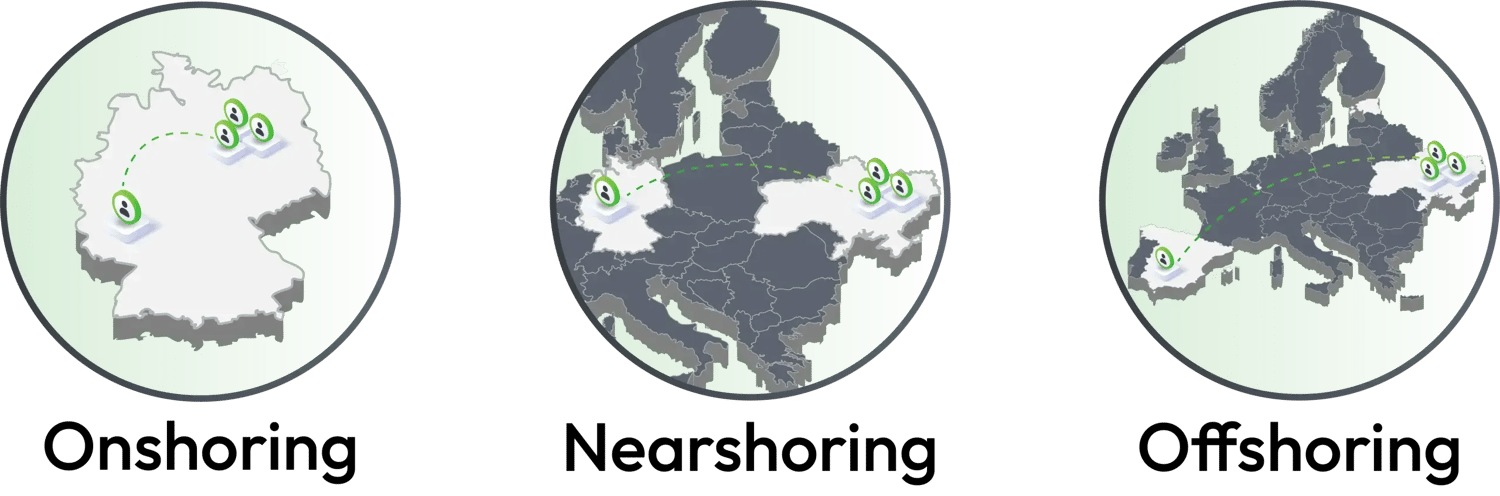
You can outsource the augmented staff from different locations in the world. Their geographical location would determine the type of staff augmentation model your company uses.
Here, the external team is located in the same country as the in-house team. This model eliminates any form of cultural and language barriers. Also, the augmented staff is familiar with customer behaviors and makes more informed decisions based on that.
However, this model is relatively more costly than the rest. It also limits the talent pool your company can source from the outside team.
This model applies when an augmented team is located in a country different from the outsourcer’s but within the same time zone. A perfect example is when you are working with a team in Ukraine while your local team is in the UK (as we explain here).
This augmented team model significantly reduces time-zone lags between the two teams. It also broadens the pool of talent to pick from. However, it is costlier than hiring offshore teams.
Offshore staff augmentation comes into play when the external team is in a different country in an entirely different time zone. It offers your company a larger talent pool at a significantly reduced price.
However, this staff augmentation model’s biggest problem is the cultural and language barriers due to time zone lag.
You can choose to use staff augmentation if:
You are working on a project that requires a specific skill set no one on your in-house team has, and hiring new personnel would be expensive and time-consuming. In this case, hiring an augmented staff would be a great way to fill the skill gap.
Your project is quite extensive, and to meet the project deadline, you would need about 4-6 more software developers. You can opt for IT team augmentation to ensure you meet your deliverables.
You’re interested in project outsourcing, but you also want more control over the dedicated outsourced team, directly communicating with them. This ensures the team produces consistent results in line with your company’s policies and culture.
Here, your company requires short-term staff augmentation to cover for a local team member's absence. You can also opt for this staffing model if there is a high demand for IT staff.
This type of staff augmentation business solution is used for long-term projects when your company wishes to fill a skill gap or doesn’t want to go through the stress of the hiring process.
Here are three considerations to help you with your decision-making.
There are many benefits of IT staff augmentation, as well as a few challenges. Listed below are some of them.
Staff augmentation gives you immediate access to experienced professionals without long recruitment cycles.
External specialists work within your systems and processes, giving you full visibility over delivery. You and your team are fully informed about every detail of the job, which ensures seamless operations between the in-house and external teams.
Because staff augmentation is an extension of your existing capabilities, all intellectual property and outputs remain fully owned by your organization.
Teams can be scaled up or down depending on project needs without long-term hiring commitments.
You manage priorities, workflows, and communication directly, as if the external specialists were part of your internal team.
Staff augmentation reduces recruitment time, training costs, and administrative hiring processes. Instead of recruiting and onboarding new employees, you pay a fee, and work begins soon. You also do not treat the ongoing training and retention costs separately.
To align distributed teams and ensure consistent delivery across locations, you need strong internal management and close monitoring and coordination of tasks between units.
This is especially true for offshore staff augmentation. Time zones, cultural differences, and remote collaboration can impact speed and clarity.
Because this new team is just being introduced, the project manager has to bring the augmented team up to date with internal tools, workflows, and company-specific practices. For a time-sensitive job, this could cause a problem and affect delivery time.
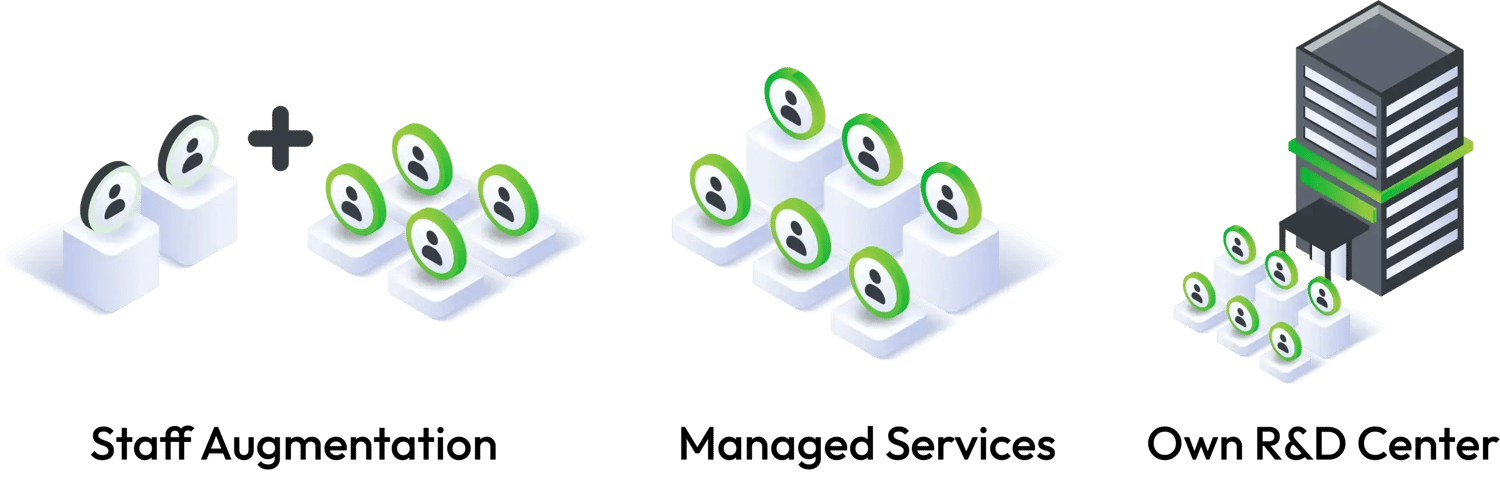
Why choose staff augmentation? Well, here is the comparison between the three major hiring models.
In this model, the company handles all aspects throughout the development of your project. All you do is pay a fee, and the external company does the rest. As a result, you have an idea of how the project is being carried out or who is on the team.
So, what is the difference between staff augmentation and managed services? Staff augmentation allows the project owner to have a say in it. This gives them more control over their project.
In this model, you can add a large number of employees to your team. This is done by establishing your R&D center in a foreign country with a broader talent pool.
The biggest issue with opening your R&D center is that you will have to comply with the laws and regulations of the country where it is located. Staff augmentation doesn’t cause the same hassle.
|
Model |
Ownership |
Control |
Speed of scaling |
Cost structure |
Best for |
|
Staff augmentation |
External talent integrated into your team |
High (you manage directly) |
Fast (days–weeks) |
Flexible/variable |
Filling skill gaps, scaling teams quickly |
|
Managed services |
Vendor-owned delivery team |
Low (vendor manages work) |
Medium |
Fixed / project-based |
End-to-end project outsourcing |
|
R&D center (GCC) |
Company-owned offshore entity |
Full control |
Slow (months–years setup) |
High fixed cost |
Long-term capability building |
At Nortal, the staff augmentation process is treated as a structured hiring, integration and ongoing coordination process rather than just a candidate supply. The focus is on long-term delivery fit, cultural alignment, sustained performance, and technical screening.
The client defines the required skills, team setup, and delivery context. This includes technical needs, seniority level, and expectations for collaboration.
Candidates go through a structured selection process, typically lasting 4–6 weeks, including up to four stages, and verifying the following capabilities:
Selected specialists are integrated into the client’s environment and tools. Teams are aligned with internal processes, communication standards, and delivery workflows to ensure smooth collaboration from day one.
Staff augmentation is a fast and flexible way to scale engineering capacity, but outcomes depend heavily on execution quality and partner experience.
An experienced provider ensures access to vetted talent, smooth onboarding, and consistent delivery support, helping you close skill gaps without slowing down product development.
Nortal applies a structured, quality-driven approach to staff augmentation, focusing on precise matching of technical requirements, team dynamics, and long-term collaboration. Our recruitment teams work to identify and integrate engineers who can contribute effectively from day one.
We follow you through the process, from team setup to ongoing collaboration, ensuring clarity, stability, and consistent performance across your augmented teams.
If you’re looking to scale your engineering capacity with confidence, our team can help you build a dedicated setup tailored to your delivery needs. Get in touch with us!
It is a model where external developers temporarily join your internal team to help deliver specific projects or fill skill gaps.
Staff augmentation is a form of outsourcing in which external specialists are integrated into your internal team while you retain direct control over delivery. The core difference is that in staff augmentation, you manage the team directly, whereas in pure outsourcing, a provider manages delivery for you.
In managed services, the provider owns delivery. In staff augmentation, you manage the team directly and control day-to-day work.
A GCC is a company-owned offshore unit, while staff augmentation uses an external provider.
Ownership: GCC = internal entity, augmentation = external partner
Setup time: GCC = long-term setup, augmentation = fast scaling
Cost model: GCC = high fixed investment, augmentation = flexible
Use case: GCC = long-term capability building, augmentation = immediate capacity
Depending on requirements, teams can often be assembled in days to a few weeks.
Yes, especially when compared to full-time hiring, recruitment costs, and long onboarding cycles.
It is widely used in software development, fintech, healthcare tech, SaaS, and enterprise IT.
No. You retain full control over priorities, workflow, and delivery management.
Nortal is a strategic innovation and technology company with an unparalleled track-record of delivering successful transformation projects over 20 years.