Search
Explore digital transformation resources.
Uncover insights, best practises and case studies.

Search
Explore digital transformation resources.
Uncover insights, best practises and case studies.
Effective product discovery is the foundation of every successful product-building journey, ensuring projects start with clarity, purpose, and the right technological guidance. We explore the early stages of the product lifecycle with visual insights and real-world business examples that illustrate how thoughtful discovery shapes the entire development process.
Service
Industry
Knowing the critical aspects of product development for so many business processes, I can’t help but publish all I can find on product strategy, starting with this journey’s first critical aspect of product discovery. Stick with me today as we define the main areas of interest in product discovery with the help of my esteemed colleague Michel Hauzeur, our Product & Design Capability Leader at Nortal. This article is nurtured by his professional expertise so we can give you the best insider knowledge together on where to start when building great products. We’re focusing on product discovery to learn how to best turn wonderful ideas into successful products in today's competitive business environment.
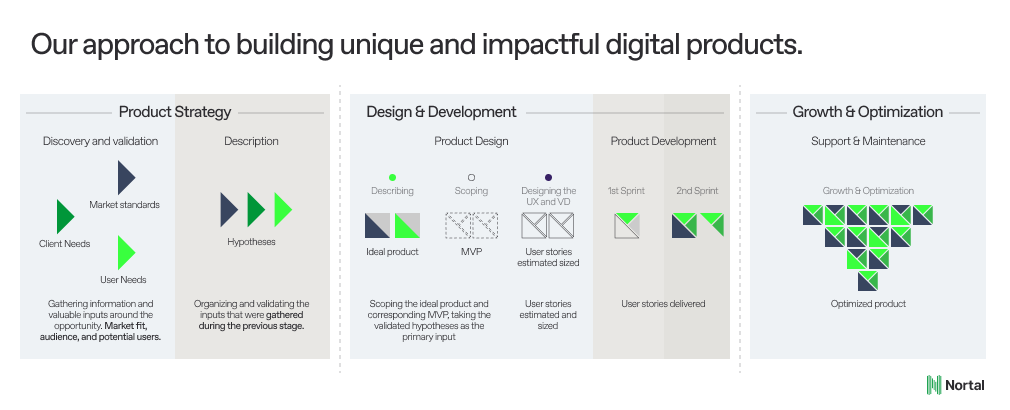
Let’s start with the big picture. When we think of creating products, we need to conceive product development as its own campus. Many buildings are needed to come up with great products in any company, and one of them should certainly read Product Development on its front door. I mean this. For us, product development (or PD as I’d like to shorten it for you) makes up an entire team.
The process, however, of building creative, lucrative, and practical solutions in product development flows through three key and main stages, which are:
1. Product Strategy
2. Design and Development
3. Growth & Optimization.
I’m focusing on the first step of the first stage of the product development lifecycle in this article.
Product strategy, a key part of product development, is not exclusively used as you’re dipping your feet in PD waters, so to speak. We’ll elaborate on other uses through examples below. Yet, in the most traditional sense of the product lifecycle, you’re just getting started with a product idea or project at this stage. Nothing has been defined around your product at this point, which is precisely why product discovery is this stage’s first step.
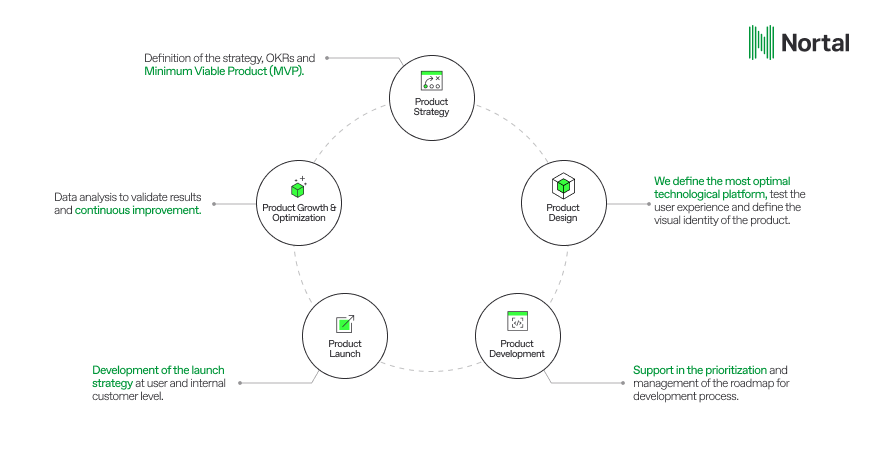
We categorically engage in a lot of research here, and we don’t really go into this stage just once. Though discovery is a key first step of the product development lifecycle, it’s also a constant need. Therefore, it’s best to see all these stages more like a rotating lifecycle, which can be better understood as follows:
As part of the heavy research that our PD teams do in this initial product discovery stage, we delve into potential product market standards while deeply considering client and user needs. We do that to come up with hypotheses. The more hypotheses we can make about the target market and audience, the better.
Taking into account the project's scope, its key objectives, and any potential challenges that may arise during development, the focus at this stage lies on defining a viable product strategy with clear objectives and key results (OKRs). We’re looking for the well-sought-after minimum viable product (MVP) here.
Now, because product discovery isn’t just needed or useful for a new product, like I said before, I’d like to give you a few examples of its full magic by showing you how it works in different scenarios across the board. I’m sharing with you three of the most common use cases in which businesses tend to find themselves in their product lifecycle journey that we’ve seen. Each of them requires best practices in product strategy and development for ultimate success.

Let’s imagine a first scenario in which a business is looking for a product strategist to help develop a brand-new idea. Product strategy is the way to start. With it, we seek to understand a product enough to validate it in any given market. We’re chasing “the why” behind a product here, and we use audience and market research to help us with that. With a clearer understanding of consumer willingness to pay, for instance, we can better set our go-to-market strategy. All this will result in the successful co-creation of our product vision. Once we achieve that, we can move on to create our coveted MVP for product validation.
A golden practice mentioned above is having a triad team of product developers, designers, and tech experts on board for this journey. Doing so allows projects to keep a clear eye on business strategy through product developers with a clear vision of customer journeys and flows from our design artists, along with a third key part secured on the most suitable and latest technologies available. Tech experts are the ones defining what’s real amidst all the possibilities in this group.
In a second scenario, let's say you needed to optimize the backlog of a recurrent live product. Backlogs pile up with ideas, needs, and nice-to-haves along the way. If you’re looking to take that burden off your teams and business, the discovery phase allows onboarding teams to fully grasp a live operation to move a product’s backlog further down the PD lifecycle.
For my last common scenario, I need to bring up the highly common need for digital transformations that we’re seeing nowadays and for a while now. Tech updates are true requirements today and migrations are a key example of them.
With product discovery, we can come to understand time-to-market and desired technology. With that knowledge, we can issue the best recommendations on ideal or additional technologies and proper management to bring a needed project to a close.
Nortal is a strategic innovation and technology company with an unparalleled track-record of delivering successful transformation projects over 20 years.