Search
Explore digital transformation resources.
Uncover insights, best practises and case studies.

Search
Explore digital transformation resources.
Uncover insights, best practises and case studies.
Companies must consistently enforce innovation in a rapidly changing world to stay ahead of their competitors. This implies, among other things, constantly searching for ways to satisfy the user’s needs better. Luckily, there are proven techniques to ensure our products are functional, intuitive, enjoyable, and impactful.
Service
Industry
One of them is design thinking, a methodology that employs a designer’s approach to create innovative solutions by getting a deep understanding of users’ needs and points of view. Among its core features, three are especially relevant:
Business professor Jeane Liedtka considers design thinking a social technology, “a blend of tools and insight, applied to a work process.” On the other hand, business analyst Michael Lachapelle differentiates between design thinking and the design process, the former being a mindset and the latter a toolkit. According to Lachapelle, the design thinking mindset is characterized by a deep customer understanding, idea prototyping, and iterative development.
In any case, design thinking enforces a designer-like approach. Whether they work in graphic design, industrial design, or user experience design, designers are trained to approach problems with a focus on creativity, empathy, and user-centered solutions. Design thinking encourages experts from different fields, like product managers, engineers, developers, and marketing professionals, to participate in the solution design process wearing a designer’s hat.
Historically, design was a surface-level embellishment for an already working product. It used to appear at the end of the creation process when the functional aspects of the object had already been established.
This changed in 1919 when German architect Walter Gropius founded the Bauhaus School of Crafts, design, Art, and Architecture. Gropius was heavily influenced by American modernist architect Henry Louis Sullivan, who had coined in 1896 the famous axiom “form follows function” (a phrase often misattributed to Gropius himself). This means that, while beauty is still relevant, the look and feel of a product should be primarily determined by its function. Usability comes first, before any purely decorative additions. This way, usability, aesthetics, and mechanics are intertwined and influence each other. The new approach encouraged everyone involved in the creation process to incorporate design principles from the start.
After World War II, many researchers began to devise a mental process comparable to the scientific method, allowing them to obtain creative and innovative ideas in the field of business. In 1960, sociologist and psychologist Herbert A. Simon proposed a model composed of three stages (Intelligence, Design, and Choice) to solve problems satisfactorily. In the mid-1960s, German design theorist Horst Rittel coined the term “wicked problem” to describe multidimensional and highly complex issues. Solving such problems would become a core goal of design thinking. In 1969, Simon made another significant contribution by proposing design as a way of thinking for the first time and emphasizing the importance of prototyping. Inspired by Simon’s work, in 1973, Robert McKim released his book Experiences on Visual Thinking, where he explained how we can exploit our ability to “think visually” (a keystone of many art-and-design-related disciplines) to achieve creative solutions.
In 1980, architect and psychologist Bryan Lawson studied the way architecture and science students (labeled respectively as “designers” and “scientists”) approached problems. Lawson concluded that the scientists were problem-focused problem-solvers, whereas the designers were solution-focused.
At the same time, users were becoming increasingly important in the design process. The 1960s saw the rise of participatory design, which involved stakeholders in the early design stages. In 1986, Donald Norman introduced user-centered design, a methodology for understanding the target audience's needs, goals, and behaviors.
While it’s disputed when the term design thinking appeared for the first time, it’s a well-established fact that it took hold in 1991, when David Kelley, Bill Moggridge, and Mike Nuttall founded the design and consultancy firm IDEO. Kelley is also the founder of Stanford University's Hasso Plattner School of Design, also known as the d.school. These two institutions have been the leading promoters of design thinking for more than three decades. It was also from Stanford University that American designer Rolf Faste proposed teaching specific design abilities (like creativity and visual perception) to engineering students to achieve products that were technically functional and artistically valuable. Since design thinking never ceased to gain ground among companies willing to deliver innovative solutions, it keeps being refined by the appearance of new frameworks and ways to implement them.
Now that we understand design thinking and how it has evolved over time, let’s begin the process.
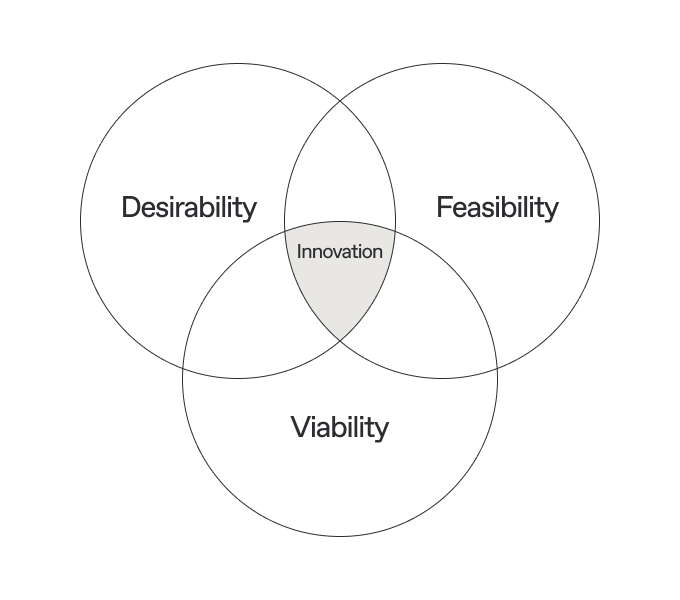
According to IDEO, design thinking allows us to deliver solutions that fulfil three different qualities:
Some authors, like Lachapelle, add a fourth, all-encompassing principle: validation (can we prove it?). The validation methods can be quantitative (like A/B testing and metrics monitoring) or qualitative (like eye-tracking and heuristic analysis).
The following process, devised at the d.school, summarizes the spirit of design thinking. These stages, known as “modes,” are not always sequential. They can be run in parallel, out of order, and repeatedly.
The process will be executed as often as needed until we get a product that satisfactorily passes the user test.
Design thinking can be applied to all kinds of organizations. Indeed, companies from different fields benefit from this approach.
In 2012, PepsiCo’s CEO, Indra Nooyi, realized that the company had to reinvent its innovation process and adopt a design-oriented approach. She thought the whole experience around their products, the entire supply chain, and not only their packaging, had to be redesigned.
The original size of SunChips was one inch by one inch, so they broke into pieces when bit. However, after a focus group in which consumers said they preferred chips of a different brand because they were smaller and bite-size, PepsiCo decided to apply the same dimensions to its product.
Another example is when PepsiCo developed Mountain Dew Kickstart, which could have simply been marketed as another flavor of Mountain Dew. However, it was sold as different product (it even came in a different-sized can). Many women who didn’t feel traditional Mountain Dew was for them became attracted by this new formula.
In 2014, innovation accounted for 9% of PepsiCo’s revenue.
Using design thinking and the Lean UX model, Citi applies user-centered design to several products.
The CitiDirect BE Mobile app was created and redesigned with the actual user in mind. This allowed the Treasury and Trade Solutions (TTS) team to identify that the login process was a friction point because users were forced to choose to log in, which placed too much cognitive load on the user. Former Citi's Project Manager Rebecca Fitzhugh explains: "To address this, we flipped our login model on its head, and now we guide the user through their login process, step by step, rather than relying on our users to make a selection upfront.
Starbucks applied design thinking through the "My Starbucks Idea" initiative from 2008 to 2018. The initiative aimed to engage customers in open innovation for product development by soliciting their feedback and ideas. They finally got nothing less than 105,000 suggestions involving products and other categories from consumers.
These ideas were subjected to prototyping and testing. Many were implemented and have become so successful that they're inseparable from the brand. For example, cake pops, pumpkin spiced lattes, free WiFi, and the Starbucks app and reward program.
Nortal is a strategic innovation and technology company with an unparalleled track-record of delivering successful transformation projects over 20 years.