Search
Explore digital transformation resources.
Uncover insights, best practises and case studies.

Search
Explore digital transformation resources.
Uncover insights, best practises and case studies.
Service
The move from AI assistant to AI coworker has been building across the industry for a while. Dreamforce 2026 was about putting it into practice. Salesforce calls it the agentic enterprise, and this year it showed agents doing real work alongside people, inside the tools teams already use, with the guardrails around them in plain view. And the clearest message of the week was an encouraging one: you don't need the world's biggest AI model to get there.
We went for a few reasons. Two of our Salesforce engineers, David Larrouy Matosas and Gabriel Juarez, gave a session on processing high-volume data with Apex Cursors. Our Head of Enterprise Platform Solutions, Ignacio Garcia, met with clients and partners. And we wanted to see up close how the platform our clients run on changes when AI agents start doing more of the work.
Below are the sessions we rate most, the trends we think matter for Salesforce customers, and what we are already doing about them.
About 43,000 people came to San Francisco for Dreamforce 2026, with more than 1,600 sessions and over 50 keynotes on the agenda. The guest list said a lot about the year: OpenAI CEO Sam Altman, Anthropic CEO Dario Amodei, and NVIDIA CEO Jensen Huang were among those who joined host Marc Benioff on stage.
This year the focus was on running specialized agents well, and on everything that makes them work in production: data, context, permissions, and governance.
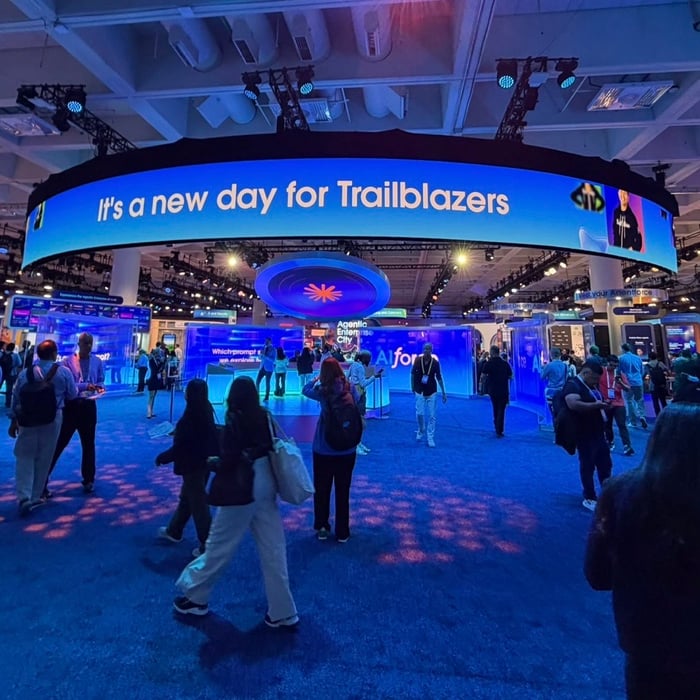
The headline was AIforce, which makes Salesforce data, workflows, and permissions available from any AI interface. It launches with Claudeforce (Salesforce inside Claude), Slackforce (inside Slack), and Agentforce Coworker, built to work alongside people inside Lightning. Claudeforce is now in open beta: a sales rep can ask Claude for an update on their deals and then update those deals in Sales Cloud without opening the app. Salesforce also showed Koa, its specialized CRM model built on NVIDIA Nemotron, and seven ready-made agents for jobs like inbound leads, customer service, and supply chain.
Muralidhar Krishnaprasad, President and CTO of Engineering at Salesforce, shared the stage with Amanda Bailey and Abhishek Nandi from Lowe's to show how Data 360 is moving from a customer data platform to the context layer any authorized agent can draw on, whether it runs in Agentforce, Claude, or Gemini. The team demoed the Agent Context Engine live, pulling only the data relevant to each request, ahead of its general availability in December 2026. Around it sits what Salesforce calls the Enterprise AI Harness, where Informatica gets data ready, Data 360 turns it into context, and Tableau defines what terms like "revenue" mean. The idea running through the session was that agents are only as good as the context they get, and that context lives in data many companies are still organizing.
The Marketing keynote brought Salesforce product leaders, including Eric Zenz, SVP and GM of Marketing Cloud, together with speakers from Contentful, Sercante, and Formula One Management, and much of it centered on AI search. Customers now ask AI about a category before they visit a brand's website, so brands need to show up correctly in AI answers as well as in Google. Palmata, an answer engine optimization tool that comes from the Contentful and Marketing Cloud integration, shows how a brand appears in those answers, compares it with competitors, and recommends what content to improve. The keynote also introduced Campaign Agent and an inbound pipeline generation agent, which take on campaign creation, content personalization, and lead engagement, and Salesforce pointed to a 2x increase in conversion rates. Headless Marketing opens Marketing Cloud to any AI assistant through MCP. Underneath it all, the marketer's role is shifting toward setting the objective, the strategy, and the limits, while the system handles execution.
Formula 1, which has Salesforce as its Official Fan Companion Agent, showed what this looks like with real fans. Its fan data used to be spread across several systems, which made it hard to get insights and personalize outreach. With that data unified, the team now segments fans in real time by their interests and behavior and sends each one tailored content on every channel, and the result has been a 22% higher click-through rate.
Claudeforce and Slackforce were the headline examples, and Salesforce also connected its platform to Google's Gemini Enterprise and Amazon Quick. People can reach their CRM data, workflows, and permissions from whichever AI tool they already use.
Much of this year's conversation was about running specialized agents well. Agent Optimizer watches how agents perform, spots patterns, and proposes fixes, while multi-agent orchestration lets a principal agent understand the request and delegate to specialists. Long-horizon agents track goals over time and decide the next step, and seven ready-made agents give business teams a faster place to start.
When agents act on CRM data from many front doors, permissions have to travel with them. Salesforce Guardian adds agent identity, so an agent can be held to tighter limits than the person using it. Agent Fabric keeps a single register of agents from any provider, with their performance and cost.
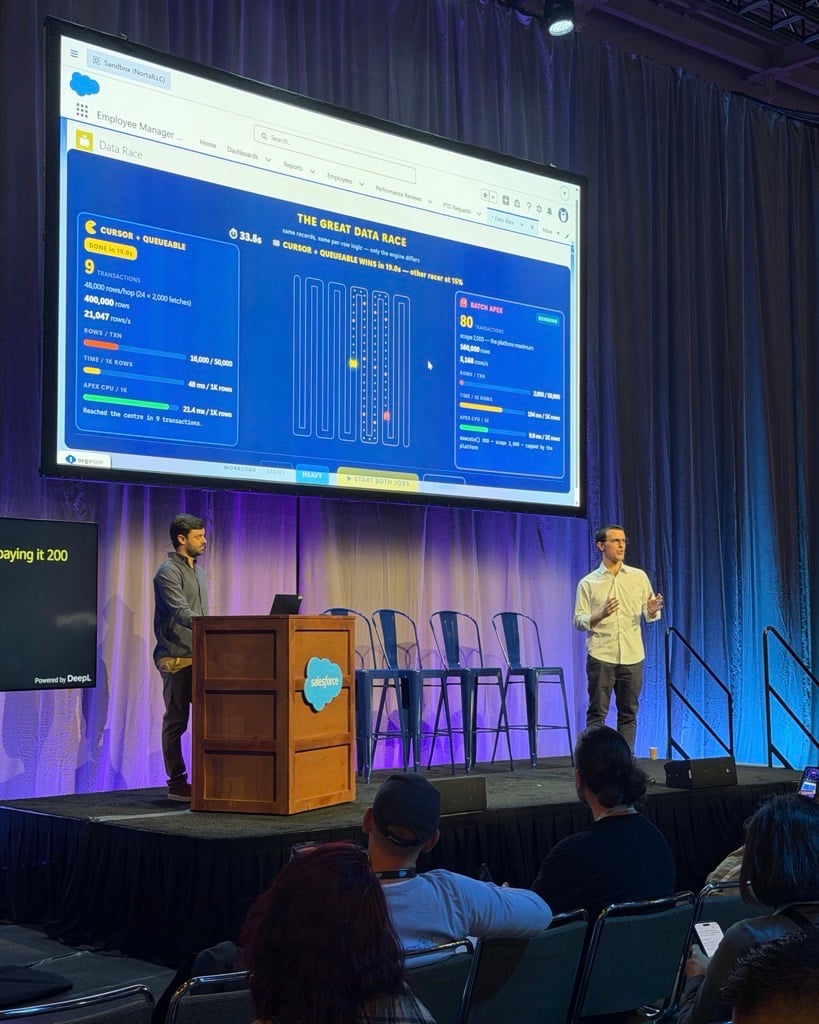
On September 15, our Salesforce engineers led "Process High-Volume Datasets with Apex Cursors." They walked through moving from Batch Apex to Apex Cursors, with real benchmarks and practical tips from our own projects. It's a technical topic that connects to everything above, since agents rely on solid data underneath and processing large volumes efficiently is engineering work someone has to own.
Away from the stage, almost every conversation we had came back to data. In our meetings with clients, the Salesforce team, and partners, we kept returning to the same questions: how the data is organized, who owns it, and whether it’s ready for agents to act on. That held true whatever stack a company ran.
Our main takeaway from the week is that agents deliver in production when the governance, permissions, and processes behind them are right, and that's where partners like us do the real work. It's also how we already work on the delivery side. Our AI-native teams use agents, with tools like Claude Code, to draft specifications, code, tests, and documentation, and our senior engineers check every output before it moves forward, so the agent drafts and a person owns the decision. That split is what makes it safe to go faster.
Our Salesforce practice brings the same discipline to the platform, from the data layer underneath to the agents that run on top of it.
As more doors open into the CRM, each new agent connection adds code and permissions that need checking. Glassworks, our agentic code review, handles that with specialist AI agents that find how small weaknesses chain into a real breach.
A good next step is to map where your customer data lives and who can see what before switching on Claudeforce or a new agent, and then to check the code and integrations that will open the CRM to those new front doors. Our data and AI teams can help with the first step, and Glassworks with the second.
