Search
Explore digital transformation resources.
Uncover insights, best practises and case studies.

Search
Explore digital transformation resources.
Uncover insights, best practises and case studies.
Service
Too often companies fall for the allure of AI and rush into developing solutions. As a result, the average ROI on enterprise AI is a mere 5.9%.
Here we’ll explore how to plan and implement AI to maximize ROI. Although driving ROI with AI isn’t impossible, you’ll need to be strategic about carrying out your specific AI solution.
Despite the huge potential of AI, few companies today are attaining the ROI they hoped for. While 74% of organizations are seeing ROI for Gen AI, the average hovers at about 6%. This is especially striking given that global AI spending will reach $200 billion in 2024.
Other studies on AI ROI according to industry are a bit more promising, with McKinsey reporting a sales ROI via Gen AI of between 10-20%.
Even so, why is there such a gap between expectations and reality? Usually, it’s a matter of poor planning. Leaders get excited about AI without analyzing the best applications for their business.
In particular, companies are keen on triggering generative AI solutions, which can automate operations and personalize customer experiences. Yet, Gen AI can quickly become vanity technology without the right vision.
To ensure your AI investment pays off, it’s important to approach it strategically. After all, 30% of generative AI projects are abandoned due to a lack of business vision. Here’s how you can set up your AI project to drive ROI.
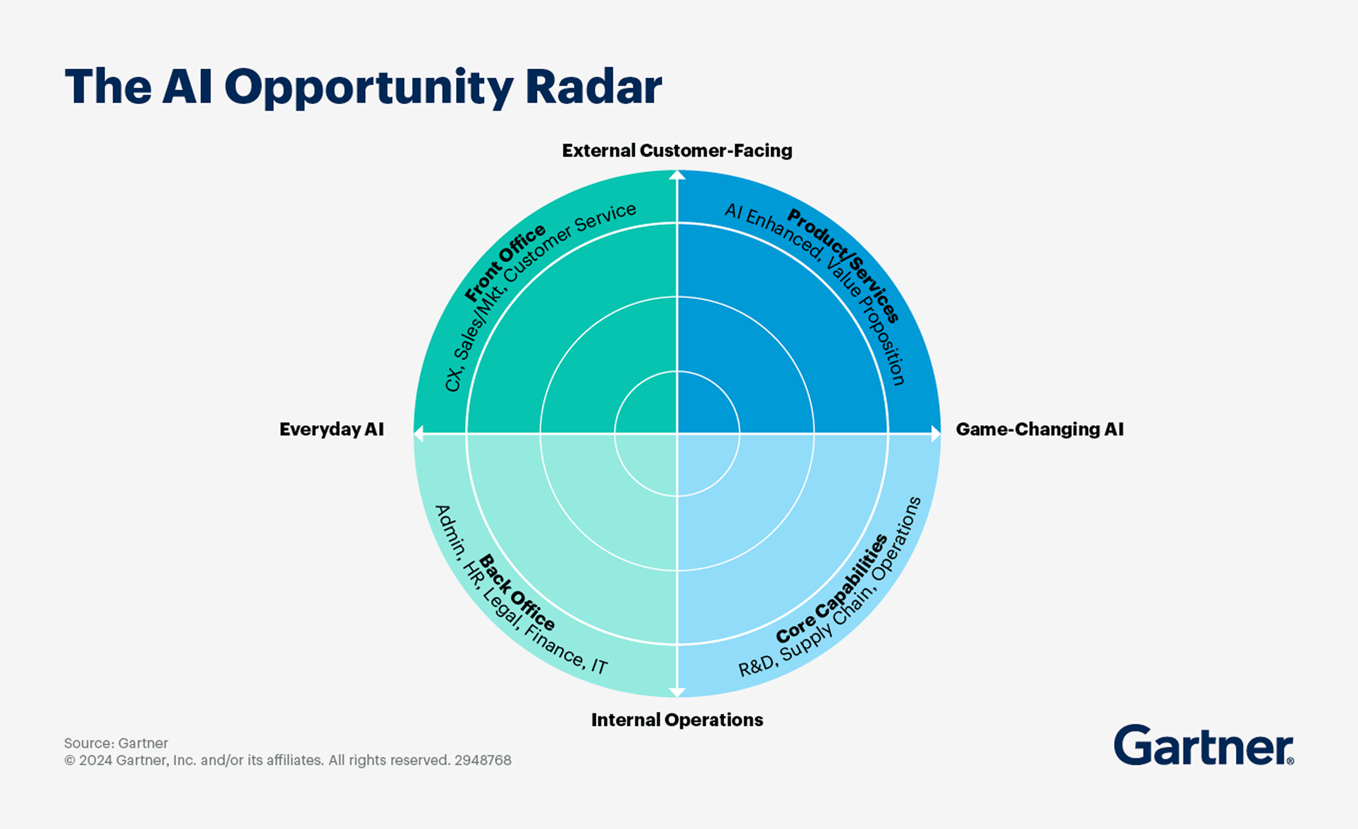
AI opportunity radar showing how to maximize AI ROI
(Source: Gartner)
First of all, it’s important to understand the most effective uses for AI today. Often you can boost ROI by selecting an AI project scope that’s already attained proven results by others.
Popular areas for AI implementation include customer service (16%), marketing (14%) and sales (12%). In another study, top uses included copywriting, simulations and business process automation.
Overall, AI is a strong possibility for:
Start with a clear business need. Otherwise, you’ll end up with a “shiny object” of little value. Look for areas where your business is most inefficient and draining resources. In essence, these are the frontline areas where AI can help the most.
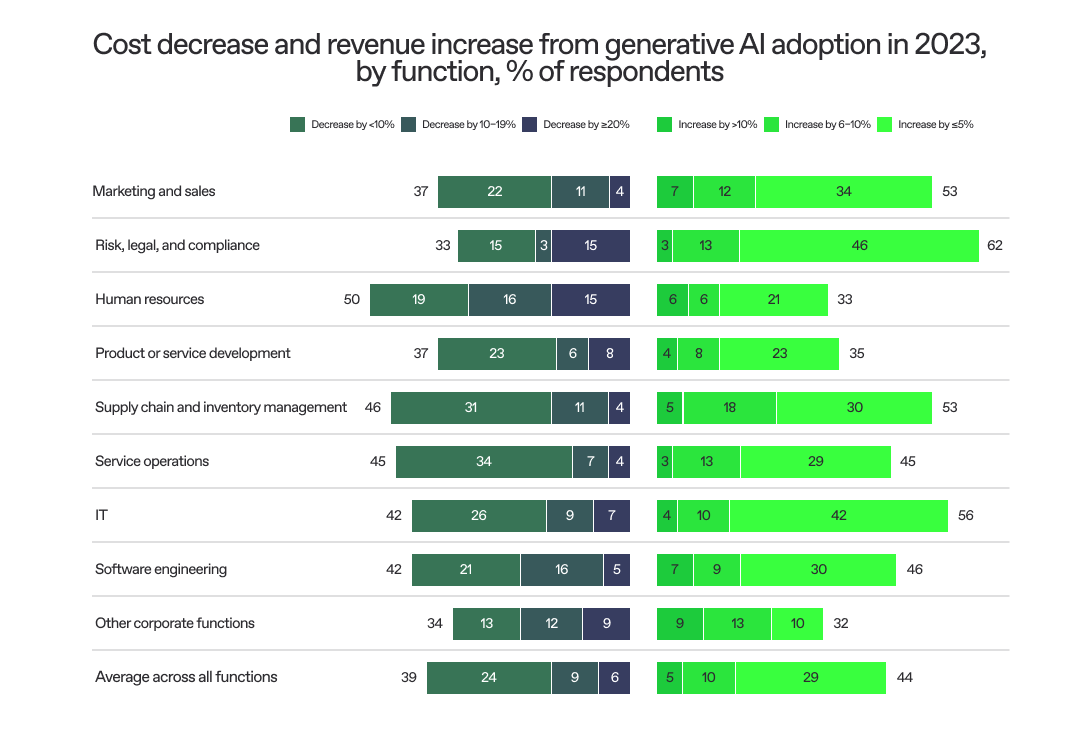
Table of quick gains for ROI with AI.
(Source: McKinsey)
Low-hanging fruit includes any areas that AI can make a big difference with little upfront investment. Chatbots for customer service and call centers are a good example. Other quick wins may involve:
Of course, the right “win” will depend on your business objectives and pain points. That’s why it’s important to work with an AI partner to identify what’s best for your business scenario.
Typically, you’ll get top outcomes from AI if you integrate it into your current way of business. Retrofitting means that you identify areas in your workflows that AI could handle more efficiently. For example, AI could cut out busy work for your sales team by expanding lead generation and automating outreach.
The same goes for your company culture. AI should empower your teams to do their best work. Ultimately, AI can’t replace critical employee skills such as creativity, relationship building and more.
So you have a big idea for AI –congratulations! Now you should validate it before allocating resources to get it developed. Ideally, conduct a discovery process with an AI partner to check that the idea is viable and valuable for your business. AI experts can enable you to understand your idea’s full implications and costs before you break ground.
AI specialists recommend beginning with something small. Doing so will help you get your bearings as you understand AI and embark on developing products with it. A pilot project also gives your teams the opportunity to build rapport with your AI partner, see how the development process works and prepare your internal teams for ongoing change. Additionally, it will give you more accurate information about potential AI ROI before a more significant investment.
Numerous AI solutions rely on high-quality data. If your company isn’t yet gathering, processing and integrating this data into a workable pipeline, you’ll want to set this up first. Often this is easier said than done, but without a high level of data readiness, your business can’t reap the benefits of AI.
Estimating costs for AI is notoriously difficult. When AI budgeting, you’ll want to work with a top-rated AI partner who can help you craft the scope and cost of building your solution. Remember that AI may involve a large upfront investment that takes time to see returns. For example, business leaders report it takes 14 months to see AI ROI after implementation.
Your tech stack isn’t just about what you need today, but what it enables for tomorrow. Be sure to select infrastructure that gives you the space to improve, innovate and pivot as needed. Iteration is a mainstay of creating value-oriented solutions, which is why you should select technology that allows you to scale. Overall, AI is a constantly evolving technology; your infrastructure should reflect that reality.
You’ve got options when it comes to setting up your AI product. Depending on your scope, you may be able to cut costs by leveraging an open-source tool such as TensorFlow, Open AI and Keras. These could potentially boost your AI ROI in the long run, though you’ll want to check the viability with your AI partner.
As you incorporate AI, don’t forget about your people. Tools are only useful if employees and customers know how to properly use them. To optimize results with AI, be thoughtful about defining your business’ human-in-the-loop workflows. Identify how employees should incorporate AI and train them to use it in their day-to-day responsibilities.
Without training, your teams won’t be able to maximize AI and enhance efficiencies. Instead, they may resist the changes and become frustrated with the new technology.
AI isn’t a one-and-done deal. You’ll want to keep up ongoing monitoring so that you can understand what’s working and identify tweaks to improve it. Set up ongoing reports on your AI solutions and continuously enhance them. Over time, this will boost your AI ROI and safeguard your product from new challenges.
AI isn’t a one-and-done deal. You’ll want to keep
up ongoing monitoring so that you can understand what’s working and identify tweaks to improve it. Set up ongoing reports on your AI solutions and continuously enhance them. Over time, this will boost your AI ROI and safeguard your product from new challenges.
It’s easy to get caught up with eye-catching AI trends. As AI becomes more powerful, these trends may hold even greater appeal. Keep in mind that AI bells and whistles may not add value for your business.
To effectively move forward with AI, stay strategic and ethical. Define your goals and values as a company. Understand how you specifically can benefit from AI and responsibly use it. Having a company ethos surrounding AI will become even more important as legal battles are resolved and consumers look to brands to ethically implement AI.
Nortal is a strategic innovation and technology company with an unparalleled track-record of delivering successful transformation projects over 20 years.