Search
Explore digital transformation resources.
Uncover insights, best practises and case studies.

Search
Explore digital transformation resources.
Uncover insights, best practises and case studies.
Learn how a DevOps team slashed $1 million in Azure costs within a year through strategic cloud optimizations and ongoing cost management practices.
Service
Industry
In today's cloud-first world, the ease of spinning up new resources often leads to the same painful outcome: eye-watering monthly bills. It's a challenge faced by organisations of all sizes – but as our own DevOps team discovered, the right approach can turn this financial drain into a massive opportunity.
Working with one of Nortal's senior DevOps engineers, a global enterprise slashed their Azure costs by an impressive $1 million within a single calendar year. The plan was set to reduce costs over the upcoming financial year. The team began work immediately in January and delivered the full savings within twelve months. Here's how they did it – and how you might apply these same techniques to your cloud environment.
Like many large organisations, our client had embraced Azure's flexibility and scalability across multiple business units and environments. However, this rapid adoption led to inefficient resource allocation, oversized instances, and redundant services that were unnecessarily draining the budget.
"Many companies face this exact scenario", explains our excellent DevOps Team Lead, who spearheaded the cost-optimisation initiative. "You have different teams deploying resources, often with a 'better safe than sorry' mindset, which leads to significant overprovisioning".
Before making any changes, the team needed clarity on where the money was going. They identified the top contributors to their Azure bill across projects, resource groups, and specific resources using specialised cost analysis tools.
The first thing was to identify what are the top contributors in terms of projects, resource groups, and specific resources. There are occasions when even a single resource can cost you a fortune.
This analysis revealed several critical insights:
- Which environments (dev, test, production) were generating the highest costs
- Which specific resource types (SQL databases, VMs, etc.) were the biggest expense categories
- Where immediate savings could be made with minimal risk
For a deeper dive into Azure’s native cost management solutions, check out Microsoft’s Cloud Cost Optimisation guide.
With a clear picture of their spending, the team identified several "low-hanging fruits" – changes that could be implemented quickly with minimal risk but significant cost benefits. These optimisations delivered immediate savings while building momentum for the broader cost-reduction initiative.
"The secret to success was identifying opportunities where we could make swift changes and see results right away," explains the DevOps Team Lead who orchestrated the cost-saving initiative. "By establishing specific criteria to determine if something was truly a 'low-hanging fruit,' we were able to focus our efforts where they'd have the greatest immediate impact".
The team prioritised changes that met three key criteria: minimal technical risk, short implementation time, and significant cost-benefit ratio. Their systematic approach allowed them to deliver impressive initial savings while building credibility for more complex optimisations down the road.
They discovered numerous premium-tier services running at less than 10% utilisation. "You are paying like 2K per month and you are using this for 5%. That's ridiculous," notes the DevOps expert who led this initiative. Simply downgrading these services to basic tiers resulted in immediate savings with no performance impact.
You are paying like 2K per month and you are using this for 5%. That's ridiculous.
- DevOps Team Lead
For non-production environments that weren't needed 24/7, the team implemented automated shutdown schedules:
- Dev and test environments were automatically powered down after business hours
- Weekend shutdowns were implemented for all non-critical resources
- Monday morning "wake-up" routines ensured systems were ready before staff arrived
Most environments aren't used 24/7. We can shut them down completely or downscale to the cheapest level possible during off-hours.
- DevOps Team Lead
By updating from older VM generation types (V2) to newer ones (V5), the team achieved up to 50% cost reduction for the same performance. This simple change, when applied across hundreds of machines, delivered substantial savings.
Beyond the quick wins, the team implemented more sophisticated strategies throughout the remainder of the year to drive continued cost efficiencies:
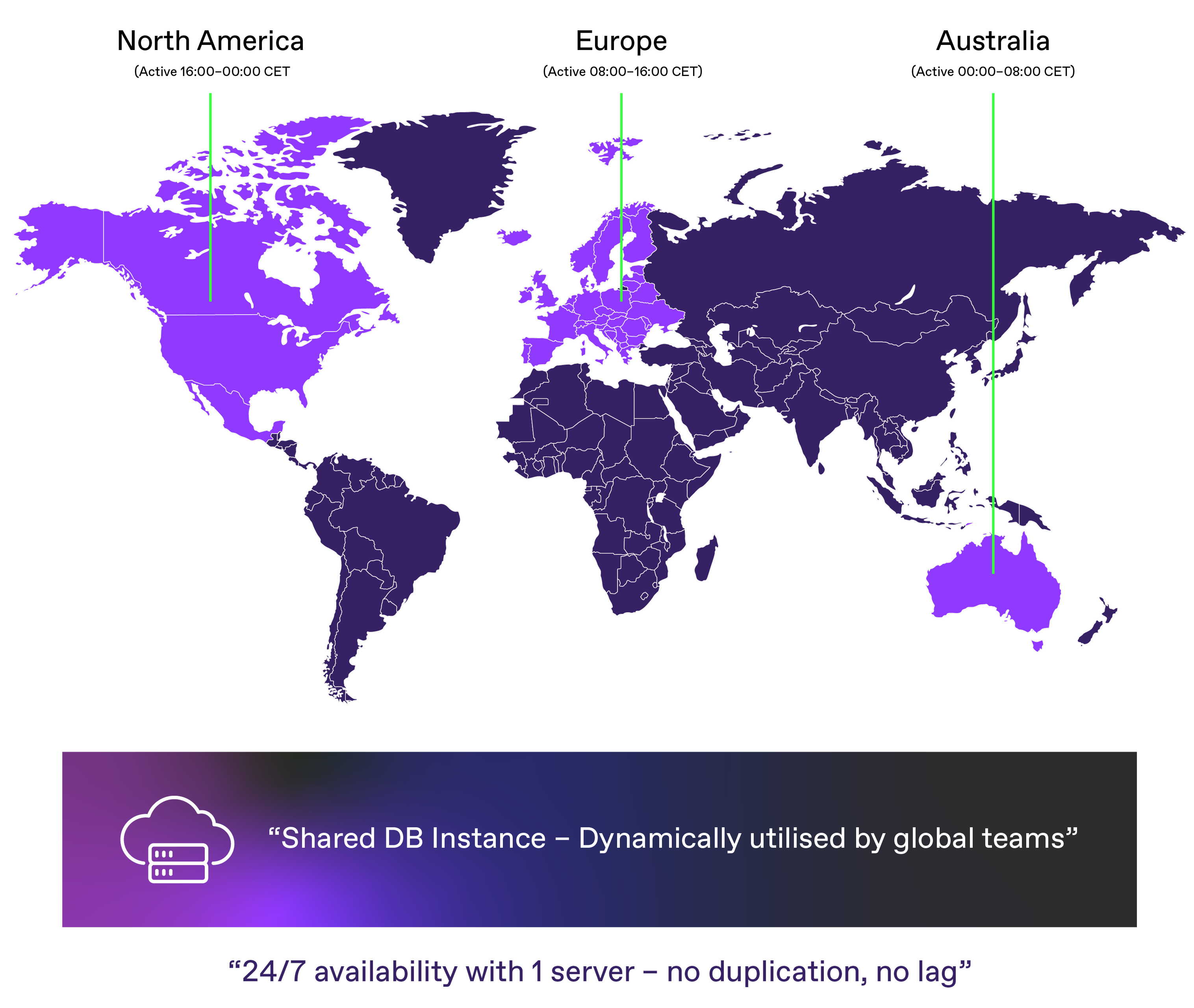
Instead of running numerous small databases on separate servers, they consolidated multiple databases onto single instances. This approach was particularly effective for globally distributed teams, as our veteran DevOps leader explains:
"When users in Australia use the databases, users in Europe and America are sleeping. Australian users have all the resources without any performance impact. Likewise, when it's night in Australia, European users can use those same resources."
The team identified legacy Azure services that Microsoft had effectively "price-penalised" to encourage migration to newer alternatives. By embracing these newer services, they reduced costs while gaining performance benefits.
For data warehouse environments with terabytes of historical data, they implemented intelligent tiering:
- Data unused for 30+ days was automatically moved to lower-cost storage tiers
- Critical data remained on premium storage
- Access patterns were monitored to ensure optimal placement.
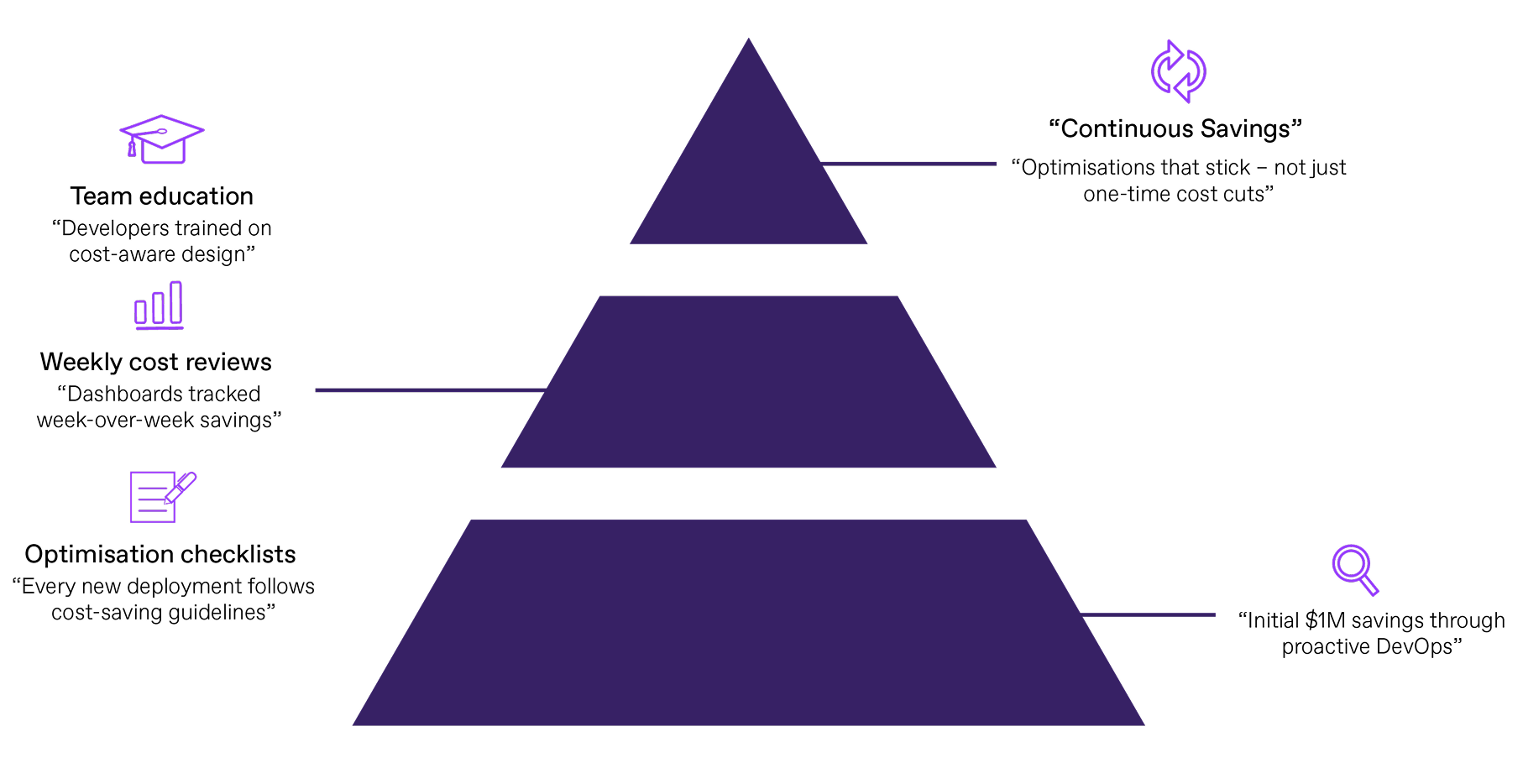
Perhaps most importantly, the team didn't stop at one-time optimisations. They established ongoing practices to prevent cost creep and ensure the savings would be sustained beyond the initial calendar year:
- Regular cost reviews
Weekly cost analysis became a standard practice, with dashboards comparing spending week-over-week and month-over-month.
- Team education
Developers and administrators received training on cost-efficient resource deployment, emphasising "building with cost in mind."
- Optimisation checklists
The team created standardised checklists for different Azure resource types, ensuring that new deployments followed cost-efficient best practices.
This culture shift, implemented during the fourth quarter, ensured that the $1 million in savings achieved during the calendar year would become the foundation for continued efficiency rather than a one-time reduction.
While the headline figure of $1 million in savings within a single calendar year is impressive, the initiative delivered benefits far beyond direct cost reduction:
By meeting their ambitious cost-reduction goal in just twelve months rather than spreading it across a longer period, our team showed that significant cloud optimisation can be achieved quickly with the right approach and focus.
If you're looking to tackle your cloud costs, the Nortal-built cloud optimisation team offers these takeaways:
| Start with visibility |
You can't optimise what you can't measure. Invest in proper cost analysis tools and dashboards. |
| Pick the right battles |
Focus first on non-production environments where changes carry less risk, then apply validated optimisations to production. |
| Automate everything |
Manually scaling resources up and down isn't sustainable. Build automation for resource management based on usage patterns. |
| Involve stakeholders early |
Product and programme owners need to understand the impact and potential risks of optimisation, so clear communication is essential. |
| Make it continuous |
Cost optimisation isn't a one-time project – it's an ongoing discipline that needs regular attention. |
| Set ambitious but realistic timeframes |
Having a clear annual goal helped us maintain focus and momentum. Breaking it down into quarterly targets made it manageable. |
Cloud costs don't have to be a runaway train. With strategic analysis, prioritisation of high-impact changes, and a continuous improvement mindset, significant savings are achievable without compromising performance or reliability.
Whether you're running a small development environment or managing enterprise-scale cloud infrastructure, the principles outlined here can help you identify waste and implement effective optimisations. And if you need expert assistance tackling your cloud costs, Nortal-built DevOps teams can achieve similar results.
Looking for more insights on cloud optimisation? Soon, we will publish another article related to Azure architecture simplification to see how the same team tackled another complex cloud challenge. Stay tuned!
While you wait for our next cloud optimisation article, our DevOps wizards are ready to work their cost-cutting magic on your infrastructure. Do you have a cloud stack so messy it makes the Gordian knot look like a shoelace?
We specialise in finding engineers who see your chaos and think, "Challenge accepted!" Where others see a disaster, our teams see a puzzle worth solving. Let's tame your cloud chaos together!
Cyber exercises must be integrated into our security strategy to truly strengthen cyber resilience. These structured simulations test an organisation’s readiness against real-world cyber threats. They help teams practice incident response, refine decision-making processes, clarify communications channels, assure roles and responsibilities, test assumptions, hone tactics, techniques, and procedures (TTPs), and build confidence in crises.
From critical infrastructure to corporate enterprises, cyber exercising equips teams with the practical experience to respond with clarity and speed. Whether defending national infrastructure or safeguarding sensitive customer data, these exercises transform static response plans into living capabilities.
Tell us how we can help. Our experts will be in touch.